Key Highlights
- John Buchanan is a World-Cup winning coach for the Australian cricket team
- John Buchanan began coaching in the mid-1990s, with Queensland appointing him coach in 1994 and subsequently winning the Sheffield Shield for the first time in 69 years
- While coaching, he used the latest technology but combined it with traditional practices like yoga, viewing it as a form of recovery
- In 2008, Buchanan joined the Kolkata Knight Riders (KKR) in the IPL, but was removed the following year
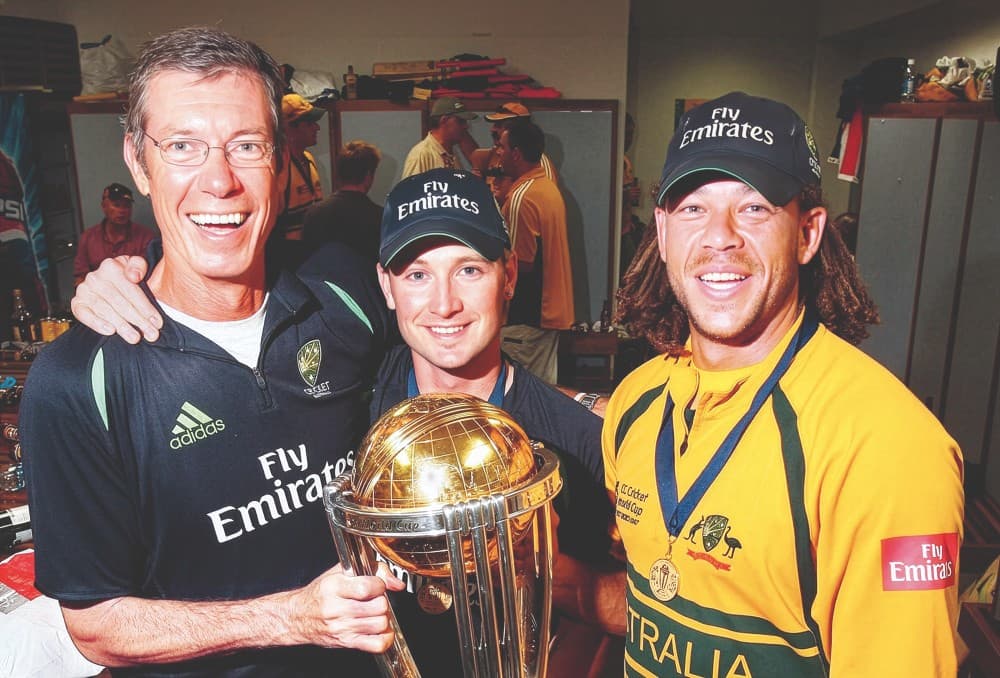
John Buchanan never played Test cricket for Australia. His first-class career lasted a single, unremarkable Sheffield Shield season for Queensland in the late 1970s. Yet, in April 2007, in Barbados, he stood at the centre of one of the most dominant teams the game has known.
Australia had just crushed Sri Lanka in the 50-over men’s World Cup final, with Adam Gilchrist’s 149 turning it into a procession. It was the Aussies’ second World Cup under Buchanan, and their third in a row. By then, they had also strung together 16 consecutive Test and multiple Ashes triumphs.
Australia did not just dominate the game, they made winning look casual and opponents look like amateurs. And yet the man widely credited with architecting it remained an outsider.
Blazing a trail, quietly
Buchanan’s route to the top did not follow cricket’s traditional script. There was no long Test career or any sports stardom. Instead, his background was in local government recreation, volleyball administration and academia. He studied human movement, pursued postgraduate work in Canada while raising a young family and even began a PhD in sociology before returning to sport.
“Traditionally, a lot of coaches these days, and certainly back then, moved from being successful on-field players into the coaching ranks,” Buchanan tells DOT.in. “In other words, if you played the game at a certain level, you should be able to coach it at a certain level.”
Buchanan is careful not to dismiss that pathway. “I’m certainly not here to say that isn’t the case… we’ve had some wonderful examples.” But his own path offered something else: “A much broader horizon, a lot of different experiences and certainly a lot of learnings that I had that could be applied to cricket but weren’t necessarily related to cricket.”
When Buchanan entered coaching in the mid-1990s, the profession itself was still catching up with the modern game. In Australia and India alike, it remained rooted in tradition. Technique dominated, fitness was assumed, and mental preparation was rarely formalised. Data meant the scorecard; recovery was often incidental.
Buchanan’s first real test came in 1994, when Queensland appointed him coach. The reaction was sceptical. Senior players had little reason to trust someone whose playing career barely registered. Buchanan did not try to impose himself. Instead, he reframed the problem. Queensland had not won the Sheffield Shield in 69 years. Success, he believed, would require a shift in thinking.
“We’d addressed the fact that for us to win a Shield, it was going to take up to 20 blokes to do a bloody good job,” one player later said. It was a move away from reliance on a core XI towards a broader, more resilient squad.
Within a year, Queensland won the title and were called the “Maroon Miracle”. Five years later, Buchanan was coaching Australia. What followed would redefine cricket coaching.
“In my opinion, there are four main pillars to individual performance — technical skill, physical capacity, mental routines and tactical awareness — plus a fifth that binds them into team culture,” Buchanan feels.
The idea was simple. What made it radical was the insistence that each part could be measured, trained and improved. Buchanan brought laptops into dressing rooms at a time when they were still rare — logging every ball, every field setting, every workload signal. It was an early version of what would later become a data-driven sport.
“It was just completely different”: Buchanan on the IPL
While on one hand Buchanan was working with the latest technology, on the other he was keen on utilising a traditional practice like yoga, which hardly had a place in any sport back then. “It was a form of recovery,” he says, “and if we could find the right conditions, a nice form of recovery. For some players, it became a form of meditation… part of their routines.”
Not all of what he was working on landed immediately. “I can’t say it was readily and wholeheartedly adopted by all the team,” he admits. To some, it felt like overreach. To others, it offered clarity. The reaction beyond the dressing room was just as divided. The Guardian famously asked whether Buchanan was a “‘complete fraud’ or cricketing mastermind?” — a question that followed him through his tenure. The same paper, in another piece, described how he had effectively “wired up Australia’s hard drive”, capturing the sense that something fundamental had shifted.
When I played well, what did I do? What was in my control? Identify those elements, repeat them, and build from there
Players were not always convinced. Shane Warne dismissed Buchanan as a “goose”, ridiculing what he saw as over-analysis. Buchanan argued that he created an environment in which players were actively trying to get better. Under Buchanan and captain Steve Waugh, Australia developed a culture that reinforced itself. Standards were set at the top and enforced throughout the group. The formulation was blunt, “The standards you walk past are the standards you accept.” Results were overwhelming. Australia dominated across formats and conditions.
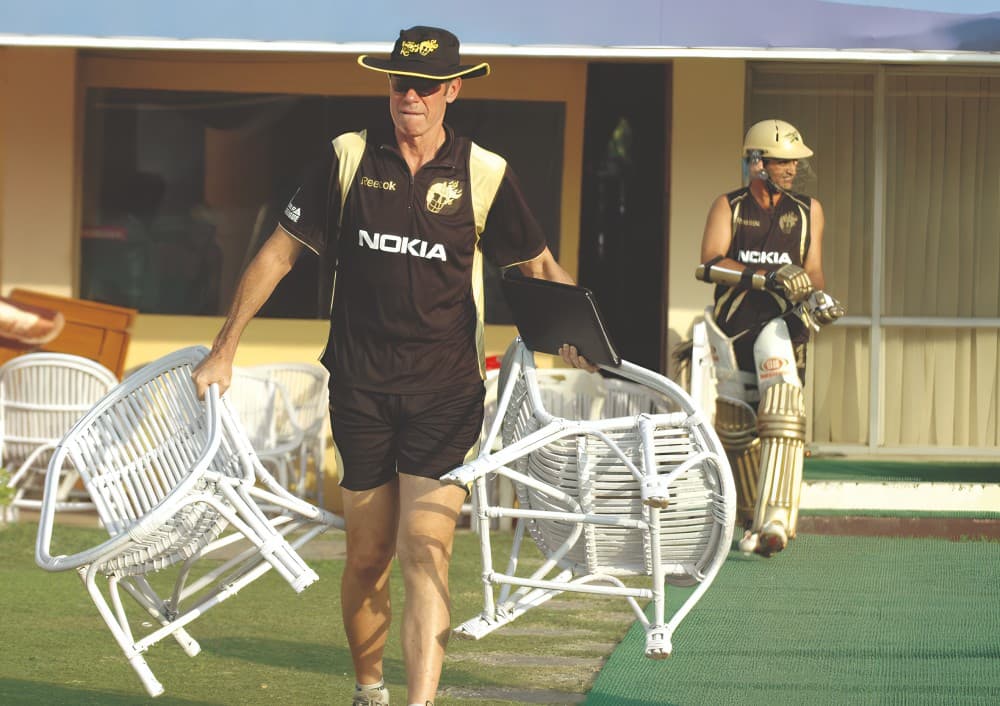
If Australia was the proof of concept, the Indian Premier League (IPL) would become the stress test. In 2008, Buchanan joined the Kolkata Knight Riders (KKR) in the Indian Premier League’s chaotic early years. The tournament was still finding its identity. “It was just completely different,” Buchanan says. “We were playing a format that was still really new. Nobody really knew exactly what T20 was all about.”
Buchanan’s instinct to experiment met resistance. His attempt to rotate captaincy among multiple players became one of the most debated decisions of the IPL’s early years. It created confusion rather than clarity. Results suffered. The team finished last, and Buchanan was removed the following season. He later admitted he was “shocked and disappointed”.

The need for conflict
Over the years, time seems to have proved Buchanan right. Data analysis is now embedded across formats, sports psychology is routine. Fitness and recovery are managed with precision. In India, particularly, the shift has been dramatic, with stars like Virat Kohli embodying the discipline that was once an experiment.
Buchanan’s legacy lies in that shift. He did not strip cricket of its instincts; he tried to understand them more clearly. Conflict, he believed, was part of that process. “If you don’t have conflict, then you have either created an environment of fear where nobody speaks up, or you have many people that are exactly the same.”
Today, his work extends beyond elite cricket, but the principles remain. For young players, his advice is simple and precise. “When I played well, what did I do? What was in my control? Identify those elements, repeat them and build from there.”
In the end, Buchanan’s career is defined by a paradox. He never wore the baggy green. He never followed the traditional path. Yet he reshaped how the game understands performance. Reflecting on that journey, he sees success and failure in the same light. “My success and my lack of success have given me the opportunity to look at both and learn more about myself,” he says. “So, from that point of view, there’s always a silver lining even if there isn’t silver to line your pocket.”
Who is John Buchanan?
Who is John Buchanan?
John Buchanan is a well-known cricket coach who led the Australian national team from 1999 to 2007, helping them win the 2003 and 2007 World Cups.
Did John Buchanan win the World Cup?
Did John Buchanan win the World Cup?
Yes, under John Buchanan’s leadership, the Australian Cricket Team won the World Cup twice, once in 2003 and then again in 2007.
Did John Buchanan play test cricket?
Did John Buchanan play test cricket?
John Buchanan has never played test cricket for Australia.
Was John Buchanan part of KKR?
Was John Buchanan part of KKR?
Yes, John Buchanan served as the coach for KKR in 2008, but was later removed.