All you hear everywhere is that AI will take over all jobs. Recently, I was flying out of Hyderabad airport, and there’s a system across Indian airports that has flyers’ information available digitally. The app is known as DigiYatra. A very high-tech data collection thing with the goal of a simpler, quicker line to enter airports, than the longer one where you have to show identity documents.
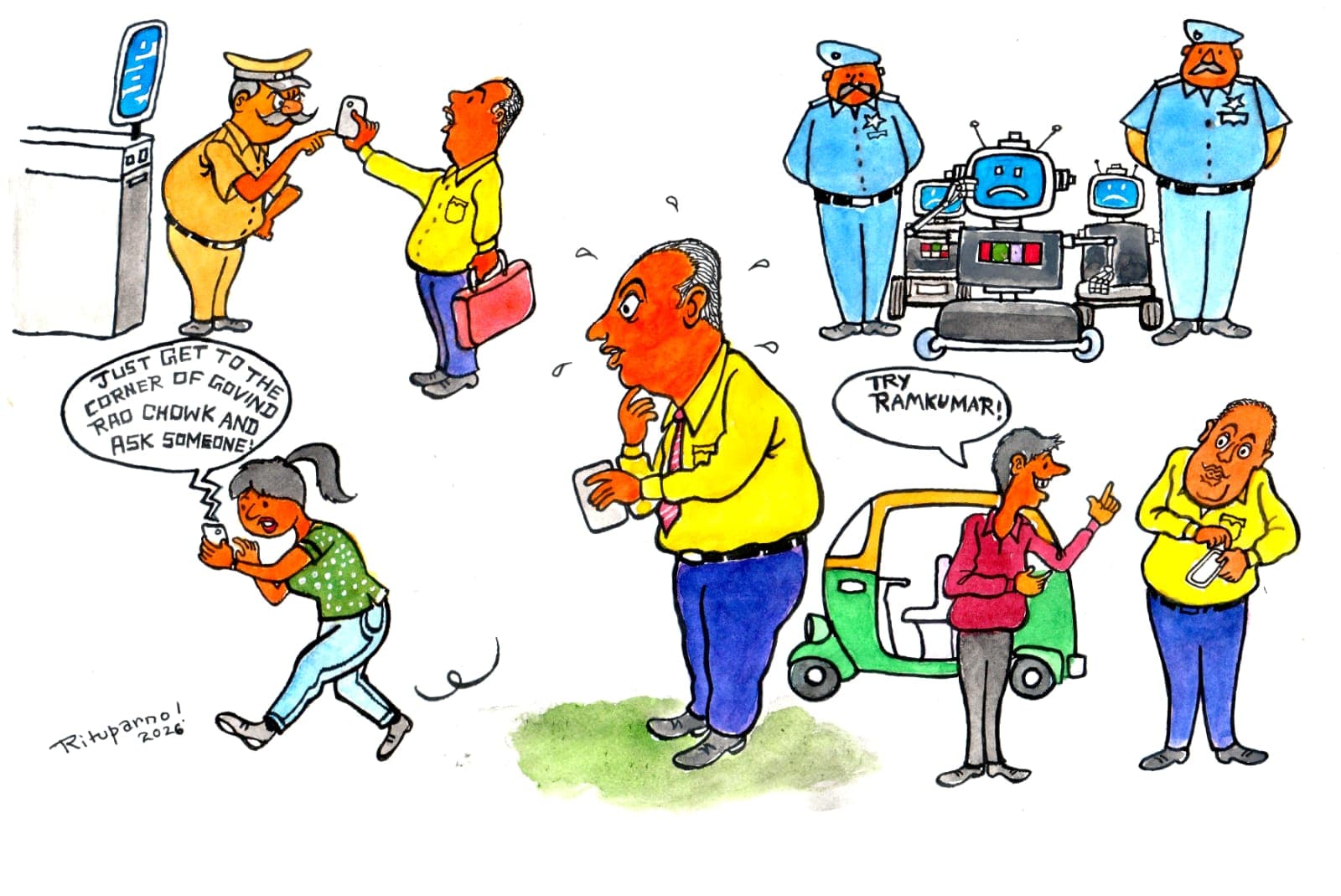
This system has your data — show the entry camera your face and you are through. Except, due to an electricity outage, the DigiYatra system wasn’t working that day in Hyderabad, so what the airport authorities ingeniously did was station a policeman at the entry instead of the automation. DigiYatra essentially became a person who was scanning your face to let you through, based on whether you credibly looked like someone who had DigiYatra.
Soon, wanting to get into the airport quicker, people were shouting “Go to DigiYatra. He IS DigiYatra!” They were pointing to a middle-aged policeman, who had essentially become a software scanner, an almost divine being. In fact, the line moved much quicker than with the actual DigiYatra.
Amusing as this was, India continues to fascinate at the precipice of groundbreaking tech innovation, and almost medieval human intervention – AI will not have an easy time here, just taking over jobs. Google Maps may have conquered the world, and the calm lady’s voice giving directions is ubiquitous. However, this is the only country where, due to a phalanx of street convolutions, and name changes, and roads within roads, even the Google Maps lady reaches the end of her AI limit. We’re not far from the time when she says, “Just get to the corner of Govind Rao Chowk and ask someone!”
Google Maps may have conquered the world, but this is the only country where, due to a phalanx of street convolutions, and name changes, and roads within roads, even the Google Maps lady reaches the end of her AI limit.
I stayed at a hotel near Mumbai airport recently, which proudly advertised that they’d replaced all their waiters with AI-empowered robots. So if anyone wanted to order, they’d just have to tell the robot, which would present options and bring the order. Anywhere else in the world this would be loss of employment for waiters. Here, time would play different tricks.
On Day 1, being a novelty, the public rushed to the restaurant. On Day 2, there was such a deluge to touch the robots, with children even kicking them, that by Day 3, they had two security guards protecting each robot. The first case in human history of AI tripling employment rather than reducing it. By Day 4, coordinating the robots and the security became too much, no one got served and the robots made all sorts of errors, with one even collapsing. By Day 5, the human waiters were back and the robots were kept in the corner for children to play with.
India has made some advances in technology, especially in small digital payments, that are way ahead of many developed nations. And yet, in little ways, the old familiar India thankfully finds a way to peek out. I recently paid someone for an auto-rickshaw ride through a phone app, and it didn’t go through for a while. Frustrated, he said, ‘Try Ram Kumar’. I said, ‘Sure, what is his Google Pay ID?’. He said, ‘No, I’m Ram Kumar’, and just extended his hand, asking for cash.