


 ion
ionKey Highlights
- Education has emerged as a bridge between the people of India and Australia, with over 140,000 Indian students in Australia in 2025 — the rapid growth in student numbers illustrating deepening bilateral relations
- Following India’s 1998 nuclear tests, the relationship between Australia and India was strained, but a shift happened around 2004, as acknowledged by John McCarthy, Australian High Commissioner from 2004 to 2009
- The current Australian High Commissioner to India is His Excellency Philip Green OAM, who was appointed in 2023
- Patrick Suckling was appointed the Australian High Commissioner to India in 2013
- Australia was the first country to take advantage of India’s new national education policy (NEP 2020) that offers a window for foreign universities to set up campuses in the country.
- The Covid-19 pandemic caused a sharp decline in Indian students in Australia, but this has revived again in the post-pandemic era, with numbers returning to their peak of 120,000 by 2024
- Indians are the fastest-growing — and the largest — migrant group in Australia
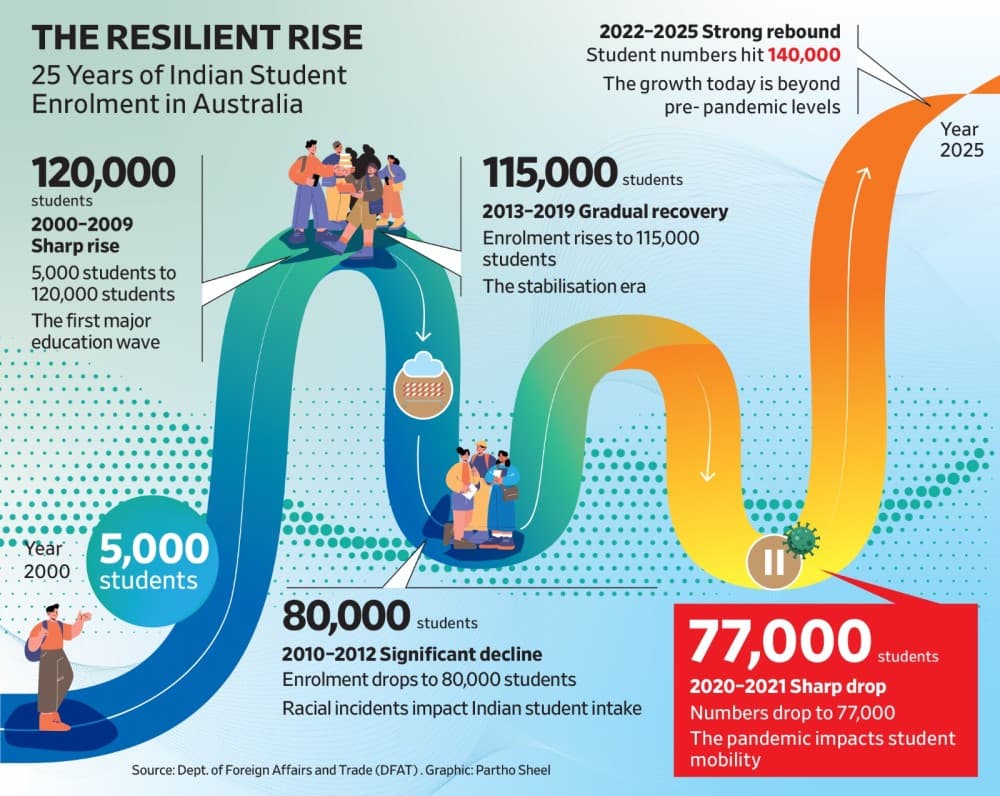
Since the dawn of the new millennium, education has emerged as a bridge between the people of India and Australia. From less than 5,000 Indian students studying in Australia in 2000 to over 140,000 in 2025, the rapid growth in student numbers illustrates the deepening bilateral relations between the two Indo-Pacific partners.
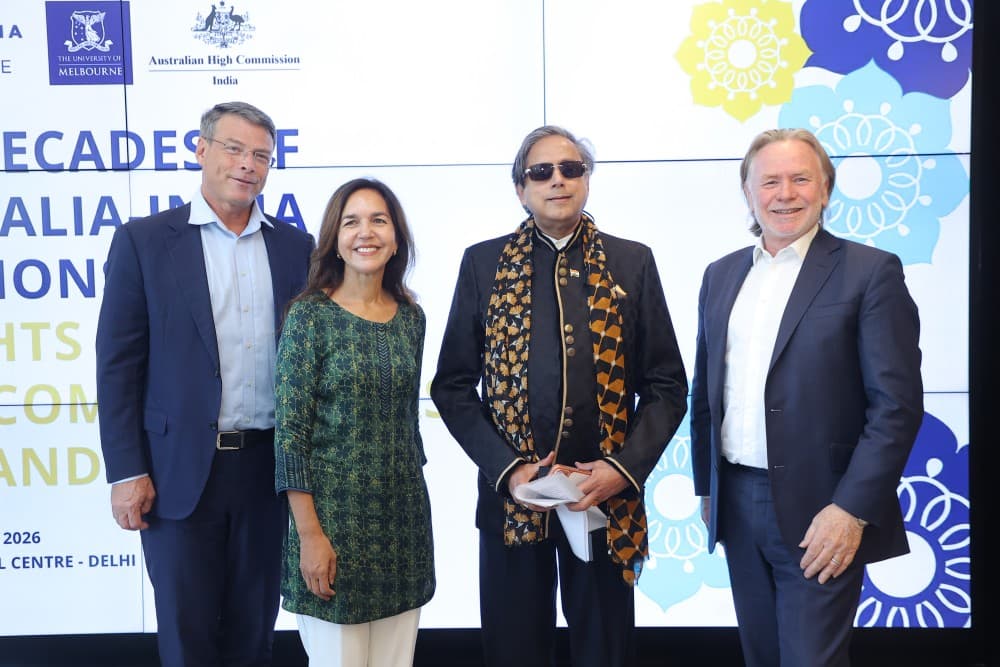
At a recent event organised in New Delhi by the Australia India Institute, three Australian High Commissioners to India — current Australian High Commissioner to India, His Excellency Philip Green OAM (2023–present) and former Australian High Commissioners to India, Patrick Suckling (2013–2016) and John McCarthy AO (2004–2009) — were unanimous that higher education has played a significant role in deepening ties between the countries.
As with any relationship, this has followed a timeline quite distinct in nature and metrics, evolving with changing geopolitical realities.
A Question of Discipline
The first decade of the 21st century served as a transformative period for India-Australia relations, defined by the restoration of ties that had previously suffered. Following India’s 1998 nuclear tests, the relationship between Australia and India was strained. A shift occurred around 2004, which John McCarthy, Australian High Commissioner from 2004 to 2009, attributed to “in large part because of Australia’s recognition that India’s time had come”.
This era witnessed a significant expansion of Australia’s diplomatic footprint in India to support burgeoning education ties. By 2009, over 120,000 Indian students were enrolled in Australian universities, though this rapid growth introduced several complications.
The bilateral system was described by Ambassador McCarthy as being one where “the whole system was undisciplined”. Diplomatic friction was further exacerbated by what he termed as “a mishandling of the whole issue by a number of Australian government departments”.
Racial tensions became a primary concern during this period, particularly following the Dr Haneef case and the “monkeygate” cricket scandal.
Ambassador McCarthy observed that “Australia always has to watch carefully the question of race”. In a candid reflection on the subsequent violence against Indian students, he admitted that “we didn’t particularly help in Australia by saying there were no racial elements at all”.
Ultimately, stability was regained through disciplined reforms in the recruitment of international students. The educational relationship repaired itself much more quickly than expected. Beyond student mobility, the period fostered a very beneficial technological partnership through a joint research fund, an area that Ambassador McCarthy believes both nations have to continue to emphasise and concentrate upon.
An Emergent India
The bilateral landscape was significantly transformed by 2013, driven by India’s emergence as a major geopolitical power. Former High Commissioner Patrick Suckling observed, “There was a very strong sense of the two countries beginning to look at one another, genuinely to see each other in a way that we hadn’t seen or been looking at one another before. And that was a profound shift.”
By the time Patrick Suckling took charge as Australian High Commissioner to India in 2013, the bilateral picture looked starkly different than a decade before. Suckling spoke about how India’s rise as a major geopolitical player in the Indo-Pacific region coupled with growing security and economic interests had brought the two countries closer and deepened mutual cooperation.
However, stark challenges remained for Australia when it came to higher education. While the period between 2004–09 witnessed enormous growth in Indian students, peaking at 120,000 in 2009, numbers fell sharply between 2010 and 2012 owing to a series of disturbing incidents of violence and racial abuse.
By the mid-2010s, revitalised by new leadership in both nations, there was a sense of wanting to take the relationship to the next level. A stronger sense of bilateral cooperation gradually normalised the flow of students to Australia again, facilitated by what Suckling describes as “genuine political commitment to driving fundamental progress across the spectrum of our interests”.
Education ties also matured into strategic research partnerships. Ambassador Suckling was witness to a shift towards industry-aligned alliances, commenting, “What I saw was more and more universities being more strategic about how they thought about that and building genuine partnerships, strategic alliances, joint PhD programmes with lines of sight to industry and jobs.”
A significant focus was skill development. The central challenge at that point was how Australia could support India’s skills requirements. This era was summarised by Ambassador Suckling as one “where the table was set” and his role as High Commissioner was “to put the substance on the bones of the relationship”.
The most pivotal development has been the transformation of education into a reciprocal arrangement. The historic opening of foreign campuses in India has been closely monitored across the world. Australia was the first country to take advantage of India’s new national education policy (NEP 2020) that offers a window for foreign universities to set up campuses in the country.
Of Resilience and Rebuilding
At the turn of the next decade as student numbers gradually normalised to around the peak 2009 levels of 120,000, the onset of the Covid-19 pandemic caused a sharp decline to about 77,000 by 2021. However, the post-pandemic era has been defined by a resilient rebuilding of educational ties, with numbers returning to their peak of 120,000 by 2024. Upon his arrival in 2023, High Commissioner Philip Green noted that the wave was bigger than it had ever been. Ambassador Green describes the current bilateral state as a building wave, noting that “my role is to harvest as much as I can in a moment of plenty between Australia and India”.
A number of “powerful developments” in the 2020s led to the government identifying India as a key partner. This culminated in India’s first free trade agreement with a Western nation. The exceptional nature of this bond was emphasised by Ambassador Green, who stated that “for us in Australia it is special” due to a “highly complementary economy with India.” He highlighted Australia’s role in providing the “metals and minerals” and “skills and training” necessary for India. This comes at a time when other countries are also adopting the pathways that Australia had taken to build its relations with India. “The competition for India’s attention is growing,” Ambassador Green remarked.
With Indians representing the fastest-growing migrant group in Australia, the focus has now shifted towards the calibre of migration. Ambassador Green asserted that “our focus is on increasing, augmenting the quality of Indian students in Australia and ensuring that there is integrity in our migration programme”.
Addressing past concerns about racism, Ambassador Green struck a note of strong assurance, saying, “Australia is one of the safest countries on the planet for anybody; for Indians.”
The most pivotal development has been the transformation of education into a reciprocal arrangement. The historic opening of foreign campuses in India has been closely monitored across the world. Ambassador Green spoke about how Australia was the first country to take advantage of India’s new national education policy (NEP 2020) that offers a window for foreign universities to set up campuses in the country.
“And guess what? The first two foreign universities to open in Gift City were both Australian,” Ambassador Green said, adding that more universities will be following soon. There are now seven Australian universities of which two are teaching. Five more universities will be opening there and there are more in the pipeline. So that is really changing the dynamic and creating another way in which this street of education between Australia and India operates, Ambassador Green said.
Member of Parliament and former diplomat Shashi Tharoor, also present at Melbourne Global Centre, Delhi, offered an apt summary: “Academic partnerships between our institutions have generated networks of familiarity and goodwill that outlast political cycles. These connections ensure that the relationship rests not only on policy, but on lived experience.”
Are there Indians in Australia?
Are there Indians in Australia?
Yes, Indians are the fastest growing and currently the largest migrant group in Australia.
Who is the present Australian High Commissioner to India?
Who is the present Australian High Commissioner to India?
The present Australian High Commissioner to India is His Excellency Philip Green OAM, who was appointed in 2023.
What is the NEP 2020?
What is the NEP 2020?
The New Education Policy 2020 is India’s policy change to redefine the education system. As part of the NEP 2020, foreign universities were allowed to set up campuses in the country.
Does India have a good relationship with Australia?
Does India have a good relationship with Australia?
Yes, India has a good relationship with Australia, with education forming one of the core pillars of that relationship.