Key Highlights
- The Ashavalli weave is a reminder of the vanished geography of Ahmedabad, which was once known as Ashaval.
- The Ashavalli is known for its twill-weave density, the weight of its zari and the ‘inlay’ technique or minakari that imparts a three-dimensional and enamelled effect.
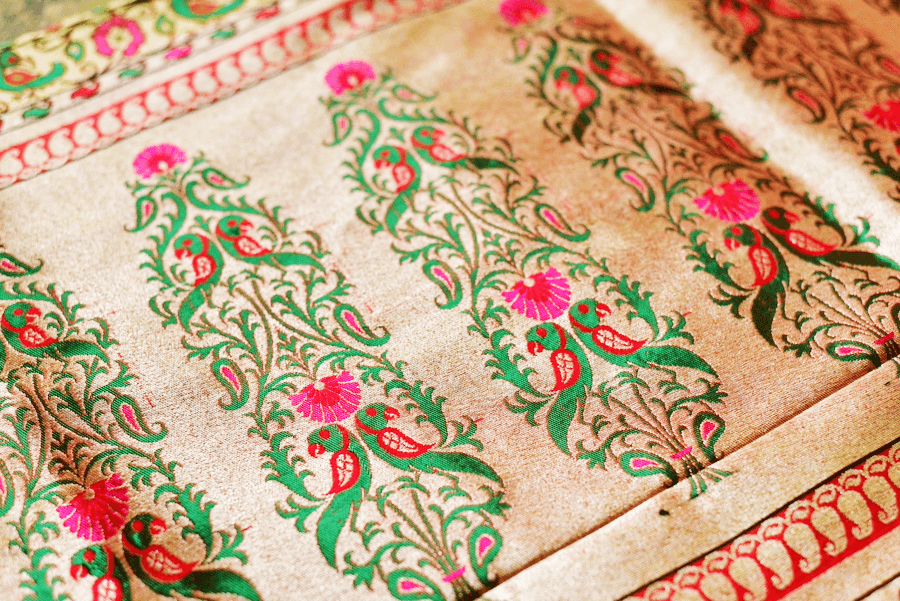
- The Ashavalli weave is known for its lively animal depictions, such as the hamsa (swan), the mayura (peacock), the shardul (a mythical lion) and the popat (parrot).
- When sourcing an Ashavalli, it is important to look for the twill weave (diagonal lines in the base fabric) and the kadwa (hand-stitched) look of the motifs
For all the trendiness of minimalism, the aesthetic dear to the Indian heart and soul remains defiantly maximalist. Think of the royalty of rani pink, the seductive sheen of silk and the bold beauty of brocade. And now that you are sufficiently enchanted, let’s get intimate with the Ashavalli weave.
Inlay and Enamel
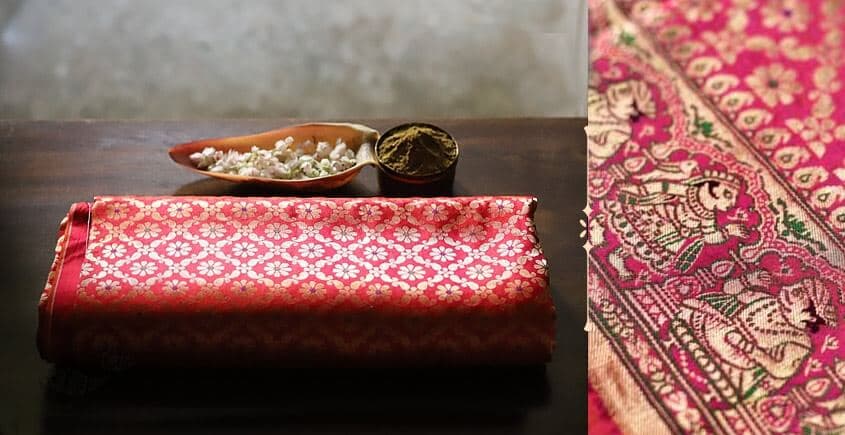
The Ashavalli aesthetic is both distinct and distinctive. Unlike the airy translucency of a Chanderi or a Jamdani, the Ashavalli is known for its twill-weave density and the opulent weight of its zari. Then, there is the ‘inlay’ technique or minakari that imparts a celebrated three-dimensional and enamelled effect. This results from the contrasting black or dark-coloured silk that Ashavalli weavers use to outline zari motifs. The end effect? Designs that appear inlaid with gemstones or enamel.
Motifs of Whimsy
Then comes the multiplicity of its motif language. Unlike several other Indian weaving traditions that moved towards only floral patterns under Islamic influence, Ashavalli retained its lively animal depictions. The hamsa (swan), a symbol of purity and grace, often glides across the borders, while the mayura (peacock) frequently dances on pallus. Fascinating also is the shardul, a powerful, stylised motif of a mythical lion, a signature of ancient Gujarati brocade. The popat (parrot) is also a common folk motif and cheers up Ashavalli textiles.
Coming to forever florals, the Ashavalli kairi (paisley) is rounder and more robust than the more sleek, elongated Banarasi paisley and is often filled with tiny floral minakari. Jangla and Jaal, the intricate, all-over patterns of intertwining vines, creepers, and flowers that are common to design languages across the country, also appear here.
The motif repository also has the celestial and symbolic, such as the chand-tara (moon and star), a clear influence from the Mughal and Sultanate periods. Swastika and Mandalas also appear, reflecting the craft’s roots in local Hindu and Jain traditions.
Vanished geographies
An Ashavalli weave is also a reminder of the vanished geography of Ahmedabad — once known as Ashaval. This was the “City of Hope,” where the Patel and Hindu Khatri communities of weavers turned silk and real gold into a visual language of bespoke prestige. Originating in the 12th century, these weaves were the preferred textiles of the Solanki kings and, later, the Mughal nobility.
Of resilience and revival
However, the story of Ashavalli is not just of long-ago royal patronage. Dynasties came and went, the name of the capital changed a few times, the capital itself shifted and industrialisation loomed. While the craft could not thrive any more, it managed to survive in the memory of a few artisan clusters in the Ridrol region, who preserved it with rugged resilience. Even so, by the late 1930s, Ashavalli had become a museum craft as the royal patronage that once sustained it had vanished.
The modern revival of this ancient brocade weaving tradition, which predates the famous Banarasi silks, owes much to the late Somabhai Patel and his descendants. Patel, a farmer who had always been intrigued by the intricate brocades historically woven by the Khatri community, took up weaving as a summer hobby. By the 1980s, at a time when the craft was nearly extinct, he established a small karkhana with four looms and convinced local weavers to join him.
His son, Vishnubhai, a civil engineer by training, gave up a government career when he realised the weave would die out if the Patel looms closed down. He modernised the process and grew the cluster from a few looms to nearly 100 by the late 1990s.
Today, Paresh Patel, the third-generation custodian, has expanded the reach of the craft to international markets and high-profile clients, including actresses Rekha and Shabana Azmi. The revival has been primarily a story of private perseverance and then, late-stage government support. Ashavalli brocade is today protected under the Geographical Indication (GI) registry.
A Rare Vintage
However, even today, finding an authentic Ashavalli can be something of a quest. Because the technique is so labour-intensive and the number of active looms few, these pieces are usually available only through specialised revivalist boutiques or weaving families like the Patels.
In the face of mass-produced fashion all around, the Ashavalli is a rich reminder of what homecoming can be. The textile equivalent of a rare vintage, an Ashavalli textile will not depreciate. It will instead remain a shimmering, gold-laden thread that ties us to a land left behind.
A Note for the Collector
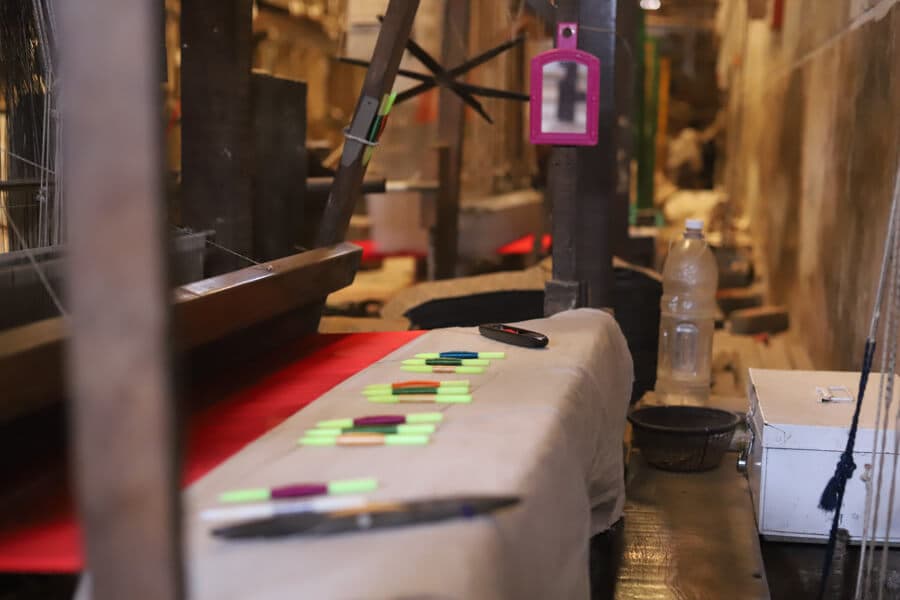
When sourcing an Ashavalli, look for the twill weave (diagonal lines in the base fabric) and the kadwa (hand-stitched) look of the motifs. A true Ashavalli will have no ‘floats’ (loose threads) on the back; it should be almost reversible, a hallmark of its complexity.
WHY IT MATTERS
- Predates Banarasi brocade
- Labour-intensive, limited looms
- A heritage heirloom in textile
Weavers and sellers
1. Paresh Patel
Paresh Patel, the grandson of Somabhai Patel — the man credited with single-handedly saving Ashavalli from extinction in the 1930s, operates out of the village of Ridrol. Their workshop remains the epicentre of the craft. Expect museum-quality pieces, often utilising real zari. Their work is also available through specialised heritage platforms like Amounee or Gaatha. A pure silk Ashavalli saree can range in price from ₹1,15,000 to ₹2,50,000. Royal Brocades
2. WeaverStory
weaverstory is a name familiar to members of the diaspora, given their expertise in taking nearly-extinct weaves to a global audience with rigorous quality control.
3. Pankaj S Heritage
For the textile lover who wants the heritage of Ashavalli but with a contemporary, high-fashion edge, pankaj_s_heritage (by Pankaj S. Chadha) could be the label of choice. They treat textiles as wearable history, often incorporating Ashavalli techniques into contemporary lehengas and luxury bridal wear.
4. Gaatha
Gaatha has direct connections with artisan clusters in Ridrol and Ahmedabad. gaatha is the place to go if you want to know the name of the weaver who spent months on your saree.
What is Ashavalli?
What is Ashavalli?
Ashavalli (also called Ashavali) is a traditional handwoven silk brocade saree known for rich zari work and Mughal-inspired motifs.
It is considered a heritage textile of Gujarat and is known for its heavy, royal look.
Where did the Ashavalli saree originate?
Where did the Ashavalli saree originate?
The Ashavalli saree originated in Ahmedabad, where it was historically woven by skilled artisan communities.
It was traditionally associated with royal and aristocratic wear in Gujarat.
How to know if the Ashavalli saree is authentic?
How to know if the Ashavalli saree is authentic?
An authentic Ashavalli saree is usually handwoven pure silk with dense zari brocade, detailed motifs, and slight weave irregularities.
Check for handmade finishing, real zari feel, and buy only from trusted handloom or artisan sellers.
Where can I buy Ashavalli sarees?
Where can I buy Ashavalli sarees?
You can buy them from trusted handloom boutiques, artisan-led online stores, or specialized heritage textile sellers in Gujarat.
Look for stores that clearly mention “handwoven Ashavalli brocade” and artisan sourcing.
How much does an authentic Ashavalli Saree cost?
How much does an authentic Ashavalli Saree cost?
Authentic Ashavalli sarees usually start from ₹20,000–₹50,000+, depending on silk quality, zari, and weaving complexity.
Premium handcrafted pieces can go significantly higher due to labor-intensive weaving.