“Dear Didi, I am writing to you from Melbourne. I am a retired tram driver-cum-conductor and activist. I was also part of the group that initiated the Melbourne-Kolkata Tramjatra all of 29 years ago. Over the years, however, the importance of trams in Kolkata’s transport structure has steadily dwindled. Today, I write to you with a request. Please consider prioritising trams in Kolkata’s public transport infrastructure. Given the backdrop of rising air pollution and climate change impacts, this, you will find, is a trend in most major cities of the world …”
In March 2023, a tram conductor from Melbourne wrote an unexpected letter to West Bengal chief minister Mamata Banerjee. It came from not within the state but many miles away. The writer, Roberto D’Andrea, a retired tram driver, conductor and public transport activist, appealed for the survival of Asia’s oldest operating tramway system.
The letter was the latest chapter in a three-decades-old bond between two cities, two tram systems, and a common belief that public transport is not just infrastructure, but inheritance.
The sound that stopped a traveller
Nearly 30 years ago, the familiar metallic gong of a tram stopped D’Andrea, who had just arrived in Kolkata as a tourist, in his tracks.
“In 1994, on my first day in Calcutta (now Kolkata), I remember being struck by that familiar gong, and by the friendliness of a group of tram workers I met in Esplanade. They took me to the Belgachia tram depot” recounts D’Andrea over a phone call from Melbourne. “They took me to the Belgachia tram depot, and, almost instantly, a long-term friendship between Melbourne and Calcutta was born.”
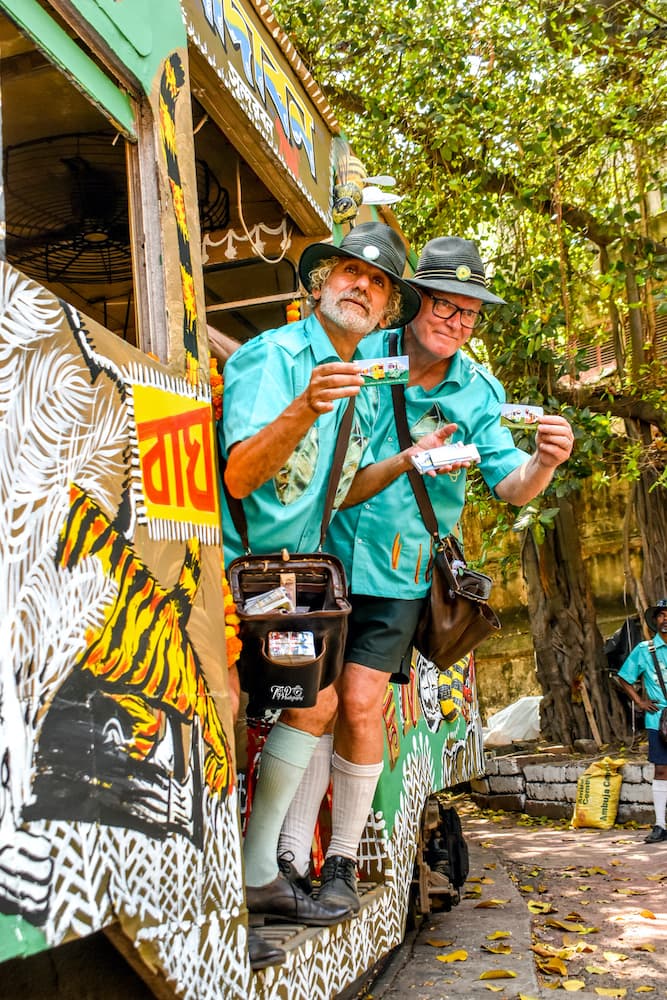
That encounter became the starting point of what later would be known as the Kolkata-Melbourne Tramjatra, a cultural and civic partnership that brought together people from both cities. D’Andrea, along with this writer, became part of the core Tramjatra group along with scientist and tram activist Debasish Bhattacharya, filmmaker Mahadeb Shi from Kolkata and academic artist Mick Douglas from Melbourne.
An SOS across continents
The timing was coincidental. On his return to Melbourne, Douglas, who later became the co-founder of Tramjatra, handed D’Andrea a letter from Bhattacharya – an SOS originally sent to the Public Transport Users Association – asking for help to save Kolkata trams. “This set the ball rolling as Melbourne also started to face a crisis with trams around the same time,” says D’Andrea.
In Kolkata, the mid-1990s saw plans to scale down the tram network and use the sprawling tram depot lands for commercial use. Bhattacharya began reaching out to public transport experts across the world, seeking support for the cause. Tramjatra formally took shape in 1996, positioning trams not just as public transport but as cultural artefacts embedded in urban life.
Over the years, Tramjatra has been held several times in both countries, often clubbed with messages on marquee social and environmental agendas, from Durga Puja and Rabindranath Tagore’s Gitanjali to cricket, climate change and the Sundarbans in 2025. “The movement has produced special-edition books, documentaries, specially designed tickets, musical and cultural shows as part of the tram festivals,” said one of the co-founders.
“Between 1996 and 2025, 16 specially designed trams ran in Kolkata, and six in Melbourne,” said Douglas.

Of countries and camaraderie
The partnership rests on a rare historical coincidence. Melbourne and Kolkata are the only two cities outside Europe to have uninterrupted tram systems for more than a century.
While trams in Kolkata, horse-drawn at that time, were initiated in 1873, the cable trams in Melbourne began in 1885. By the mid-90s, both started questioning the future.
The Kolkata government had already begun edging out the trams, while Melbourne's trams were also struggling, primarily due to a massive industrial dispute over the introduction of driver-only operations and a new ticketing system. This led to a 33-day tram blockade where trams were left abandoned in the streets, eventually resulting in the loss of conductor jobs.
And then the paths diverged.
On different tracks
While trams have made a strong comeback in Melbourne, the system is now all but symbolic in Kolkata.
Today, Melbourne has the largest tram network in the world with over 500 trams running on 24 routes spread over 250km of track. Trams are not treated as nostalgia but as efficient urban transport.
In Kolkata, by contrast, trams continue as heritage landmarks, catering mainly to tourists. A city, which once had more than 340 trams running on 37 routes, today only has 10 trams plying along two routes.
This retreat stands in contrast to what’s happening globally. Over 450 cities worldwide have tramways or Light Rail Transit (LRT) systems, including Berlin, Vienna, Brussels, Toronto, Zurich, Milan, and St Petersburg, with Europe having the highest concentration. Cities in the United States like Seattle, Boston, San Francisco, New Orleans and Philadelphia also have expanding tram systems.
In a world of increasing air pollution and leapfrogging climate change, the case for trams is not symbolic. It is pragmatic.

Not a lost cause
“Many think this is a lost cause,” says Mahadeb Shi, secretary of the Calcutta Tram User Association (CTUA). “But we feel that constant reminders on the importance of trams could influence public opinion and policy,”
The West Bengal Transport Corporation (WBTC) recently partnered with Bengal’s transport department for another successful season of Tramjatra. Tramjatra 2023, which coincided with the 150th anniversary of Kolkata’s tramways, saw historic tram parades, decorated wooden-bodied trams, children participating in an art exhibition and a series of brainstorming events.
D’Andrea and Shi are exploring ways to generate funds for a detailed documentary on Kolkata trams. “We have also prepared a 2026 Kolkata tram calendar,” says D’Andrea.
Hopefully, if their efforts bear fruit, Kolkata trams will not exist on a calendar alone.
Why this story matters now
The Kolkata-Melbourne Tramjatra is not simply about transport. It is about whether heritage is allowed to evolve or only be preserved as spectacle.
For diasporic readers, especially those in Australia, this story reflects a deeper question. Does progress only mean speed, or can it be also measured with sustainability?
Trams, after all, are a quiet luxury. They trudge along unhurried, resisting the sense of urgency of urban city life. For the DOT.IN reader, who values context and cultural intelligence, a tram journey is not about reaching the destination fastest, it is about being present while you do.
Key Highlights
- The shared tram cultures of Kolkata and Melbourne is what led to the founding of the Kolkata-Melbourne Tramjatra
- The Tramjatra core group included Roberto D’Andrea, a tram activist and driver-cum-conductor from Melbourne
- Other core members were scientist and tram activist Debasish Bhattacharya, filmmaker Mahadeb Shi from Kolkata and academic artist Mick Douglas from Melbourne
- Trams in Kolkata were initiated in 1873 and were horse drawn at that time
- Cable trams in Melbourne began in 1885. Currently, it has the largest tram network in the world with over 500 trams running on 24 routes spread over 250km of track
- From 1996 to 2025, Tramjatra has had tram exhibitions involving 16 specially-designed trams in Kolkata and six in Melbourne
Does Kolkata still have trams?
Yes, Kolkata still has trams, but they primarily serve as a tourist attraction these days
What is Tramjatra?
Tramjatra is a celebration that links Kolkata and Melbourne through their shared tram culture
Which is the largest tram network in the world?
Melbourne currently has the largest tram network in the world with over 500 trams running on 24 routes spread over 250km of track
When was the first Tramjatra held?
The first Tramjatra was held in 1996