


 ion
ionKey Highlights
- A hike across Tasmania’s Freycinet Peninsula becomes an unexpectedly spiritual encounter
- The turquoise sweep of Wineglass Bay offers a moment of stillness, awe and emotional release
- A natural rock formation appears to resemble Ganesha, the remover of obstacles and guardian of travellers
- The travelogue explores the idea of pareidolia — the human tendency to find familiar forms in abstract patterns
- Science explains the phenomenon as pattern recognition, but the author questions whether meaning can sometimes go deeper
- The encounter becomes a meditation on identity, belonging and the emotional instincts of the Indian diaspora
There are some spots on earth that are not very easy wins. They might not be icy mountains, but granite scrambles that make your calves ache. Sometimes, you might have to push through a chilly wind, and sometimes you will be warmed by the touch of the gentle Tasmanian sun. And at the end of the walk, you witness a small part of the wondrous beauty that our world holds. Freycinet Peninsula on Tasmania’s east coast is such a landscape — ancient, alone and spectacularly beautiful.
Early one morning, I had wandered down Freycinet Drive, making my plans for the day. The name Wineglass Bay had made me envision pleasures civilised and restorative — cold chardonnay, oysters that smell of the sea and a table with a gorgeous view. The drive up from my lodgings had taken barely 25 minutes. And what a pleasant drive it was on its own merit, with grey-green eucalyptus standing sentinel-like all along the road.
Then came the climb. Short but steep. A sharply-rising track that wound between she-oaks and banksias.
Putting one booted foot in front of the other on the famous pink-red soil was a meditative process and I counted the minutes till I reached the hilltop.
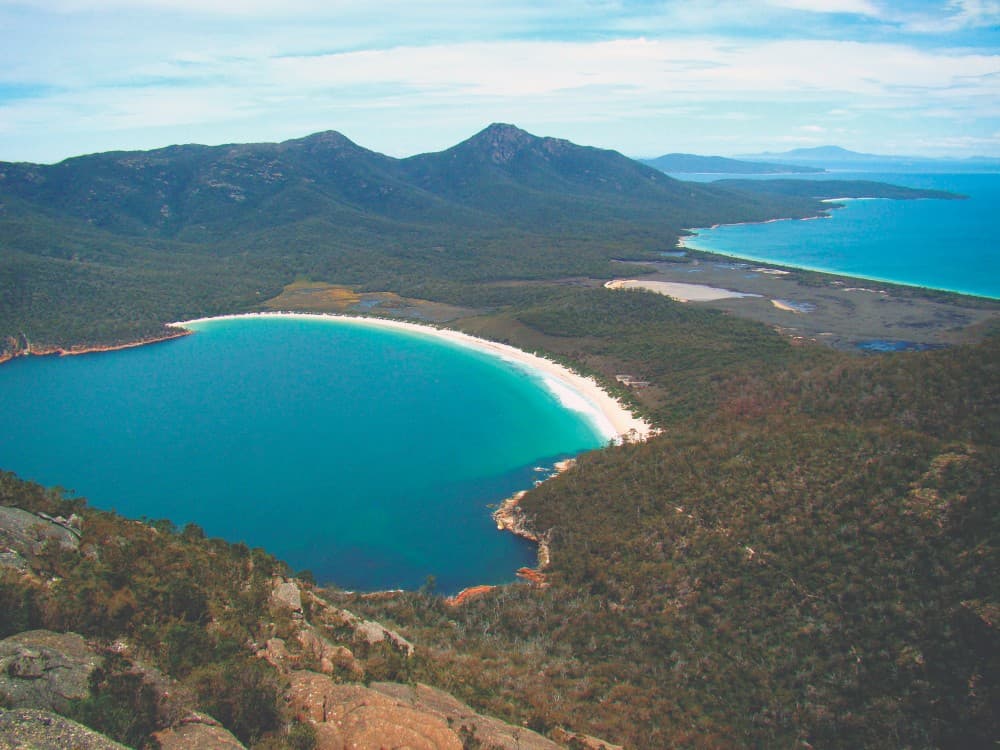
I came upon a lookout and the bay revealed itself. It was immediately clear why people make journeys here. I saw a wine glass, yes, but filled with something infinitely more intoxicating than anything the human hand could make. Water radiantly turquoise, rimmed in white surf and that famous lazy arc of light-coloured sand. I felt the stress I had been carrying quite unknowingly, dissolve. It was one of those moments when you are simply thankful for the gift of breath, of life.
Then I turned.
Why, you ask? Because I felt watched.
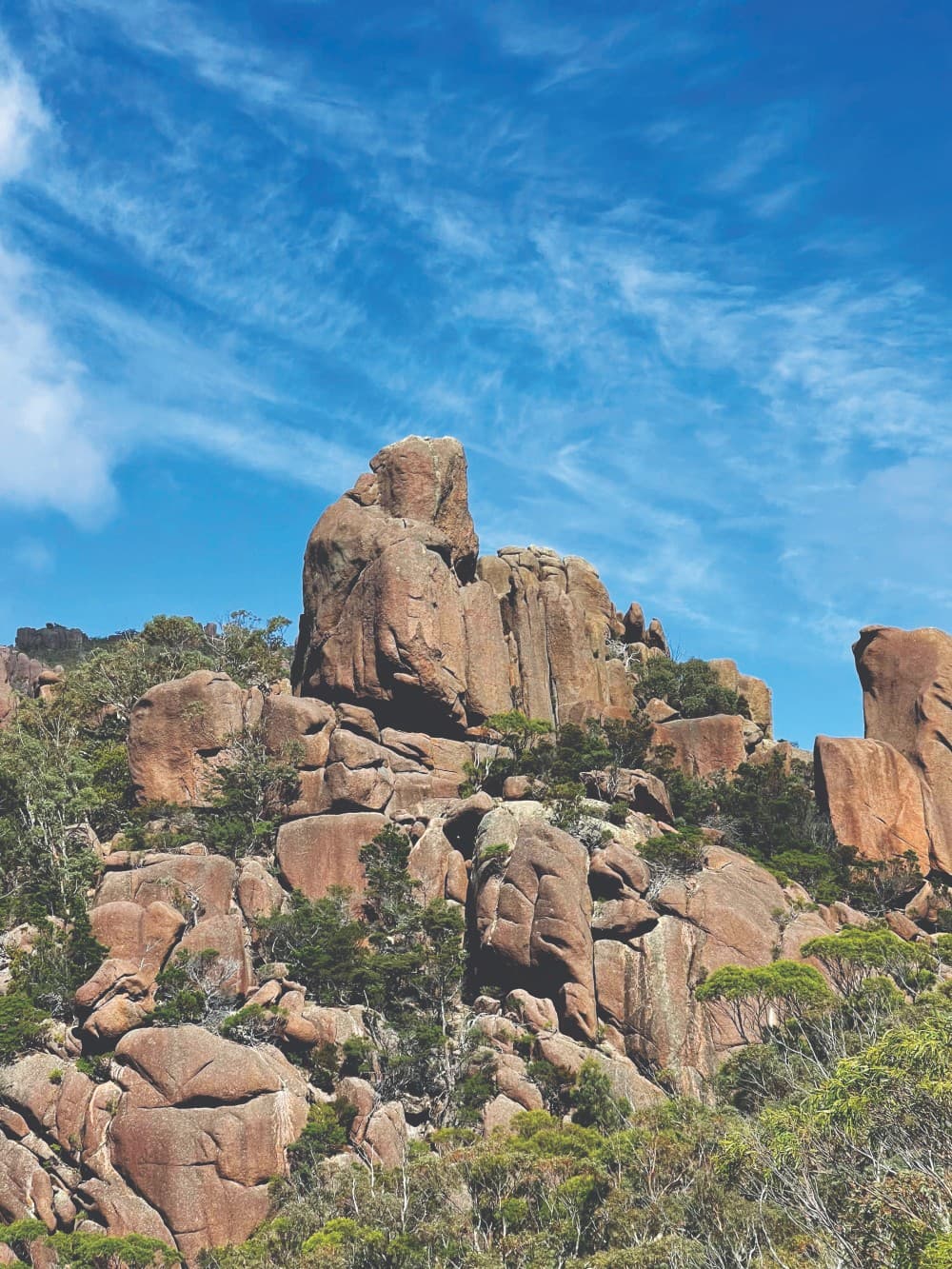
As I looked around for other travellers close by, all I saw was the track making its way back into the scrub. And then I noticed a rock face rising above the track, with the hard southern light on it. Not one rock — several. Enormous slabs of pink, Devonian granite, stacked and settled over millennia by the impersonal forces of geology, weather and time.
And then I saw it.
The suggestion of a trunk, curving softly to the left. The rounded protrusion of a full belly. The breadth of what could only be described as shoulders. And above it all, a slightly smiling composure that left me quite breathless. I was looking at a Ganesha. The revered Hindu God, remover of obstacles, seated in a rock face on the Freycinet Peninsula, carved not by human hands but by millennia of wind, water and the slow mathematics of the earth.
The formation was vast, around 6 to 8 metres to my eye. It seemed as if I had chanced upon the largest natural Ganesha in the world, sitting calmly hidden at the edge of the Southern Ocean, overlooking a beautiful bay, waiting for someone to turn around.
Since that revelation, I have read about Pareidolia — the human brain’s almost compulsive need to find faces and forms in the abstract. This explains why universally, we seek and see animals in clouds and faces in tree trunks. Scientists perceive this as an evolutionary advantage. A brain wired to detect pattern and face is a brain that has survived. And thus, evolution has made us into meaning-making creatures by design, coded to find the familiar in the formless.
But I wonder… Is that explanation really the whole story? Those rocks at Freycinet Peninsula did not look vaguely like something. To my eyes, my mind and my heart, they looked like a specific deity — one I had grown up knowing, one associated with beginnings and the clearing of paths, and also one who watches over travellers. And I was, undeniably, a traveller. Not just that day in Freycinet, but in life as a member of that restless Indian diaspora.
Perhaps Ganesha was truly always there. Perhaps all he wanted was for someone to turn around.
Where is Freycinet Peninsula located?
Where is Freycinet Peninsula located?
Freycinet Peninsula is located on Tasmania’s east coast and is known for its granite peaks, coastal walks and dramatic ocean views.
What is Wineglass Bay famous for?
What is Wineglass Bay famous for?
Wineglass Bay is renowned for its curved white-sand shoreline and turquoise waters, often ranked among the world’s most beautiful beaches.
What is pareidolia?
What is pareidolia?
Pareidolia is the human tendency to recognise familiar shapes or faces in abstract forms such as clouds, rocks or trees.
Why does the author see Ganesha in the rock formation?
Why does the author see Ganesha in the rock formation?
The author experiences the rock face as resembling Ganesha, reflecting both visual perception and a deeper emotional and cultural connection.
Is the Ganesha rock formation an official landmark?
Is the Ganesha rock formation an official landmark?
No, the formation is a personal observation and interpretation rather than a formally recognised site.
What themes does the essay explore?
What themes does the essay explore?
The piece reflects on spirituality, memory, travel, identity and the search for meaning within landscapes.
How does the essay connect to the Indian diaspora experience?
How does the essay connect to the Indian diaspora experience?
The author links the encounter to the emotional experience of being a traveller between cultures and worlds.