Key Highlights
- In the early-to mid-2000s, a massive wave of Indians immigrated to many countries across the world, mostly driven by India’s technology sector
- Several global cities now have large Indian immigrant populations
- Unfortunately, some older Indians are upset that a ‘different class’ of migrant is now spoiling their name
- While Indians around the world have contributed much to countries they have moved to, the Great Immigration Debate is complex
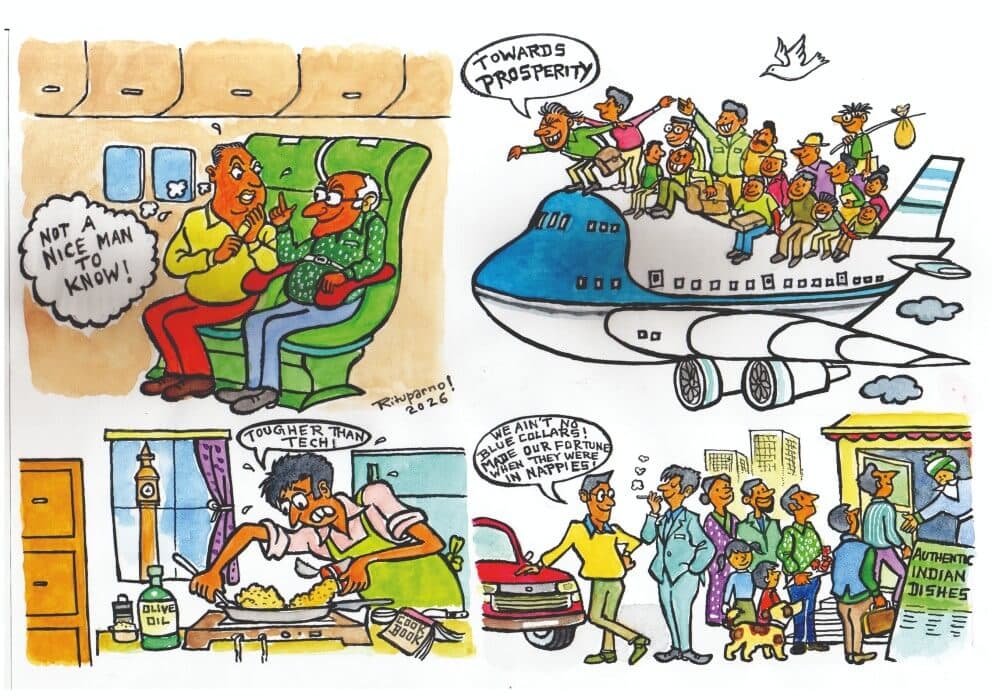
On any international flight out of India, there’s always at least one old person going to visit his non-resident Indian son and invariably has difficulty understanding the international air crew. And often, as life has it, you will find they’re sitting next to you.
Movies and ads are full of stories of an airline conversation leading to a romance or a business deal. Mine often involve translating for someone (a 79-year-old Telugu-speaking uncle in this case), if they’d like the chicken or the fish, only to be informed he’s vegetarian and then accidentally arguing on his behalf about why they don’t have his meal request, when all I wanted to do was not do anything. One expects an airline journey to be about foreign things. It never is, if you’re Indian.
If you grew up in the 90s, going abroad was a near magical, impossible thing, done mostly by a small group of the elite who’d have to take out a loan to pay off the US university. They were mostly English-speaking and privileged.
Something shifted in the early-to mid-2000s, and a massive wave of immigration flowed to many countries across the world, mostly driven by India’s technology sector, but also of unskilled labour, where foreign migration could suddenly become a middle-class aspiration rather than only an upper-class one.
One of the positive aspects of this was that it levelled the playing field and meant that getting your shot at a meritocratic opportunity abroad was not just about how you spoke or fit in, but about what skills you had. It is perfectly common, in fact the norm now, in cities across the world with large Indian populations, from Melbourne to Houston, to see them only converse in some Indian language. The great irony is that in all the anti-India immigration rhetoric one hears, the most racist language comes from older Indian immigrants who are upset that a ‘different class’ of migrant is now spoiling their name.
The great immigration debate is complex. Indians have given so much to countries around the world and at the same time, a mindset can’t be easily shed
My airline neighbour’s son was one such beneficiary of America’s tech needs. Born in a small village not far from Hyderabad to semi-literate parents and having studied in a rural college, he worked incredibly hard to make his way to Microsoft — the great American dream. And now he was flying over his father, a shop owner who’d never finished school, for his first US trip and first time on a plane. In theory, a Hollywood ending.
When I heard the story, and seeing an elderly person, as we’re taught in India to respect elders, I went out of my way to help him navigate the flight logistics and explain what the crew were saying to him. However, as we flew along (feeling quite good at having been a good samaritan), his conversation went from inquisitive to downright offensive — from how much money I make to a tirade against a particular religion to his views on women, especially western women, wholly misogynist, racist and uninformed.
Not to mention, since we had become acquaintances, he helped himself to my dessert and bread from my dinner, without asking. By the time we landed, I wanted nothing to do with him but he assumed I’d carry his bags and escort him to his son, because he’d decided I was also his concierge.
The great immigration debate is complex. Indians have given so much to the countries around the world and at the same time, a mindset can’t be easily shed. For my part, I started with a belief that this was a great migration success story and ended up a servant to a racist uncle.