Key Highlights
- Australia set the standard for limited overs dominance in men’s cricket between 1999 and 2007
- India have emerged as worthy successors since the 50-over World Cup in 2023
- Steve Waugh and Rohit Sharma were fundamental to the success stories of their respective nations
- Australia never had the off-field clout during their glory days that India have harnessed in theirs
- History may remember Australia more for their style while celebrating India for their greater efficiency
The Chicago Bulls in the ’90s, led by the irrepressible Michael Jordan. FC Barcelona under the visionary management of Pep Guardiola. New Zealand’s all-conquering All Blacks in Rugby between 2011 and 2015. The US women’s soccer team inspired by the high-octane adaptability of Jill Ellis.
All these iconic sporting outfits share a common crucible: an aura of inevitability. A force field around a collective that feels impossible to penetrate. Even when individual parts of their winning machine falter, the rest of the unit sails along. And the result is never in doubt. Sustained excellence is gruelling in any sport, but the combination of skill, synergy and spirit that is required to triumph repeatedly and memorably makes greatness rarer in a team game.
In the 21st century, the benchmark for collective cricketing greatness has long been the relentless Australian sides under Steve Waugh and Ricky Ponting. Their non-stop aggression, meted out with characteristic swagger, altered the template of limited overs cricket in the early 2000s, culminating in an era of dominance that saw them win three consecutive 50-over World Cups between 1999 and 2007. For more than a decade and a half, it seemed nobody would (or could) come close. Step forward, India. Specifically the Indian men’s team since the start of the 50-over World Cup in 2023. In the past two-and-a-half years, India have won three titles and reached the final of the only other white-ball competition they did not win. In doing so, they have inherited the cape of invincibility from the Aussies. But does that mean they are better?
Leaders and turning points
It’s the morning of 13 June, 1999, in Leeds. A topsy-turvy Australia are about to confront the multi-faceted menace that are South Africa, powered by career-defining performances by all-rounder Lance Klusener. Heading into the match, Australia’s beleaguered leader, Steve Waugh, is aware of the stakes. A loss not only jeopardises his team’s chances of qualification, but also puts him at risk of being dropped from his own lineup. To turn up the heat even further, South Africa put on a steep score of 271, with Herschelle Gibbs notching a century. In pursuit, Australia are three down for 48 when Waugh enters the fray. As always, his mantra is: “Don’t get bitter, get better.” What follows is a tour de force of batsmanship under the most intense scrutiny. Waugh’s counterattacking ton not only clinches victory (with just two balls to spare), but galvanises a squad that had felt lesser than the sum of its parts. Exactly a week after Waugh’s heroics, Australia reclaim the 50-over men’s World Cup, for the first time in 12 years. They wouldn’t let go of it for another dozen years, with Waugh making way for a more swashbuckling skipper in Ricky Ponting.
It’s the evening of 10 November, 2022, in Adelaide. India have just been trounced by England in the semi-finals of the T20 World Cup. A 10-wicket defeat is about as deflating an outcome as possible for a team fancied to go all the way. At the centre of the aftermath is India’s circumspect batting, epitomised by Rohit Sharma’s laboured 27 off 28 balls. At 35, critics are beginning to write Sharma’s obituary in the shortest format. Some speculate if he should be axed from the 50-over format, too, where he has multiple double centuries to his name. Confronted with questions over his technique and temperament, the Indian captain goes back to the drawing board. One of modern cricket’s finest strokeplayers makes a crucial decision to reinvent his approach. Instead of playing sheet anchor at the top with the goal of batting as long as possible, Sharma chooses to prioritise impact. In other words, he will smash it from ball one. Sharma’s gambit pays off, as India cruise to the final of the 50-over World Cup on home soil in 2023, break a 11-year trophy curse to capture the T20 World Cup in 2024, and regain the Champions Trophy the following year. Under Sharma’s mentorship, Suryakumar Yadav becomes a fixture of the T20 squad, takes over the captaincy from the ‘Hitman’, and leads India to another T20 World Cup crown in 2026. “It was purely my choice… I wanted to try something else… It only adds up in your list of batting abilities. Unless you do it, you won’t know it,” says Sharma when asked to describe the change in his mindset.
Of empires and eras
Between the start of the 50-over World Cup in England in 1999 and the end of the 2007 edition in the West Indies, Australia played a total of 234 One Day International (ODI) games, with a win percentage of 74. At the time, T20 cricket wasn’t yet a mainstream component of the international game, but Australia were peerless in the only limited overs version that existed. With Matthew Hayden and Adam Gilchrist going all guns blazing as openers, most teams would be on the back foot from the get-go. After Waugh’s time in ODIs was up in 2002, Australia’s batting became even more formidable. The top and middle order was stacked with class, from the imposing Ponting to the effortless Damien Martyn, from the hustle-bustle of Michael Hussey to the suaveness of Michael Clarke. Michael Bevan was invariably there towards the end of the Australian innings to put the final touches, with Andrew Symonds a useful utility player. While neither Shane Warne nor Glenn McGrath, Australia’s most decorated Test bowlers, were as influential in ODIs, the Kangaroos had more than adequate back-up in the express pace of Brett Lee, the guile of Jason Gillespie, and the unconventional variations of Nathan Bracken. As a fielding unit, Australia were head and shoulders above the rest, with Ponting, Symonds, and Clarke spearheading the charge.
After finding momentum at the right stage in the 1999 World Cup, Australia never lost it in 2003 and 2007, finishing both campaigns with a combined win/loss record of 25-0. The Champions Trophy (previously known as the ICC Knockout Trophy) was their bogey tournament for a while, but even that was set right in 2006, with another commanding display in India.
It is not a stretch to say that the Indian champions of the present learnt a thing or two by following the exploits of the Australian icons of the past. Chiefly in having more than one or two match-winners, the norm for just about every other team. The added dimension of T20 cricket meant that white-ball supremacy wasn’t just about world-class consistency. It was also about role definition, constant adjustments, and courage. The courage to know when to stick and when to twist.
In the 50-over World Cup in 2023, India batted around Virat Kohli, the greatest run accumulator in the format. This allowed Sharma, Shubman Gill, Shreyas Iyer, KL Rahul and Yadav to express themselves, while Kohli piled on the records. With ball in hand, it was Jasprit Bumrah who was the pivot. As devilish with the old ball as he was devastating with the new, Bumrah was scintillating in 2023, but somehow found new levels of jaw-dropping performances in the two subsequent T20 World Cups. Axar Patel added punch with the bat and poise with the ball, while a rotating cast of pacers and spinners combined effectively with India’s answer to Symonds — Hardik Pandya.
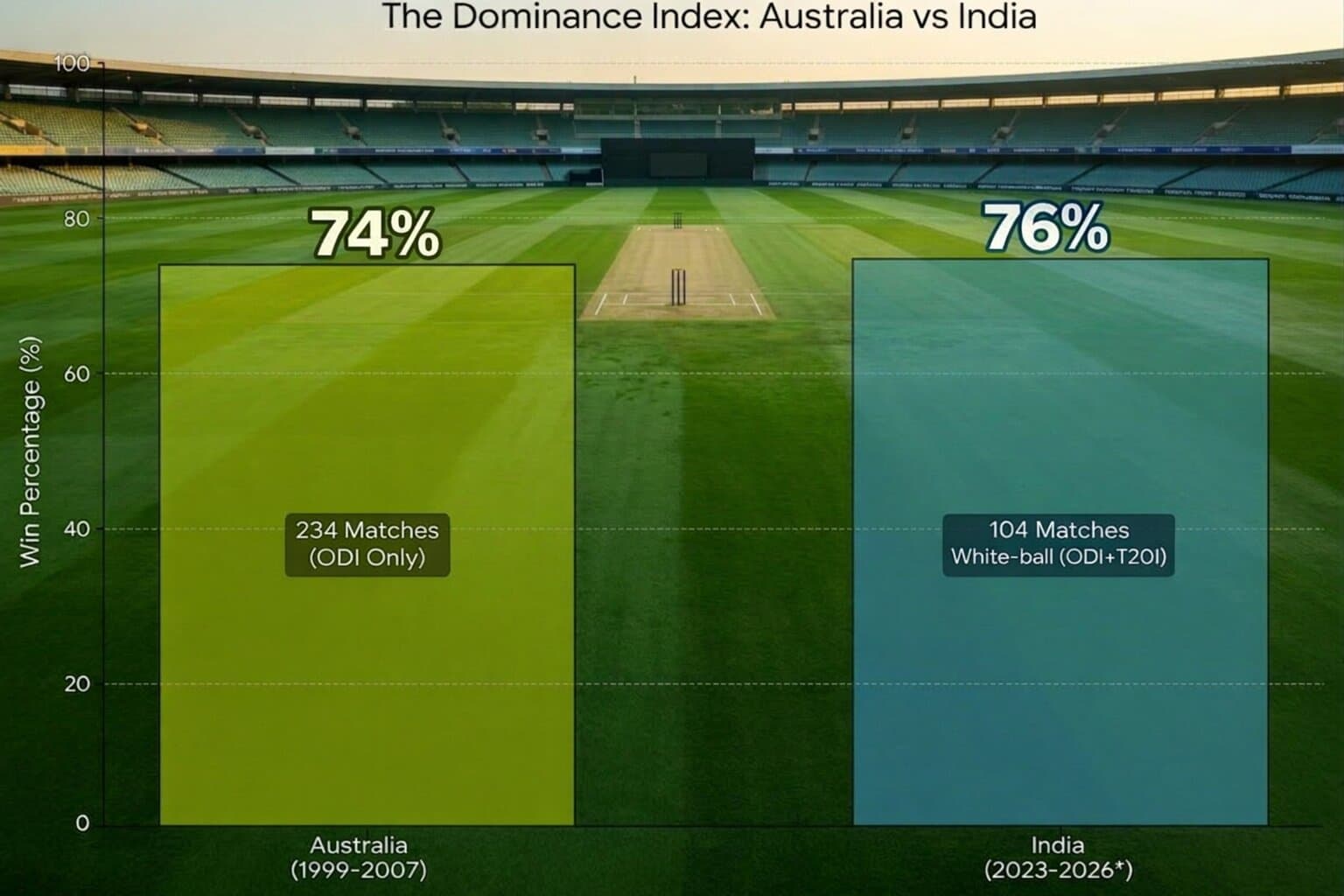
Between the start of the 2023 World Cup and the end of the latest T20I extravaganza, India have played a total of 104 white-ball games, with a win percentage of 76. This includes a barely believable record of losing only two games across four ICC limited overs tournaments and 33 matches — something no other team may ever replicate.
A clash of equals?
To say that prime Australia would eclipse peak India in ODIs while India would edge Australia in T20Is seems disingenuous, a hunch-driven cop out. A deeper perspective would acknowledge that Australia were more spectacular alongside admitting that India have been more dependable. While the Aussies could launch into untouchable territory ever so often, they also had blips, where complacency crept in slightly (as Bangladesh would remember fondly from 2005). With India, though, the cricket may not always be dazzling, but there are even fewer bad days at the office. This is more remarkable given the inherent fickleness of T20 cricket, where the Indian juggernaut has found a way to control the mini-battles with high percentage, non-stop attacking cricket. As opposed to Australia’s reliance on specialists, India, more so under present coach Gautam Gambhir, have prioritised all-rounders and greater versatility across conditions and competitions.
In assessing two outstanding teams, one must also contend with the quality of their respective adversaries. Prime Australia had to go up against a much stronger Sri Lanka, Pakistan, and the West Indies while peak India have had to contend with a more adventurous England as well as more efficient iterations of South Africa and New Zealand. Whereas Australia’s ultra-competitive domestic cricket scene churned out a conveyor belt of mature yet malleable cricketers, the Indian Premier League (IPL) has helped unleash an almost unlimited supply of prodigies for India, to the extent that the world’s most populous nation can legitimately field two separate stellar XIs at all times.
Unlike Australia, India’s on-field success has come in tandem with unparalleled strength off the field. Adjusted for inflation, The Board of Control for Cricket in India (BCCI) is approximately 70 times richer in 2026 than the Australian Cricket Board (ACB) was in 2007. This has led to a presumption of supremacy for India, where they are expected to turn up and win everything, everywhere (especially in limited overs). This expectation stems from a certain cynicism in a skewed playing field rather than a surrender to pure competence, as was the case with Australia. This shouldn’t take away from India’s achievements as much as contextualise them within the broader power structures that run cricket. When Australia were in their heyday, cricket was still a niche sport with little global headway. Today, largely because of India’s muscle, cricket has never been more popular.
For all their trophies and exhilarating performances, Australia and India have both made limited overs cricket somewhat predictable. No wonder that the sport’s romantics will never love them as much as the underdogs from Sri Lanka in 1996 or the enigmatic West Indians from 2016. But that’s the price for generational dominance. A price that India would have happily paid in 2007 and one that the Australians would be just as glad to accept in 2026.