Key Highlights
- Srinagar is a prime spot for birding, cradled by the Himalayas and the landscape ranges from wetlands, glacial lakes and mountain streams to alpine meadows and pine forests
- Srinagar attracts migratory birds during the summer and winter months, but also has a few species that are there year-round
- In winter, the valley attracts birds from Siberia, Central Asia and Europe. Some species found here during those months are: the greylag goose, the great bittern, the white-tailed eagle and the long-eared owl
- During the summer months, Srinagar becomes home to birds like the Kashmiri flycatcher, the European bee-eater, the brown dipper, the western tragopan and the spectacled finch
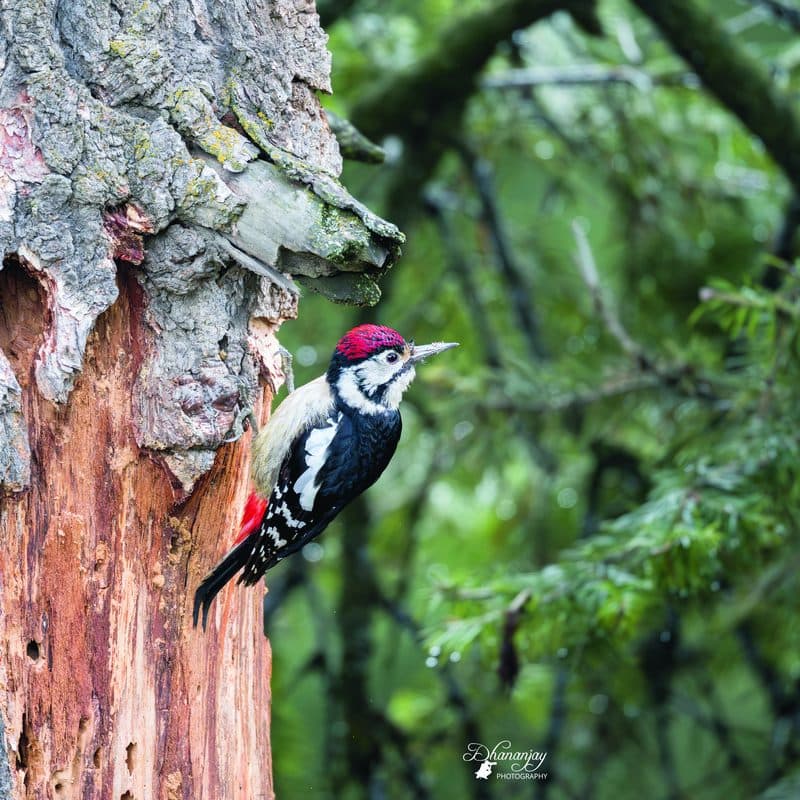
- Other birds you can see all year are the Kashmiri nuthatch, the Kashmiri nutcracker, the tawny owl, the orange bullfinch and the Eurasian jackdaw
You can arrive in Srinagar with a checklist of attractions. Or you can arrive with binoculars.
The mountains still stand tall and majestic, and the lakes still shimmer under streaks of sunlight, as the birder’s gaze shifts to reed-filled wetlands, dense forests and mountain slopes. The senses are alert to a movement in the willows, a call from the marshes and the silhouette of a raptor circling above a lake.
Welcome to a Kashmir that exists beyond the postcards.
What makes Srinagar a birder’s paradise?
The secret lies in Kashmir’s geography.
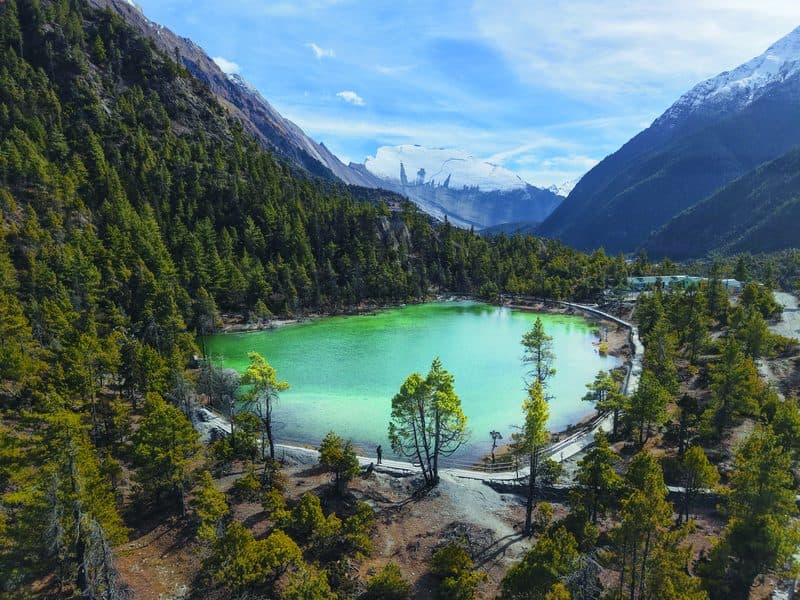
The valley is cradled by the Himalayas, and the landscape ranges from wetlands, glacial lakes and mountain streams to alpine meadows and pine forests — all within a relatively small region. The harsh winds of Central Asia are blocked by the Himalayas, keeping the valley milder than the high country around it. It becomes a refuge for birds escaping severe winters farther north.
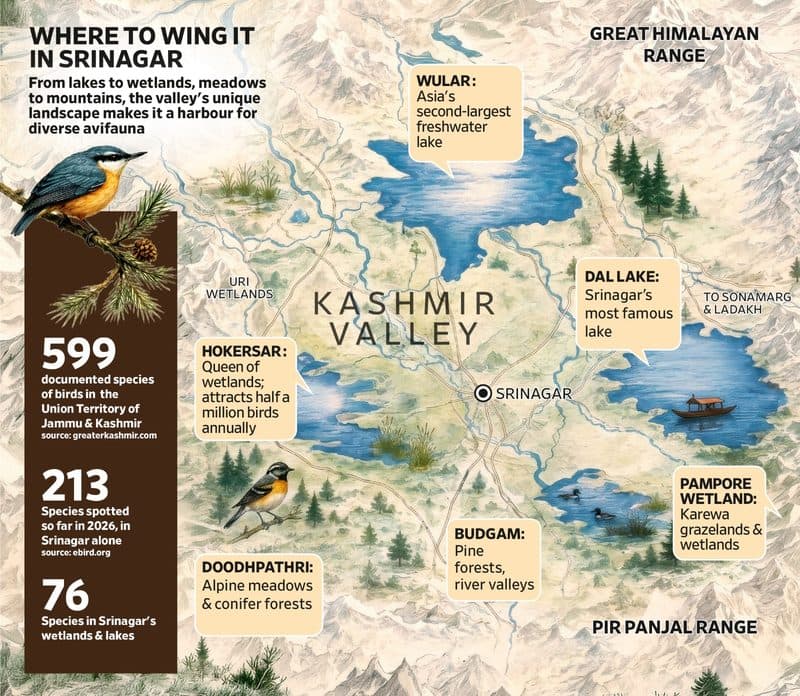
Within the valley, there is enough elevation and habitat variety for each species to find its own niche. But the wetlands are the true lifeblood of it all. Dal Lake, Wular Lake, Hokersar and the Pampore wetlands offer food, shelter and breeding grounds for countless species. In winter, they are home to migrants from Siberia, Europe and Central Asia, and in summer, they act as nurseries for resident birds.
Geological evidence tells us that a great part of Srinagar was once a lake, and when it transformed into a valley some four million years ago, the Karewas were formed. Pioneering Indian geologist Birbal Sahni described the Karewas in a 1936 article as “flat terraces or table-lands”. They offer ideal nesting habitats for species such as the European bee-eater and chukar. Their porous soil absorbs rainwater, regulating water flow while protecting wildlife from strong winds.
Together, these landscapes form a network that sustains birdlife across the seasons.
Two seasons of wings
Srinagar’s bird calendar doesn’t follow the tourist calendar.
Winter brings birds down from Siberia, Central Asia and Europe, fleeing the cold. In summer, roughly between April and August, birds escape the heat of peninsular India and Sri Lanka and arrive to breed in Kashmir’s cool climes. For both groups, the valley is a temporary home.
And then there is a third category: birds that never leave.
Resident birds of Kashmir
Before the visitors arrive, the valley already belongs to a few year-round locals.
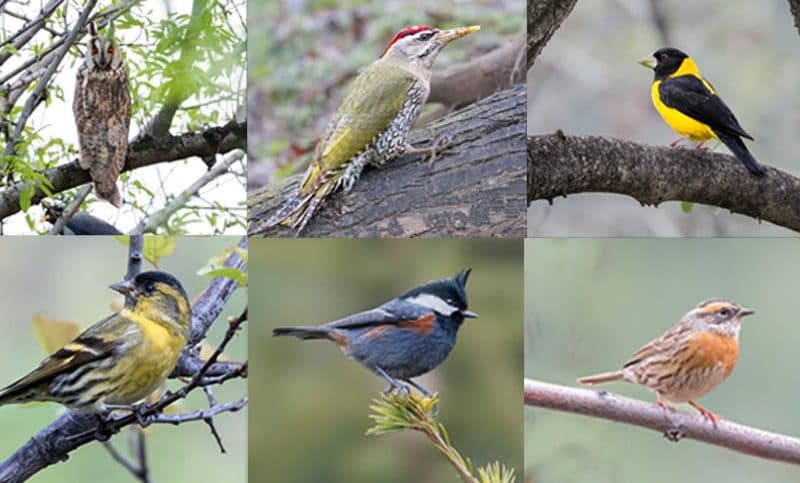
High in the pine forests of Yousmarg and Doodhpathri live the Kashmir nuthatch, a small grey-and-rust tree climber, and the Kashmir nutcracker, a whitish bird that spends its days burying pine seeds in the soil. Sharing these forests is the black-and-yellow grosbeak, a big-billed finch whose male is impossible to miss, with bold black wings set against a body the colour of egg yolk.
In Budgam, around seven miles southwest of Srinagar, you can hear the tawny owl long before you see it. It is a rare find, and its low, ghostly hoot drifts out of the dark. Wasim Bhatt, a well-known bird guide in Srinagar, says that one of these owls lived in the same chinar tree for years, becoming visible only in winter after the leaves had fallen.
The orange bullfinch is another eye-catcher — a small, elusive bird whose vibrant orange plumage seems to glow against Kashmir’s winter landscape. While it spends summer in the high forests, winter often brings it down to the hills around Srinagar in search of food.
And everywhere, in noisy little trains, is the Eurasian jackdaw, with its strange pale eyes, like two small moons set in a black face.
Down on the water, at Hokersar and other wetlands, the common mallard never bothers to leave.
Winter brings birds down from Siberia, Central Asia and Europe. In summer, roughly between April and August, birds from peninsular India and Sri Lanka arrive to breed in Kashmir’s cool climes. And then there are the birds that never leave
Travellers from the cold
Every year, as the cold tightens its grip on Siberia and Central Asia, thousands of birds fly south, and many of them choose to spend winter in the valley.
By late autumn, Hokersar, about 10 km from Srinagar, starts to fill up with teals, shovelers, pintails and mergansers. The greylag goose comes too, all the way from Siberia, and close behind comes the white-tailed eagle — a huge, patient hunter that follows its food.
Among the other guests is the long-eared owl, making the journey from Afghanistan and Kazakhstan and settling into the orchards around Budgam and Ganderbal. A trio of finches — the pine bunting, the brambling and the yellowhammer — make the same long journey from Siberia and Europe, landing in the very same belt of villages.
Lastly, we have the great bittern, a recent addition to the list. It was first spotted in the valley in 2024, at Wular Lake, which wildlife officials called a landmark moment for Kashmir’s wetlands. Since then, it has often been seen at Dal Lake, Wular Lake, Hokersar, the Pampore wetlands and Manasbal.
The summer interns
Like their winter counterparts, there are a host of winged visitors that make Srinagar their home from April onwards.
The Kashmir flycatcher breeds here after wintering in south India and Sri Lanka, gathering around Shankaracharya Hill, Baramulla, Wular Lake and Bandipora. The European bee-eater arrives from Europe to nest in the soft Karewa soil around Budgam, Pampore and Srinagar.
Higher up, between 2,800 and 3,500 metres, the spectacled finch breeds at Sinthan Top, Yousmarg and Doodhpathri, while the western tragopan, one of the rarest pheasants in the world, thrives in the forests of Lachipora and Limber, near Uri. Along the valley’s mountain streams, keep an eye out for the brown dipper bobbing on wet rocks, and the crimson-billed ibisbill picking through the shingle.
The tourist map of Srinagar ends at the lake’s edge, but a birder’s map is always in motion. To discover a side of the valley few travellers ever see, simply follow the wings.
What is the best time to go birding in Kashmir?
What is the best time to go birding in Kashmir?
There is no specific birding season in Kashmir. It attracts birds of all species throughout the year. Some are migratory birds that come in during the summer and winter months, others stay all year round.
Is Srinagar the best place for birding in Kashmir?
Is Srinagar the best place for birding in Kashmir?
Srinagar is the one of best places for birding in Kashmir because its landscape has wetlands, glacial lakes, mountain streams, alpine meadows and pine forests, making it suitable for birdlife across seasons.
What are the winter birds found in Kashmir?
What are the winter birds found in Kashmir?
The winter birds found in Kashmir include the greylag goose, the great bittern, the white-tailed eagle and the long-eared owl.
What are the summer birds found in Kashmir?
What are the summer birds found in Kashmir?
You’ll find the Kashmiri flycatcher, the European bee-eater, the brown dipper, the western tragopan and the spectacled finch.
When can I see the orange bullfinch in Srinagar?
When can I see the orange bullfinch in Srinagar?
Birds like the orange bullfinch, the Eurasian jackdaw, the common mallard and the Kashmiri nutcracker can be spotted all-year round in Srinagar.