Calcutta was the second city of the mighty British Empire, which in turn was the second-most significant empire in the history of the world. If Kolkata came second to London in importance, the British Empire came second to the Roman Empire before it. This centrality of Calcutta in the annals of mankind has been due in large part to the city’s long-term structural strengths. And then there are its people, civilisationally trained over centuries to produce and sustain greatness.
The city is strategically located in the Indian oceanic network, bringing fundamental advantages in terms of global trade, cultural exchanges and political-diplomatic negotiations.
Being situated at the interstices of two great civilisations helped. From the north-west came the great ‘Aryan’-Sanskritic-Central Asian waves, from the east came the Tibeto-Burman and various south-east-Asian streams. This functionality added to the enduring underlying strengths of the city.
It is not surprising, therefore, that the place has been a magnet since Mughal times. This evolution was rooted in a pre-colonial continuum of regional power and strategic wealth. When the Mughal General Munim Khan attacked Daud Khan Karrani — the last sovereign independent Afghan ruler of Bengal — at the Rajmahal Hills on the Bengal-Bihar border, Daud fled eastward, entrusting his vast royal treasure to his general for safekeeping. That official, Srihari, followed the Sultan’s route but deviated towards the marshy jungles near the present-day city of Jessore in Bangladesh. It is believed that eventually he used this immense wealth to establish the dazzling Kingdom of Jessore (literally Jashohara, the stealer of fame).
On his death, his kingdom was split in two — 5/8 going to his son, Raja Pratapaditya, and 3/8 to his brother, Raja Basanta Ray (there are streets in Kolkata even today after their names).
Pratapaditya built a formidable regional kingdom among the Baro-Bhuiyan warlords. When the Mughals defeated the independent overlords of eastern Bengal to annex the province into their empire, one of the revenue officials managed to secure zamindari rights from the Mughals by collaborating with them. This gave them control of the eastern bank of the Ganga-Bhagirathi, and soon the Kalikshetra Kalighat evolved on the riverbank; whence the name of the city.
Kalighat was a confluence of culture and commerce at a point of time when Indian oceanic trade was expanding to invite European companies. The Portuguese, the Dutch, the Dane, the French and the English came to nearby Hugli-Saptagram areas for international trade. It was not by accident that Job Charnock came to Calcutta: it was organic growth and shift toward the Bay of Bengal at a strategic inland harbour point that offered the right draft and smooth upstream riverine navigation away from the Mughal control, perfectly positioned within the Bay of Bengal trade routes. In fact, similar factors such as being an inland shelter led to Shanghai’s development, too.
As for colonial interests in this region, while the other European nations gradually withdrew, declined, faced battle losses or lost interest, the English grew. Then came the English East India Company’s history-defining 1757 battle victory at Plassey with Lord Clive vanquishing the Mughal governor, Nawab Siraj-ud-Daullah, at Murshidabad. For the victorious English, power led to plunder and Calcutta became the seat of rulers who looted Bengal and caused one of the worst famines the world has ever known in the 1770s.
In 1793, Lord Cornwallis, the man who was defeated by Washington in the New World to be posted as the Governor-General of the English East India Company at Calcutta, introduced the Permanent Settlement to create a set of aristocratic allies in the zamindars whom he gave rights to govern rural Bengal.
These zamindars were mostly Bengali upper-caste Hindu males, and they stayed mostly in Calcutta. This group of regional elites acted as interpreters and intermediaries — the classic dubhashi — collaborating with the rising imperial British power at a key geopolitical node.
In the nineteenth century, thus, Calcutta belonged to the colonial Sahibs and the aristocratic Bengalis. Together, they ushered in English education, socio-religious reforms, and cultural renaissance in the city. The awakening of the times was not an isolated phenomenon. Just as Elizabethan England produced both global commerce and Shakespeare, the rising British Empire and 19th-century Victorian England acted causally for the flourishing of the Bengali bhadralok.
Post the revolt of 1857, however, both sides changed. The English became more conservative and racist, while the Bengali bhadralok became patriotic, nationalist, and even to an extent, extremist. Calcutta in the second half of the nineteenth century was dominated by such patriots as Ishwar Chandra Vidyasagar, Bankim Chandra Chattopadhyay, Michael Madhusudan Dutt, and of course, Rabindranath Tagore and Swami Vivekananda.
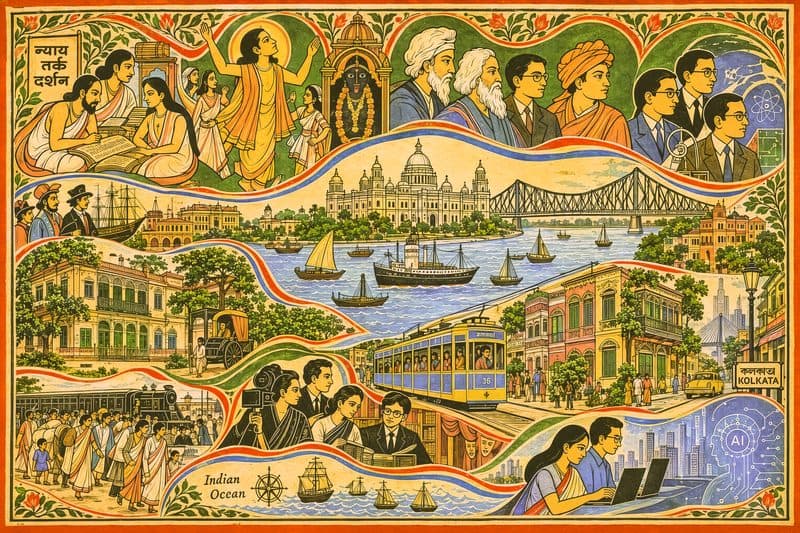
This awakening was not solely literary or socio-cultural. Centuries earlier, Bengal had eclipsed Mithila as the seat of Navya Nyaya (New Logic) — a tradition of rigorous syllogism and philosophical argumentation. This logical discipline organically underpinned the city’s later golden age of scientific inquiry through giants such as Jagadish Chandra Bose, Satyendra Nath Bose, and Meghnad Saha.
Around the same time, anchor institutions emerged where the discovering Occident met the “discovered” Orient. For instance, Sir William Jones, a friend of Edward Gibbon, studied Sanskrit at Nabadwip and founded comparative philology here. James Prinsep deciphered Ashoka’s edicts and then, physical vaults of knowledge were established in the Indian Museum, the National Library, the Imperial Record Department, and the Victoria Memorial (where Tipu Sultan’s diary is preserved even today).
In 1911, there came a landmark change. The British Indian government shifted the country’s capital to Delhi. This shift did not deeply affect the native Bengali psyche, which most commonly viewed it with relief. But European capital resented the migration strongly. The great UK managing houses such as Bird & Co., Andrew Yule, and Balmer Lawrie remained anchored through the Bengal Chamber of Commerce and Industry. Then, after the First World War, the aristocratic or middle-class Bengali bhadralok — once formidable as collaborators and then fierce as competitors of the Empire — lost ground to Mahatma Gandhi, to a community of empowered Muslims who were rapidly gaining influence, and to the incoming, financially astute Marwaris.
The Calcutta of yesterday and the Kolkata of today are driven by that very same mind. Shaped by geography, chiselled by history, and tested by the fire of Partition, this unique mindset is what Kolkata assembles and embodies. It is this unbroken, resilient continuum that explains the city’s distinct personality today and remains its greatest reservoir for the future
Gandhi made the all-India political mosaic far stronger than the metropolitan politics of Calcutta. Educated members of the Muslim community used British political reforms to gain leverage in the legislative politics of Bengal, while Marwaris used the unfurling business and industrial opportunities to become, financially, the dominant group in Calcutta.
In 1947, Mohammed Ali Jinnah wanted Calcutta to be part of his Pakistan, but Syama Prasad Mukherjee and others managed to forge a Bengali Hindu social coalition that succeeded in retaining the city in the truncated slice of West Bengal. Many Muslims, including their formidable leaders, left Calcutta for East Pakistan. In return, on trains and steamers, on foot and in carriages, came thousands of uprooted Hindu Bengali refugees from East Pakistan. The city of Bengali aristocrats transformed into a city of colonies for the uprooted and the displaced.
By the 1960s, class struggles and ethnic conflicts coalesced in tandem. The displaced, impoverished and radicalised Bengali refugees dominated the politics of West Bengal, while the economic levers remained with the upcoming Marwaris. Industrial unrest and even violence followed. Calcutta was described as the city of nightmares. Capital and enterprising talent both fled the city as fast as they could. The political culture became populist.
Yet even amidst this turbulence, the city’s intellectual core flourished through cinema, literature and theatre: the masterworks of Satyajit Ray, the refugee angst of Ritwik Ghatak, the radical theatre of Utpal Dutt, the writings of Sunil Gangopadhyay, the economics of Amartya Sen, and later, the incisive cinema of Rituparno Ghosh.
Today’s Kolkata occupies a strange half-world. Long written off as a dead city by those who measure worth only in commerce, Kolkata and, dare we say, Kolkatans, continue to exert a strange magnetism.
Kolkata cannot be written off, neither should it be reduced to mere romanticism, nor should we lionise all Kolkatans as intellectuals. The city was a global power node, and even while losing out for some time politically and economically, it remains one because of an abiding intellectual vigour forged over a thousand years.
Whether navigating the logic of Navya Nyaya in the 15th century, pioneering modern science in the 20th, or applying precise analytical thinking to the new frontiers of IT, data science, and Artificial Intelligence today, it is driven by the very “same mind.” The mind that produced Buno Ramnath, the highly revered 18th-century scholar, philosopher, jurist and logician from Nadia, is the exact same mind that animates Nobel laureate Abhijit Banerjee — with the same incisiveness, same penchant for the global, and same passionate curiosity about human nature.
The consciousness that animated the medieval saint Sri Chaitanya Mahaprabhu in Nabadwip to preach that all had equal right to chant God’s name is no different from the impulse that drove the austere — even if often misdirected — radicals in the 1960s to fight for all human beings to be treated equally.