An unflinching honesty, and a life as bold as the colours on her canvas. Amrita Sher-Gil’s work captured reality with a gaze that helped shape generations of Indian Modern Art. Her paintings, a study in juxtaposition. Her life, an endless exploration. Often called India’s Frida Kahlo, she depicted women’s stories and struggles, making India both her muse and her mirror.
“Europe belongs to Picasso, Matisse, Braque, and many others. India belongs only to me.”
Her origins are just as colourful. She was born in Budapest as Dalma-Amrita on January 30, 1913, to Umrao Singh Sher-Gil, a Sikh scholar from Punjab, and Marie Antoinette Gottesmann, a Hungarian opera singer. Even as a child, Amrita was illustrating Hungarian folk tales and the fairy stories of Grimm and Hans Christian Andersen.
The family’s move to Shimla (then called Simla) in 1921 introduced her to newer horizons and subjects. Encouraged by her uncle, Indologist and painter Ervin Baktay, she began using local faces and surroundings as models. At 16, she was expelled from her convent school for openly declaring herself an atheist and challenging the school’s orthodox atmosphere. Others say it was due to her early explorations into art, and for having been found painting a nude.
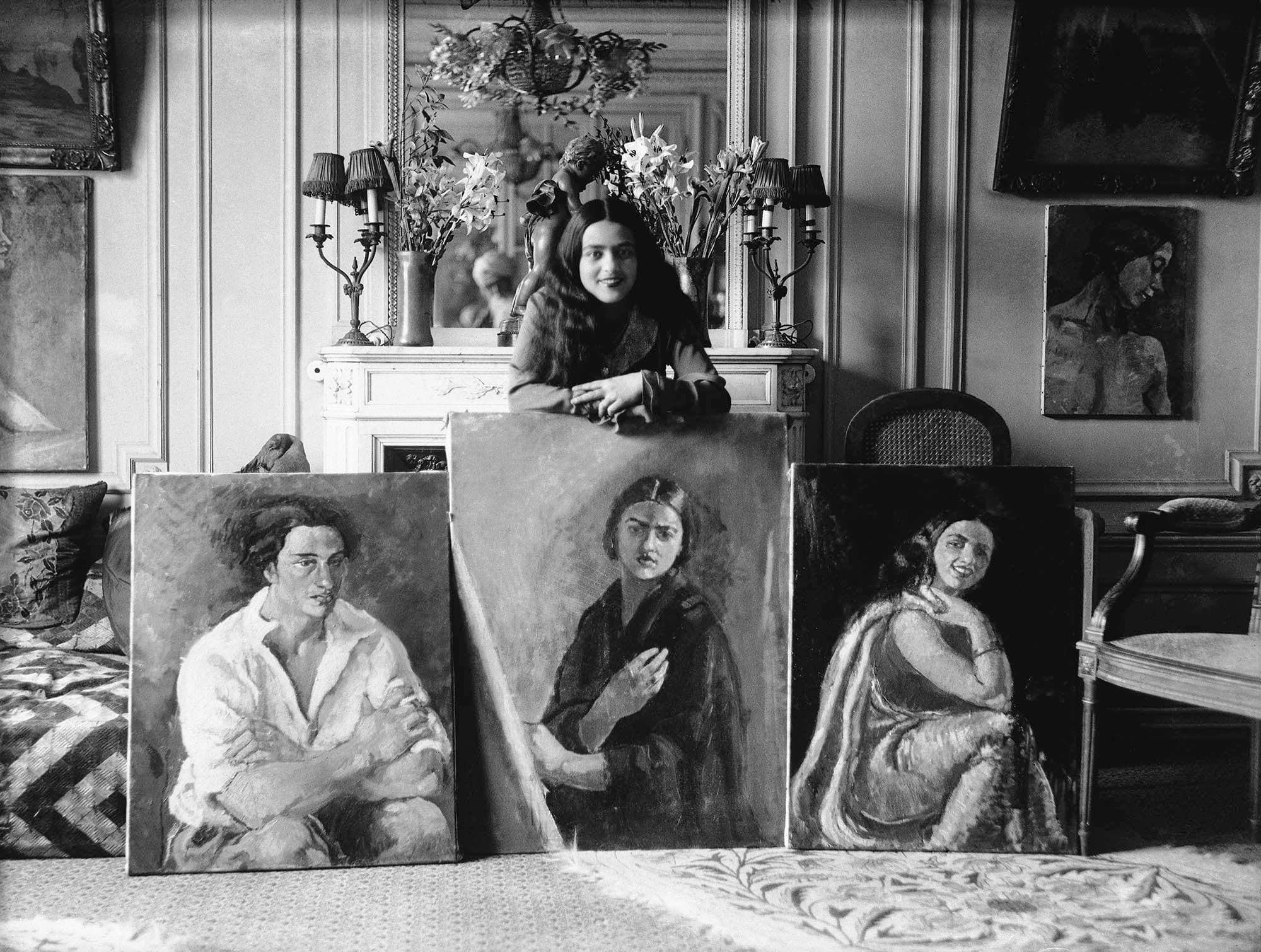
Soon after, the family moved to Paris. While her sister Indira studied music, Amrita pursued formal artistic training, an uncommon privilege for a young Indian woman of the time. She trained at the Académie de la Grande Chaumière under Pierre Vaillent, and then the École des Beaux-Arts, under Post-Impressionist painter Lucien Simon, inspired by Paul Cézanne, Paul Gauguin and Amedeo Modigliani.
A Scandal in Bohemia
Letters from this period show a young artist determined to live as intensely as she painted. This frankness, combined with her nude studies and self-portraits, contributed to her bohemian image.
Yet beneath the social façade were hours of figure study and self-critique. Attending salons and travelling widely, she also wrote sharply about art, identity and purpose. In 1924, she briefly attended Santa Annunziata art school in Florence, Italy, before returning to India.
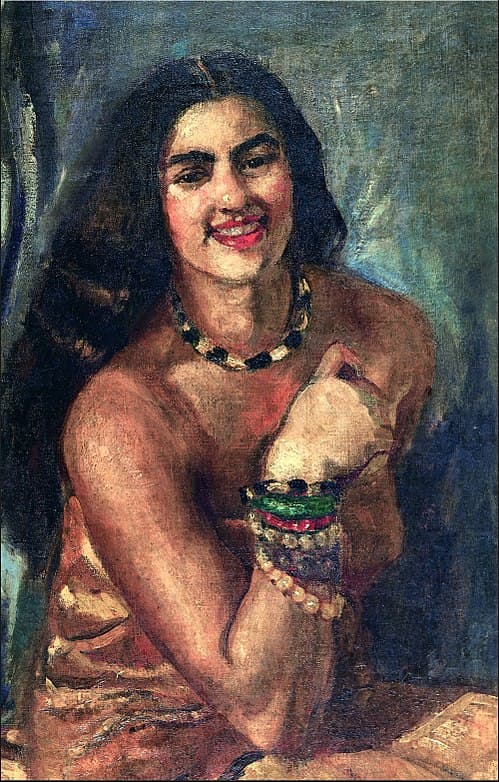
Amrita balanced technique with subjects that bordered on provocative. The frankness of her poses and the weight of her stare unsettled conservative sensibilities. Her Self-Portrait as a Tahitian (1934) shows up as a subtle dialogue with French Post-Impressionist and Symbolist painter Paul Gauguin, with a tone firmly her own. Her 1932 oil painting Young Girls earned her a gold medal at the Paris Grand Salon the following year. She was also elected an Associate — the youngest member and the only Asian artist to receive that distinction.
Yet Paris could not contain her for long.
Passage to India
Feeling that her voice would resonate most deeply with her own heritage, she returned to India in 1934. What followed was the relentless pursuit of an artistic identity.
“As soon as I put my foot on Indian soil, my painting underwent a change not only in subject and spirit but in technique.”
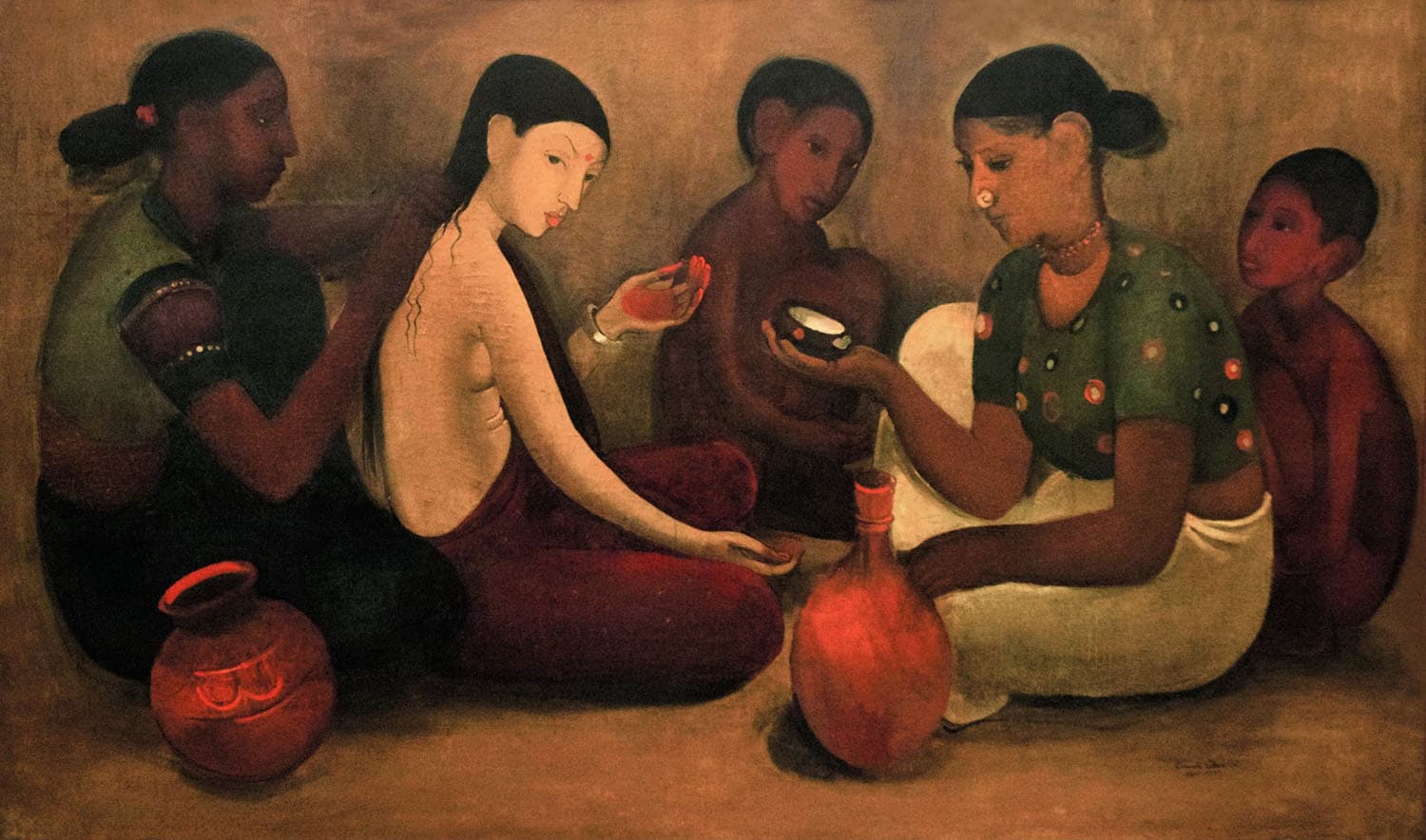
The frescoes of Ajanta and Ellora, rhythms of rural life and silent dignity of women at work or in repose became her subjects. Village Scene, In the Ladies’ Enclosure, and Siesta portray life in rural India. A 1937 journey through South India shaped her defining works — Brahmacharis, South Indian Villagers Going to Market and Bride’s Toilet. Her art fused Western technique and Indian soul, Parisian studios and dusky matriarchs, strong hues and flat strokes.
A Case for Identity
In 1938, she went to Hungary, where she married her cousin Victor Egan. A year later, they moved back to India, settling in Saraya, Uttar Pradesh. Here, she turned for inspiration to 17th-century Mughal miniatures, applying their composition and colour to the technique from the Ajanta paintings. This is evident in works such as Village Scene (1938), Woman on Charpai (1940) and Ancient Storyteller (1940).
Sher-Gil was also an evocative writer. Her letters and essays were compiled by her nephew Vivan Sundaram in the two-volume Amrita Sher-Gil: A Self-Portrait in Letters and Writings.
As in life, Sher-Gil’s death was also the subject of speculation. She died on December 5, 1941, at the age of 28 in Lahore, under mysterious circumstances, just days before a major exhibition. While it is said she died of peritonitis, there have been allegations of foul play as well.
In the Marketplace
- 2006: Village Scene fetched Rs 6.9 crore (1.5 million USD) at a New Delhi auction, the highest price for a painting in India at the time
- 2021: In the Ladies’ Enclosure (1938) was auctioned for Rs 37.8 crore (about 5 million USD) in New Delhi, making it the fifth most-expensive Indian painting ever sold
- 2023: The Story Teller (1937) broke the record for most expensive Indian painting ever sold (at Rs 61.8 crore, or 7.2 million USD) at that point. Today, it is the third-most expensive Indian painting on record.
A Symbol of Significance
Sher-Gil’s brief but brilliant career fundamentally shifted the trajectory of Indian art by merging a Western modernist sensibility with a deep, empathetic focus on the human condition. She remains an enduring icon of feminist agency, having reclaimed the female form from traditional idealisation to reveal the quiet strength and complex interiority of the Indian woman.
She was the first woman in India to represent herself and other women as conscious, introspective subjects rather than passive objects or goddesses. Her paintings, such as Group of Three Girls and In the Ladies' Enclosure, captured the melancholy, boredom, and resilience of women living within domestic and social constraints.
As a professionally successful woman who lived a bold and independent life, she paved the way for future generations of Indian women artists such as Arpita Singh and Bharti Kher.
In 1972, the Indian government declared her one of the Navratnas or National Art Treasures. A fitting tribute, for Amrita Sher-Gil didn’t inherit a language, she built one impossible to ignore.
India’s Navratna Artists (National Art Treasures)
In the context of Indian art history, the term Navratnas refers to a distinguished group of nine artists
Recognised under the Antiquities and Art Treasures Act, 1972
- Their artworks are declared National Art Treasures
- They collectively define the early trajectory of Indian modernism
- Their work is legally protected and regulated against export
The Nine Navratnas: Raja Ravi Varma, Rabindranath Tagore, Gaganendranath Tagore, Abanindranath Tagore, Nandalal Bose, Jamini Roy, Nicholas Roerich, Sailoz Mookherjea and Amrita Sher-Gil
Notable works
Self-Portrait (1930): Early, formal training in Paris.
Self-Portrait (untitled) (1931): Continued European influence.
Girl in Mauve (2) (1931): Focus on portraiture.
Hungarian Gypsy Girl (1932): Depicting subjects from her time in Europe.
Marie-Louise Chassany (1932): Portraiture.
Spanish Girl (1933)
Sleeping Woman (1933)
The Girl in Black (1933)
Self Portrait as Tahitian (1934)
Group of Three Girls (1935): A breakthrough work marking her return to India, winning a gold medal at the Bombay Art Society.
Hill Women (1935)
Two Women in White (1935)
Summer (1936)
The Child Bride (1936)
South Indian Trilogy (1937): Bride's Toilet, Brahmacharis, and South Indian Villagers Going to Market, marking a definitive shift toward Indian subjects and earthy, warm colors.
Young Man with Apples (1937).
Fruit Vendors (1937)
Village Scene (1938)
Open Air Painters (1938)
Tribal Women (1938)
Female Torso (1939)
The Bride (1940)
Ancient Storyteller (1940)
Two Elephants (1940)
The Swing (1940)
Woman on Charpai (1940)