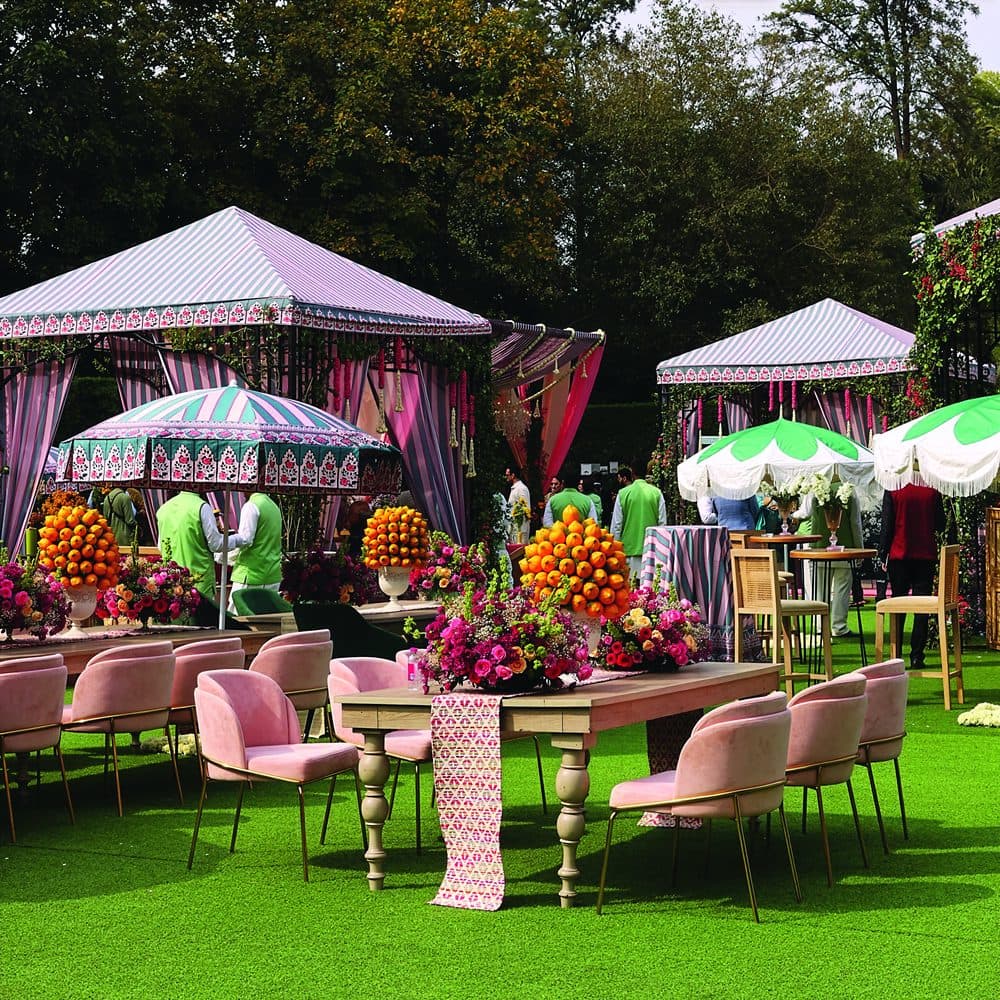
The caviar arrived before the baraat. Under a canopy of damask roses in Marrakesh, guests in Sabyasachi lehengas gathered around an ice sculpture while a chef shaved white truffle over miniature khichdi tarts. Servers circulated with flutes of Dom Pérignon. As one guest later put it, “For a moment, you forgot you were at a wedding.”
I was not there, of course. I am never invited to these things. But when a billionaire Indian NRI family based in Thailand recently took over every five-star hotel in Marrakesh for their son’s wedding and flew in 41 chefs from around the world to cook across the celebrations, enough details filtered through the grapevine for the world to take notice, with mild envy.
What happened in Marrakesh is no longer an anomaly. According to a 2024 Jefferies report, India’s wedding industry is worth an estimated AUD $185 billion, with Indians spending almost twice as much on weddings as on education. Across an estimated 10 million weddings each year, even small shifts in how affluent families think about food ripple through an enormous industry. At the very top, the shift is anything but small.
Among India’s wealthiest families, the fiercest one-upmanship is no longer about the decor, the performers or even the jewellery. It’s about the menu.
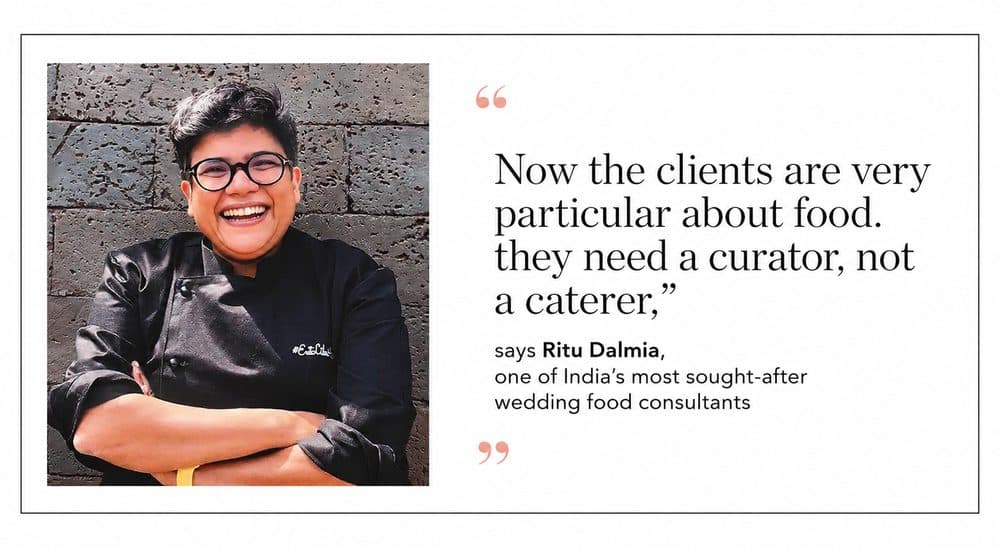
There was a time when wedding food followed a familiar format. One caterer. One sprawling buffet. Guests ate quickly and returned to judging each other’s outfits. “Earlier when one would go to a wedding, they would eat khaana beforehand because they knew it would be bulk cooking,” says Ritu Dalmia, founder of Diva, the celebrated Italian restaurant in Delhi, and one of India’s most sought-after wedding food consultants. “That has completely changed. Now the clients are very particular about food. They need a curator, not a caterer.”
The shift has happened in the last five to seven years. Rather than one caterer handling everything, families now commission specialists, a different kitchen for each cuisine, a different chef for each evening. In some cases, the bride’s family and the groom’s family each bring their own chosen chefs, operating parallel menus at the same wedding, a quiet culinary competition playing out beneath the shamianas.
“Clients are asking us to curate restaurants rather than buffets,” says Varun Tuli of The Yum Yum Tree Group. “Every meal is expected to have a unique identity and a narrative. Instead of saying ‘we want Italian,’ they’ll ask for a neighbourhood trattoria, a Tokyo ramen bar, a Sichuan mala dumpling house, a New York deli or a Mexican taqueria, each to be recreated with the same level of detail you’d expect from the real thing.”
Aditi Dugar, co-founder of Urban Gourmet India and Masque, identifies the deeper shift from variety to storytelling. “The biggest change has been from unabashed luxury to quiet, understated abundance,” she says. “Today, families want food that reflects their personalities, their travels and their memories.”
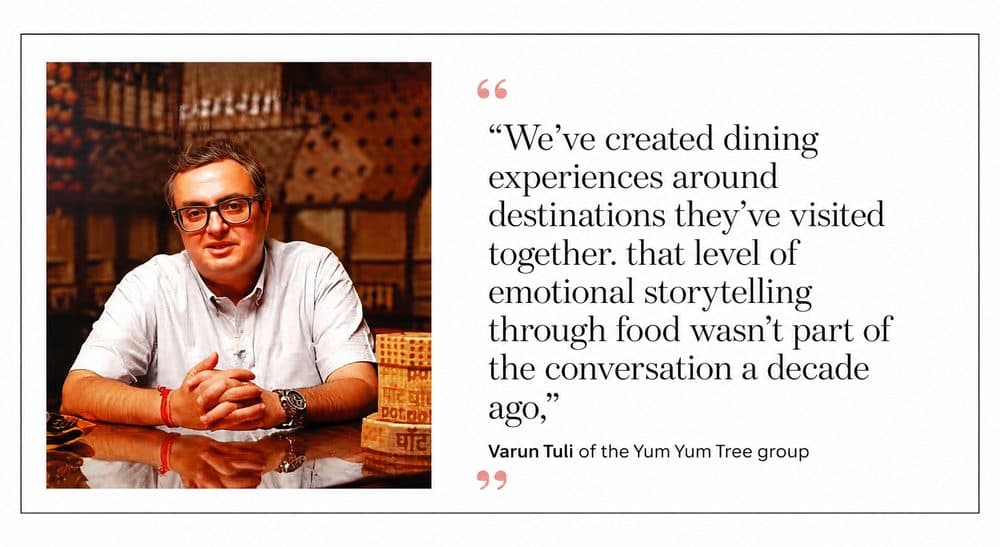
The most telling new trend is the biographical menu. Families commission food that traces the couple’s own story. “We’ve created entire dining experiences around destinations they’ve visited together, favourite street foods from childhood, or restaurants where they had their first date,” says Tuli. “That level of emotional storytelling through food simply wasn’t part of the conversation a decade ago.”
Today’s luxury Indian weddings unfold in two distinct worlds. Some remain rooted in India’s great palace hotels: the Rambagh in Jaipur, the Lake Palace in Udaipur, the Falaknuma in Hyderabad. Others travel the globe, taking over resorts in the Maldives, villas on Lake Como and Alpine ski towns. Wherever they take place, the expectations around food travel with them.
The food itself reflects a world with no culinary borders. Oyster stations maintain precise cold chains from coast to table. Rare Japanese strawberries appear on dessert buffets. Michelin-starred chefs are commissioned months in advance for a single evening’s service.
And then there are the requests that defy description entirely. “The last one I had was to have robots serving the food,” Dalmia says, with the measured tone of someone who has heard everything.
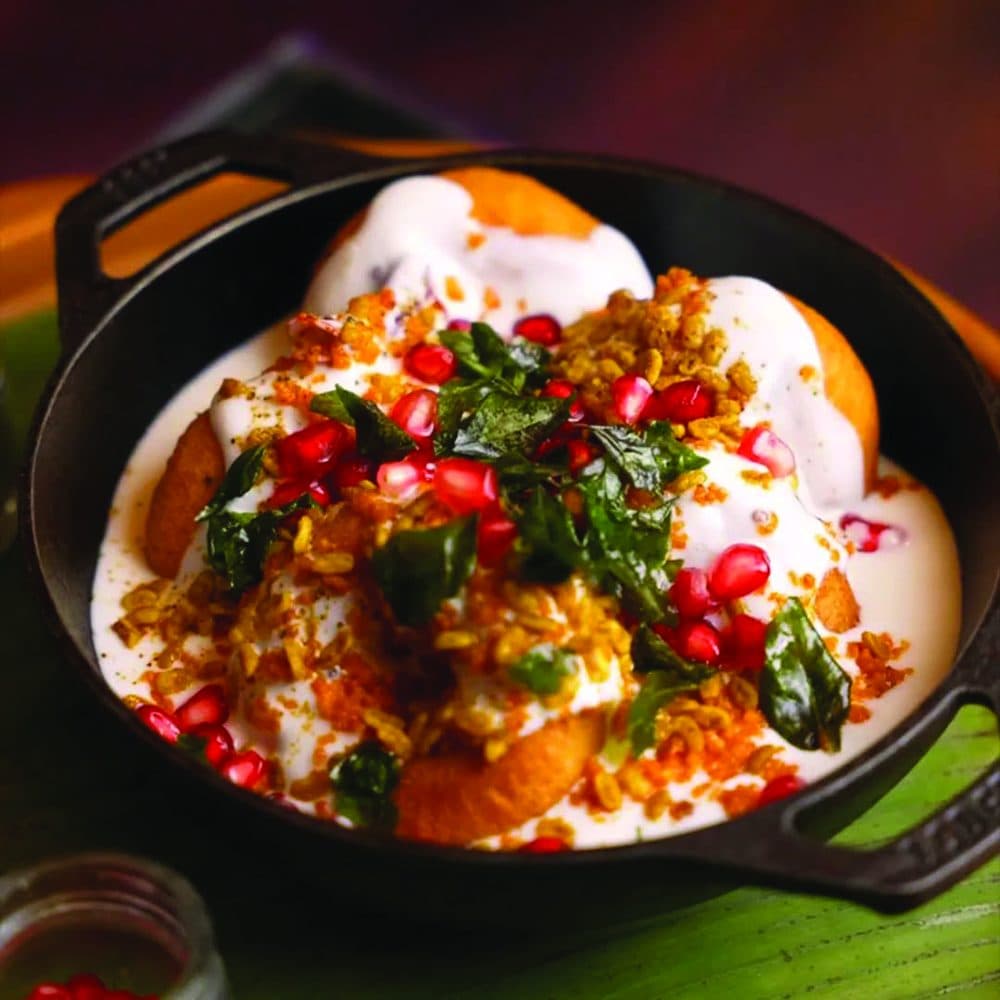
What hasn’t disappeared is regional Indian food. It has been elevated. The dal makhani still disappears first. The live Kulcha counter still draws a crowd. Banarasi chaat still commands the longest queues at midnight, now simply positioned beside a Beluga caviar station, each served in custom crockery under a dedicated spotlight. The Indian wedding has not abandoned its food heritage. It has given it a black card and a tasting menu.
“Less is more now,” says Dalmia. “They don’t want five hundred dishes. They don’t need hundreds of metres of buffet.” Dugar agrees. “Families really want the food piece to be super memorable. The more personal, the better.”
Food now accounts for a remarkable share of luxury wedding budgets. Dugar puts it at around 10-12 per cent on average, Dalmia says 14-15 if she’s lucky, while Tuli estimates food and beverage can account for as much as 20 per cent at the country’s most premium celebrations. What they agree on is that the absolute numbers are extraordinary.
AUD $185b — India's Wedding Industry
10–20% — Of Luxury Wedding Budgets Now Go To Food
41 Chefs — Flown Into Marrakesh For One Indian Wedding
AUD $150,000 — For One Evening With A Three-Michelin-Star Chef
10 Million — Indian Weddings Every Year
A kilo of white truffle hand-carried from Alba costs upwards of AUD $7,500. Premium caviar runs between AUD $300-$700 per hundred-gram tin. A three-Michelin-starred chef flown in for a single evening can charge up to AUD $150,000.
Social media has accelerated the race. Wedding food is now designed to impress not only the guests but the millions who will see it online. Every station is designed to be photographed before it’s eaten. Desserts are finished tableside with liquid nitrogen and drama.
And then, at 4am, when the sangeet has wound down and the guests are somewhere between elated and delirious, the longest queue is invariably at the Maggi counter. Not plain Maggi, of course.
Live-cooked Maggi, tossed inside a wheel of Parmigiano Reggiano flown in from Modena. You can spend millions on Michelin-starred chefs and imported ingredients, but at 4am, two-minute noodles remain the ultimate equaliser.
The irony is that the Indian wedding once represented the most democratic form of eating imaginable. Everybody ate the same buffet. Everybody stood in the same line for jalebi with rabdi. The modern luxury wedding has changed that. Food has become curated, deeply personal and, increasingly, the language through which families tell their story.
Jewellery goes back into the safe. Flowers wilt by morning. The band packs up. But the food stays with you. Guests remember the dish they could not stop talking about on the flight home. They remember the counter that ran out before they got there. The modern Indian wedding is no longer judged by how beautiful it looked. It is judged by what it tasted like.