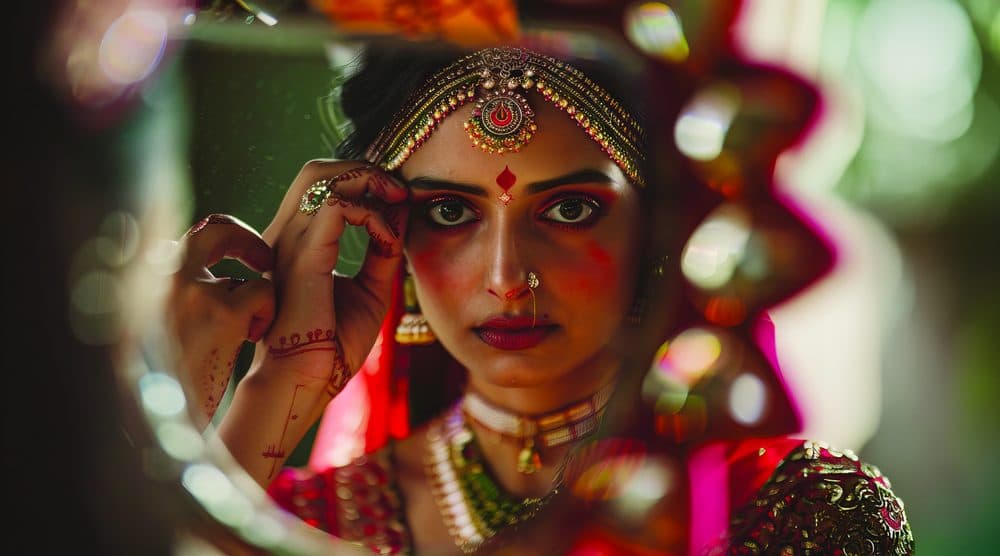
A flame-red dot framed by fine sandalwood lines. Eyes, kohl-lined and dream-filled. In every Indian wedding, the camera will seek, find and then zoom in on the bride’s forehead. Often, this gets more screen time than the sheen of the wedding silks or the sparkle of the bridal gold. And why not, when across a geography that is home to a thousand identities, almost every community writes on the forehead.
Placed over the Ajna chakra — the brow centre that yogic tradition associates with intuition, clarity and inner sight — this inscription is not just a decoration. It is a mark of identity, as well as an everyday call to the sacred. We are talking of course about the bindi.
Today, thanks to globalised beauty and mass manufacturing, the contours of the bindi have shrunk to a standardised, single red felt sticker in a plastic booklet. The only place where we perhaps still get to see it in uncompromised glory is on the Indian bride.
Women — and men — often transform into living canvases of provenance, a moving repository of ancestral motifs on their wedding days. Even if today’s brides reject a full-blown regional ‘costume’ in favour of a look that integrates all the identities they carry, the bindi usually stays true to her roots.
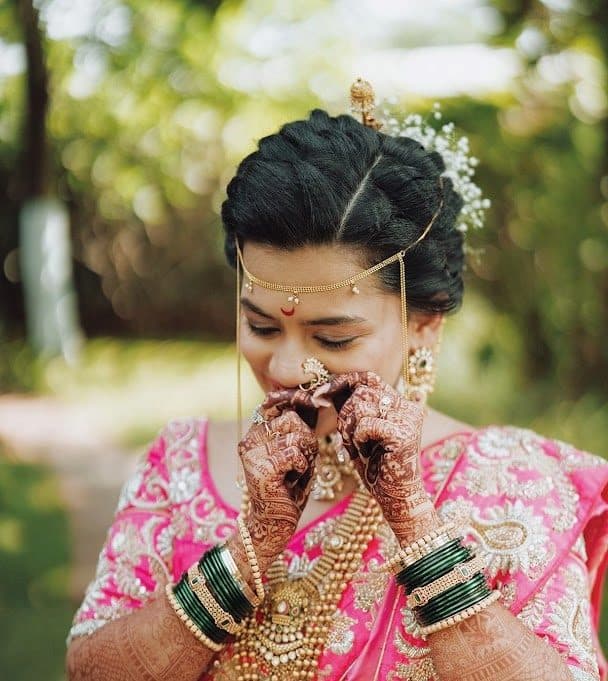
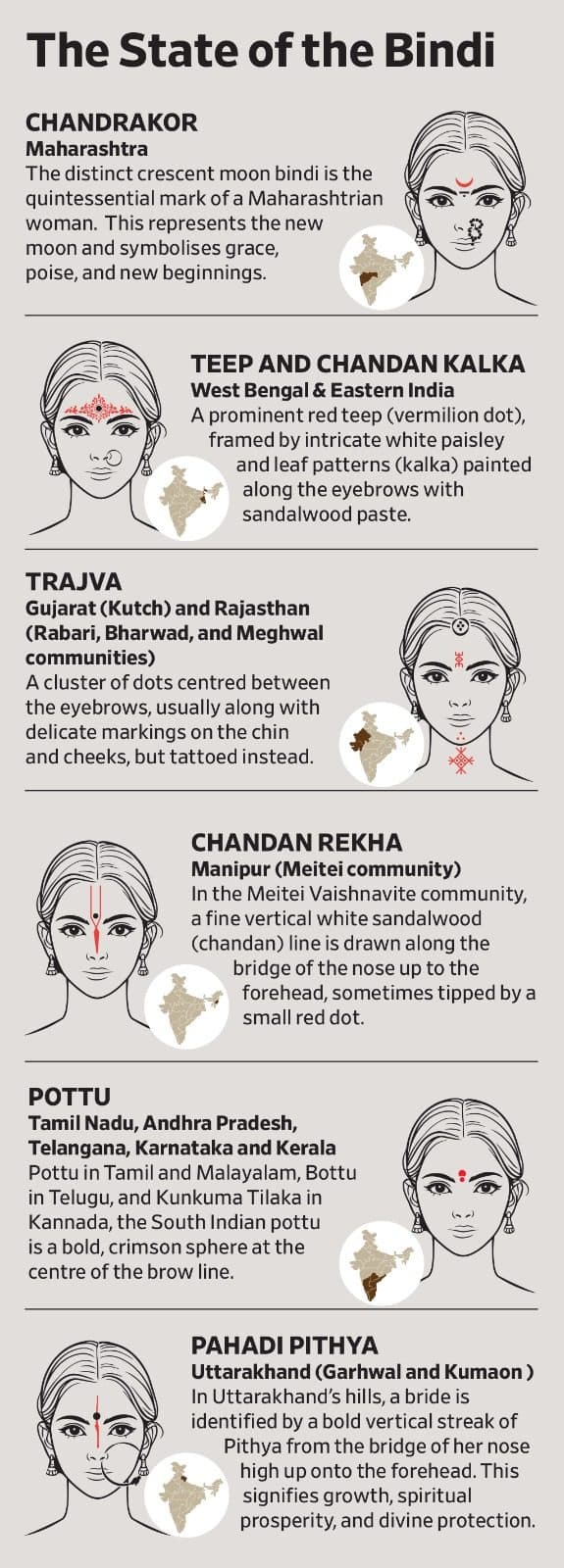
Take the Maharashtrian bride. The delicate upward-curving crescent moon, grounded by a single dot beneath its arc is one of the most distinctive bindi shapes. The chandrakor, as it is called, is a hard-working bindi, whose form carries both spiritual connotation and political history. It represents the new moon, and thus, auspicious beginnings. Politically, as a mirror of 17th century warrior king Shivaji’s royal seal (rajmudra), it has long symbolised Maratha identity, sovereignty and pride for both men and women. When the chandrakor is paired with the iconic pearl nath (nose ring) and for brides the mundavalya or pearl strands across the forehead, it is Maratha identity come to life.
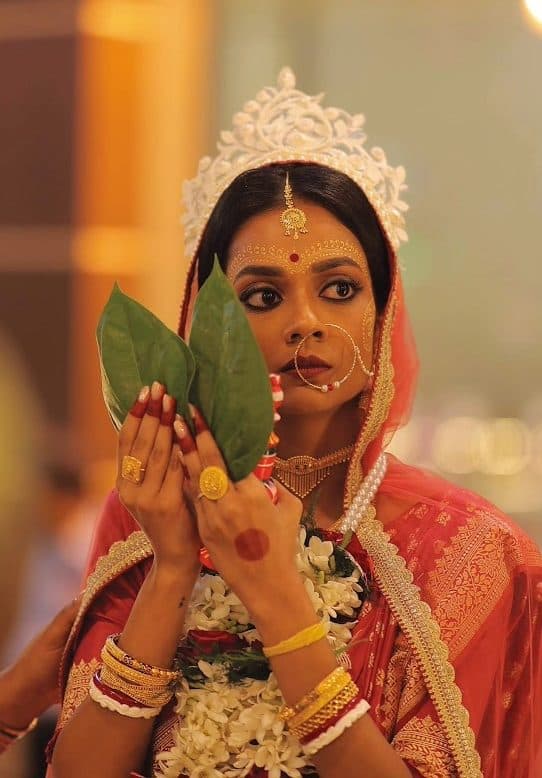
As we move across the country to the eastern coast of Bengal, the bridal bindi becomes a bold crimson circle, framed by intricate tendrils, paisley shapes and delicate dots that extend across the forehead down to the cheeks, known as chandon kolka or chandon alpona. The red dot both evokes and invokes Shakti — the fierce protective energy of the Goddess Durga — while the sandalwood calms and purifies.
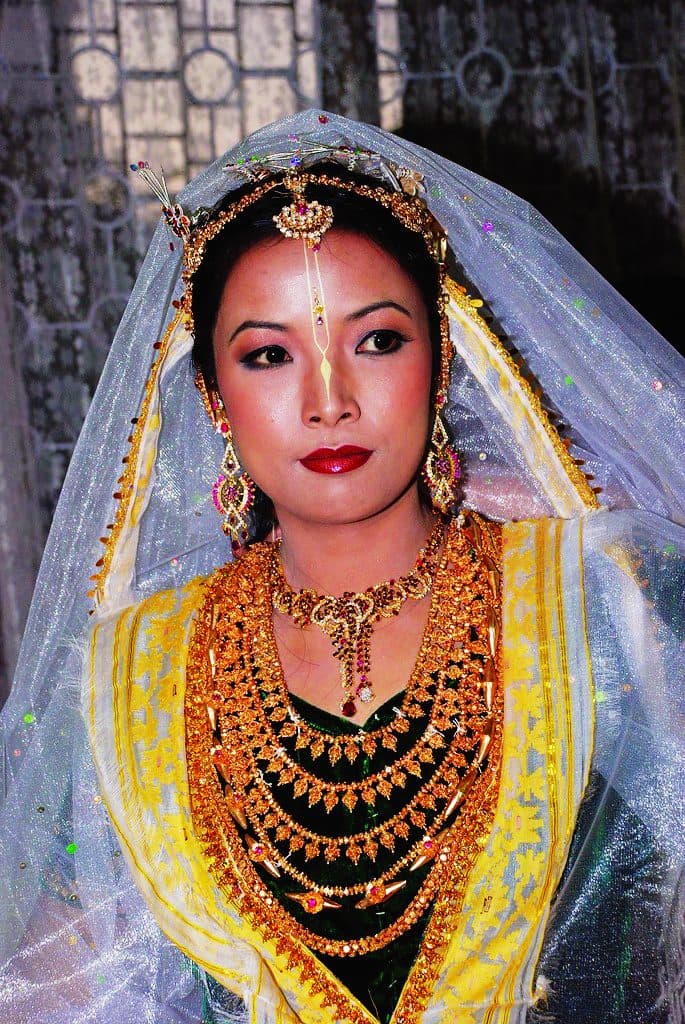
Further Northeast, in the lush valleys of Manipur, the Meitei Hindu bridal bindi signifies devotion and austere elegance. The Meitei chandan rekha is a pristine vertical line of sandalwood paste drawn down the bridge of the nose and extending upward to the forehead. This represents purity, surrender and a direct path between the human soul and the divine.
In the Himalayan valleys of Uttarakhand and Himachal Pradesh, bridal bindis are primarily markers of blessings rather than adornment. Elders apply the pithya tilak on the bride during the rites. A broad band of bright yellow raw turmeric paste is the base on which a dramatic vertical streak of vermilion is drawn from the upper nose to high on the forehead. This is said to represent the sacred peaks of the region and to invoke the protection of the mountain deities.
Down South, across Tamil Nadu, Andhra Pradesh, Telangana, and Kerala, the bindi is known as the pottu or bottu and during weddings, the kalyanam tilakam. This is usually a rich crimson teardrop or circle in the centre, flanked by vertical lines of white clay or sacred ash (vibhuti). Accompanied by rich Kanjeevaram silks, heavy temple jewellery and fragrant jasmine garlands, the pottu highlights the third eye of the bride with simple, precise grace.
And then there is the trajva. Here regional identity eschews temporary paints for indelible ink. Across Kutch and Saurashtra in Gujarat, among the pastoral communities like the Rabaris, women carry the trajva — permanent blue-black tattoos of desert creatures such as scorpions and snakes as well as configurations of dots — inked directly onto the forehead, chin and throat. Historically, these were designed to protect against the evil eye, and serve as a woman’s permanent personal ornament that was invulnerable to worldly hardships.
Each region in India has its own bindi grammar. What they all share is saluting the central importance of the space between the eyes as sacred, powerful and a marker of identity. For today’s brides, while the pull of the diamante bindi or an unmarked forehead may seem more tempting, perhaps there is some ancient wisdom and power in reclaiming these regional forms, at least in the bindi.