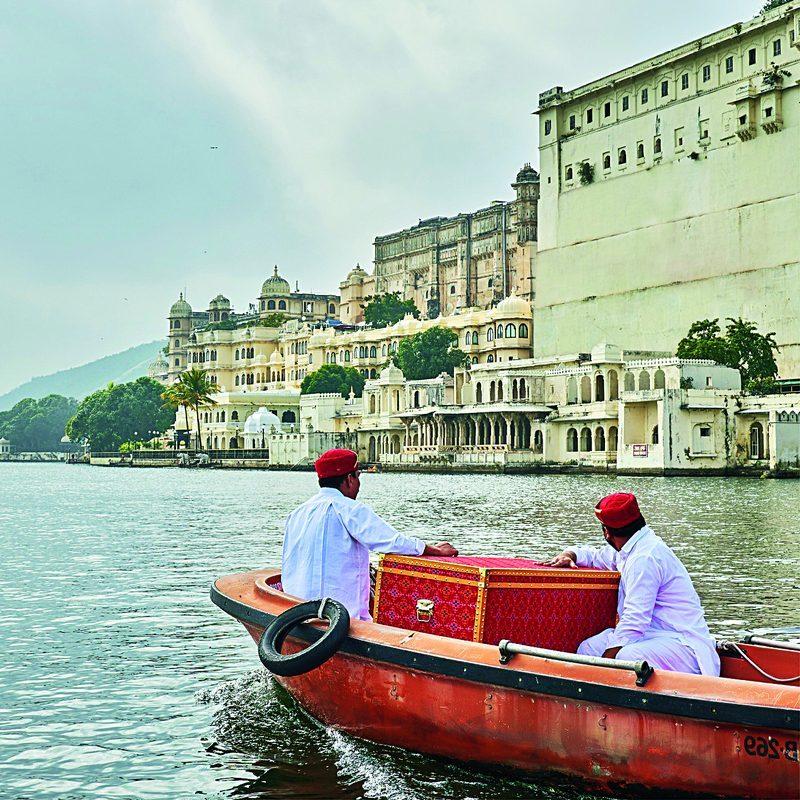
It’s a breezy evening at City Palace, Udaipur, as visitors thronging the historic museum pose outside for selfies and group photos.
Take a flight of ancient marble steps past the museum entrance, hang a left and climb four more steps. Adjacent to the impressive Mewar royal family tree — which includes the current Shriji Huzoor Lakshyaraj Singh of Mewar and his young son — one of the columned balconies reveals a striking sight.
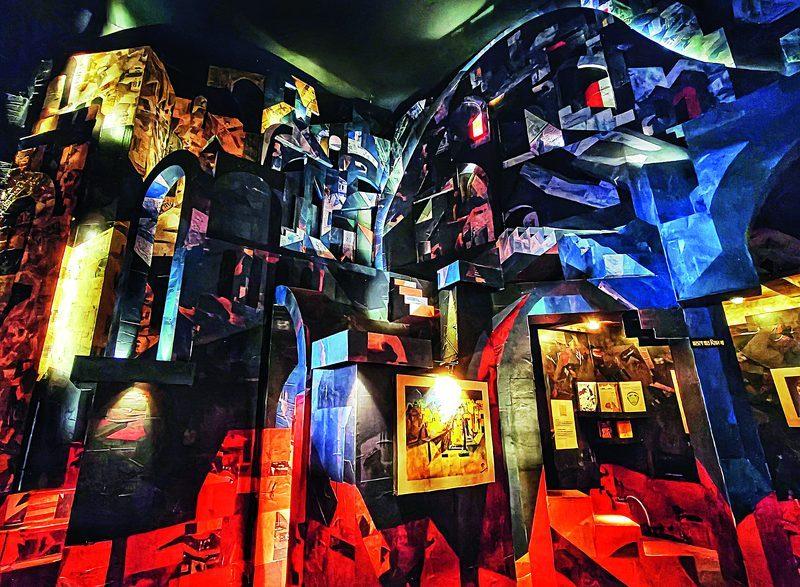
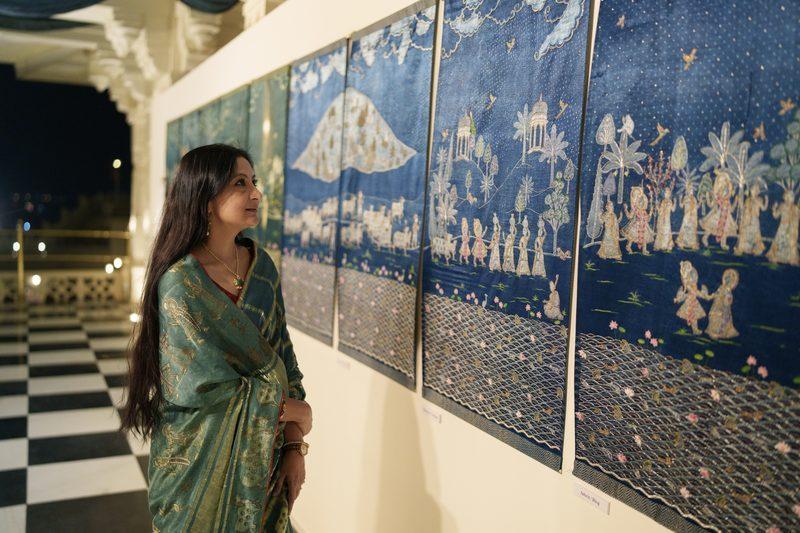
Here, the 12-panel installation ‘Sudarshan’ — literally an offering to Lord Srinathji (Lord Krishna) — by apparel and textile brand Aavaran in collaboration with the Maharana Mewar Charitable Foundation stretches side by side across the breadth of a space strewn with mudas (small stools). Mewari classical singers fill the air with devotional songs.
“These 12 panels are dedicated to Lord Krishna who found a new home in Nathdwara,” says Alka Sharma, founder of Aavaran. “These were brought to life through the processes of dabu (mud-resist block printing) and dyeing with natural indigo, along with surface embellishments such as zardozi.”
Dabu is a painstaking mud-resist, handblock-printing and dyeing process. The 12 panels, conceptualised by architect Abhijeet Karwa and designed by Krishita Sharma, underwent this process at the Aavaran workshop in the suburbs of Udaipur (Dabu was originally done by the Chippas of Chittorgarh in Mewar.)
What’s remarkable is that the installation shows the story from when Lord Srinathji came as an infant to Mewar with the first panel depicting his arrival (by mixed media artist Mohit Dochania), sent by Damodar Dasji, the premier disciple of Pushtimarg (the path of Grace, a sect of Vaishnavism founded in the 15th century by Vallabhacharya), from Mathura to Mewar. Here he encounters Maharana Raj Singhji of Mewar who offers Shrinathji protection from Mughal persecution, leading to the foundation of the Nathdwara temple, shown in subsequent panels.
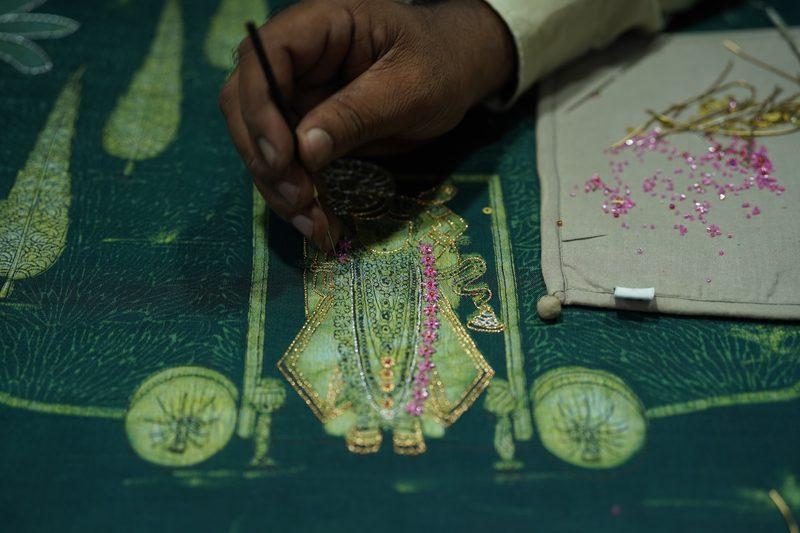
Each darshan/panel has a different mood — 12 seasons for 12 darshans/panels — from playing holi, to a mango-filled summer, to Lord Krishna dancing with his gopis (cowherd girl, his friends) in the moonlight, the monsoon, the swirling waters of the Yamuna, lotuses, birds and animals, the landscape and history of Mewar come alive in the indigo panels through dabu, and zardozi in pink, green, silver and gold thread.
“Through the efforts of Aavaran, the Udaipur-based organisation reviving the traditional art of dabu, this craft has gained renewed recognition, reaching national and international audiences,” says Shriji Huzoor Lakshyaraj Singh Mewar, chairman of the Maharana of Mewar Charitable Foundation, and 77th custodian of the House of Mewar.