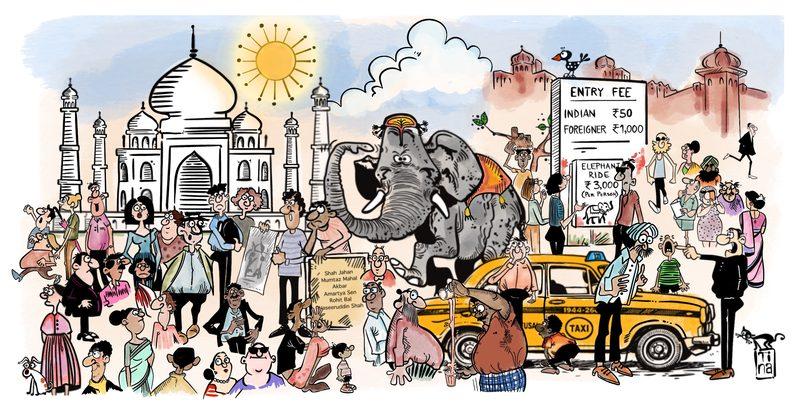
I’ve never taken a guided tour of the Taj Mahal, because like most Indians, I feel I know the history and there isn’t anything a guide can teach me. Shah Jahan loved Mumtaz Mahal very much, built her a mausoleum, lots of people died building it, lots of exhausted elephants, insane amounts of marble, it is exquisite — lately politically delicate — end of story.
However, on a recent trip I was fascinated to find a whole other history of the Taj Mahal that the local tour guides make up for foreigners who sign up with the faith that the history being narrated is true.
This is what one tour guide said to a German group. “This is the Taj Mahal built by the famous Emperor Shah Jahan, as an anniversary present to his wife. He was first cousin of Emperor Naseeruddin Shah, grandson of Emperor Akbar, brother of Prince Mohammed Siraj. His main advisor was Birbal, his court fashion designer was Rohit Bal, his court musician was Tansen, and his court finance minister was Amartya Sen.”
The Germans nodded, agreeing, nobody challenged him. One among the Germans, clearly a well-read Indophile, said, “Are you sure about all the names you mentioned? What about Jahangir”, to which the tour guide said, “Trust me sir. If we need Jahangir, I will tell you.”
Mentioning a Bollywood actor, a recently deceased Indian fashion designer, a Nobel-winning Bengali economist and an India XI test match fast bowler, within the context of the Mughal era, was fraudulent
I had to go up to this tour guide and tell him I’d heard most of his nonsense and while not entirely inaccurate about some of the facts, mentioning a Bollywood actor, a recently deceased Indian fashion designer, a Nobel-winning Bengali economist and an India XI test match fast bowler, within the context of the Mughal era, was fraudulent. To which he explained that Indians never take his tour and foreigners never correct him and while he’s not playing fast and loose with history, he’s tinkering around with tangential names that don’t matter anyway. That the times were tough and even though he’s got his tour guide certification, he’s really bad with names.
Dropping some contemporary names that sound 16th century — helps. He summed it up, irritated: “If the Germans don’t mind, what’s your problem?”
That’s when I realised there’s an entirely different India for foreign tourists and Indian tourists, which is, pardon the pun, foreign to us.
For one, the cost. It is exponentially more expensive for a foreign person to visit any museum or architectural site of historical significance, than a local. On the face of it, this seems less like patriotism and more like fleecing. “Give me your higher valued foreign currency, as I show you this Mughal or Rajasthani marvel that I control,” is the attitude it suggests.
Sometimes there are things that Indians feel are scams but foreigners love to do — like sitting on an elephant going up to Amer Fort in Jaipur. Clever businesses exploit it, charging ridiculous amounts.
Lately, foreigners have begun asking if the elephants are treated well — a business problem the exploiters didn’t foresee. It is fair to assume that if they’re cheating a tour group of British pensioners, it is unlikely they’re treating the elephant with fairness.
Luckily, the dacoit-like vibe that used to exist at Indian airports, charging foreign tourists three times the fare to get to their hotel, has stabilised now thanks to Tripadvisor and Uber etc, and a million warnings on Google and Chatgpt, guiding foreigners on the best way to navigate India. The catch though is one never knows whether a random bystander (which is literally everyone, if you’re a white tourist), means well or wants cash. No AI can tell that yet.