The air changes first. Before the lights go up or the pandals take shape, there is the late-September autumn breeze and the gentle sway of kash phool in the fields. It smells of shiuli flowers damp with morning dew and the faint, sweet warmth of roasting coconuts. For millions, Durga Puja is a profound ache of longing, followed by the purest joy of homecoming. And joy, in the Bengali sensibility, is so often tied to artistic expression.
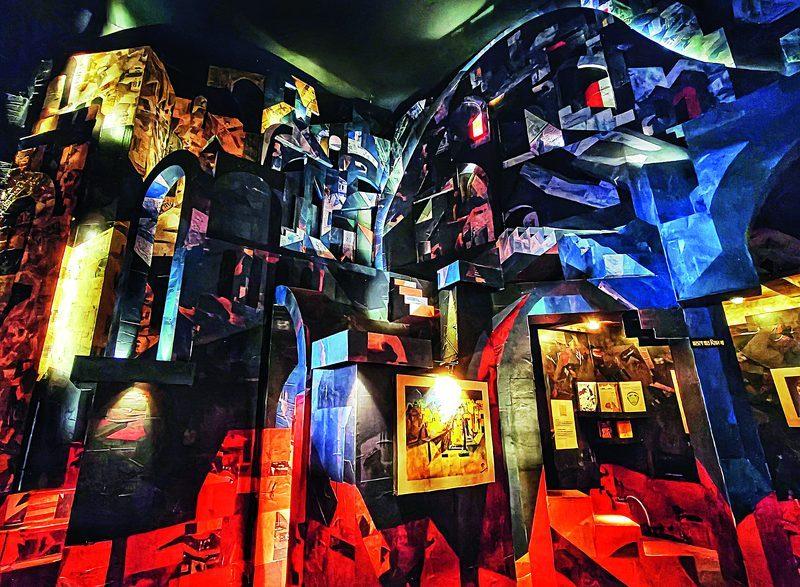
And so, every autumn, Kolkata performs a unique feat. Artists are commissioned, concepts developed, materials researched and sourced, teams assembled and entire neighbourhoods temporarily redesigned as immersive works of art. The city streets become exhibition halls and parks turn into fairgrounds of fantasy; sound, sculpture, painting, typography, light and performance are magically choreographed into a single — and singular — experience.
And, then, within days, almost everything comes down.
What Kolkata has evolved, particularly through the rise of the ‘theme’ Puja from the late 1990s and early 2000s, is a vast, decentralised exhibition system: one that returns every year and for which admission is absolutely free. The enthusiasts of this art show up in surges, on foot, around the clock. For a few nights, even sleep becomes negotiable for a city known for its particular fondness for rest and relaxation: people walk down familiar and unfamiliar lanes, and even an oft-visited street corner can hold the promise of surprise. Art historian Tapati Guha-Thakurta, whose work, In the Name of the Goddess: The Durga Pujas of Contemporary Kolkata, studies this phenomenon, describes the ‘theme’ Puja as having created “a new category of temporary public art”. Elsewhere, she calls Durga Puja “the city’s biggest public art event”.
Art and its expression have undoubtedly become central to the celebration of Durga Puja. In fact, the Pujas considered to be the ‘best’ are usually those in which an artist controls a visual language across the pandal, idol, materials, illumination and, increasingly, sound. Art educator Mousumi De was making the case for this as early as 2010. Kolkata’s Durga Puja installations, she argued, should be understood as public art because ordinary viewers actively engage with their artistic, spatial and temporal aesthetics in the streets, without the filters of class or specialist art knowledge.
The pandal has an author
Traditionally, different specialists might work separately to create the image of the goddess, erect the bamboo-and-cloth pandal and devise the lighting. The ‘theme’ Puja, however, increasingly brought these parts under an overarching artistic conception. Individual styles became more recognisable and, as a result, the artist or designer’s name began to gain prominence. Before long, Puja committees were competing to book sought-after artists mere months — sometimes immediately — after the previous edition of the festival ended.
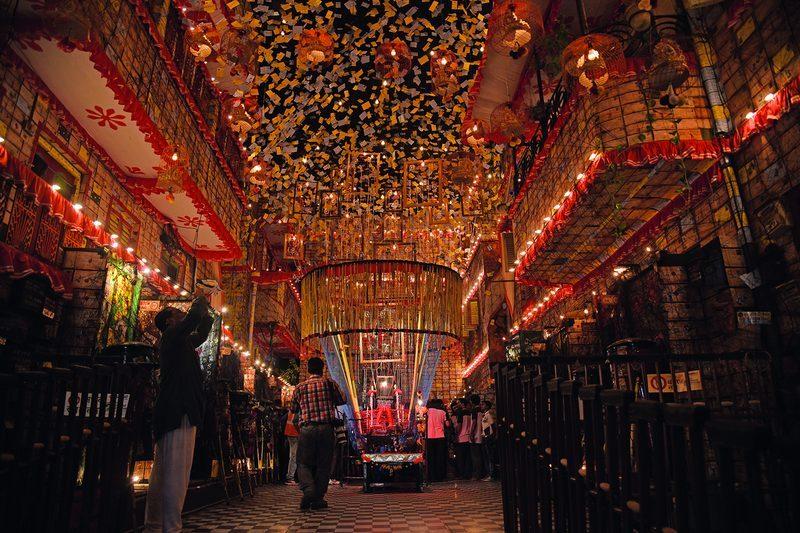
In 2010, at Nalin Sarkar Street in Hatibagan, artist Sanatan Dinda decided to treat a cramped north Kolkata lane as the actual site for sculpting the idol. This production included an Art Nouveau-inspired pavilion; in 2011 came a monumental boat along with nets, suspended frames, sculpture, lighting and the music of Lalon Fakir; in 2012, at 95 Pally, Jodhpur Park, he created a visual homage to M.F. Husain. Thus, instead of the goddess sitting still inside the pandal, the pratima, the pavilion and the passage ended up forming a self-contained, authored environment.
Elsewhere, Bhabatosh Sutar pushed the boundaries of this artistic language. At Natunpally Pradeep Sangha in Lake Town in 2006, his Shabdokalpon (The Realm of Sound) used cave-like forms, earthen surfaces, water pitchers, bells and other objects to make sound a crucial part of the installation. At Khidirpur 25 Pally the following year, drawing inspiration from an 18th-century Ramprasad Shyamasangeet, he turned agriculture into an abstract sculptural landscape of ploughs, stalks and other symbols of cultivation. Significantly, Guha-Thakurta records that the three Puja commissions Sutar took each year became the principal financial support for his more experimental art practice, which itself generated little income. Durga Puja is not an extraneous part of the artist’s life; for some, it makes that life economically possible.
Nor is creativity confined to a small canon of stars. Sushanta Pal’s 2010 Parar Pujo at Badamtala Ashar Sangha extended the artwork beyond the pandal by persuading residents to allow the surrounding neighbourhood itself to be repaired and painted as part of the composition. Guha-Thakurta calls the result a rare example of public art that temporarily made the para itself the canvas.
The experiment continues

A new generation of artists is keeping the ball rolling as far as innovation and change are concerned. In 2023, Anirban Das and his team transformed an entire north Kolkata lane into a black-and-white world inspired by Sukumar Ray’s Abol Tabol, painting house fronts and lamp posts so visitors appeared to walk into an illustrated page. Two years later, at Dum Dum Park Tarun Sangha, Das crossed Sharadindu Bandyopadhyay’s Byomkesh Bakshi with the visual vocabulary of 1950s and 1960s pop art. The pandal became a giant comic strip, complete with painted speech boxes, live performers and an oversized installation titled Byomkesher Diary. One might think that literature, theatre and visual art would have been parallel attractions at the Puja; on the contrary, they actually became a cohesive, integrated piece of immersive storytelling.

A few years ago, Krishanu Pal’s Samaj Sebi Sangha installation took as its subject the creative economy of Durga Puja itself. Pal told Architectural Digest India that his team of 60 to 70 included decorators, fabricators, sculptors, painters, sound designers, music directors, lighting designers and electricians. Bimal Samanta, who began as a painter of signboards and film posters, covered Ballygunge Cultural Association with metal, aluminum foil and hand-rendered Bengali poetry, while his daughter Suchana Samanta Adak worked on the Shibmandir Puja.

The boundaries widened again in 2025. At Tridhara Sammilani, contemporary artist Shilo Shiv Suleman collaborated with Rajasthan’s Lohar blacksmith community on Dhwani, a 12-feet, 150-kg sculpture conceived around Kundalini energy, curated by Myna Mukherjee and set against a black-themed pandal by Gouranga Kuila. Here, fine art, folk metalwork and Puja design all came together on the street. As Mukherjee put it, the point was to insist that “art belongs to everyone, not just to the privileged few”.

For here is Durga Puja’s most radical proposition: art does not need to ‘survive’ in order to be valuable
The economy behind the spectacle
This annual burst of invention also corrects a persistent, romanticised idea about art: that artistic freedom is antithetical to the question of commerce. Durga Puja is, quite unequivocally, a commissioning economy on a formidable scale. In a British Council study of the 2019 Durga Puja creative economy, conducted with research led by Queen Mary University of London and supported by IIT Kharagpur, 35 per cent of respondents said that Durga Puja supplied 81 to 100 per cent of their annual income, while 92 per cent of Puja organisers reported spending more than 20 per cent of their budgets on paying artists.
That is why the ‘industry’ that is Durga Puja cannot, in any way, diminish the festival’s artistic heft. If anything, the opposite is true: commissions create the conditions under which artists can build their practices, employ teams, train apprentices and take creative risks. Ballygunge Cultural Association’s general secretary, Saptarshi Basu, said that it is “staggering to see how many livelihoods depend on this industry”.

The art of disappearance
The festival’s joy is always faintly shadowed by its ending: Bengalis know that these days will vanish almost as soon as they arrive. For here is Durga Puja’s most radical proposition: art does not need to ‘survive’ in order to be valuable. Every year, the likeness of the goddess is made with the knowledge that immersion inevitably awaits her; the pandal is built with the knowledge that the street must shortly return to daily, more dreary uses. Guha-Thakurta describes Durga Puja as a “mercurial artistic entity” in which works are destined to be destroyed, dismantled or recycled. The labour behind the entire exercise is of added significance precisely because permanence is not the objective.

As such, it is perhaps in this transience that Durga Puja comes closest to the spirit of contemporary installation art. The fleeting, ephemeral nature of this astounding display of public art is what differentiates Durga Puja from other festivals celebrated with a cultural-religious foundation. After all, the city did not build a festival on this scale to preserve masterpieces.
In the blink of an eye, it will be gone. The goddess will take her leave, the gallery will disappear, and the artists will go back to their (other) lives. And that is quite alright. After all, everyone knows that next autumn, the city will light up again.
Photographs: Durga Puja: The People's Festival, Amit Datta, Amit Ghosh