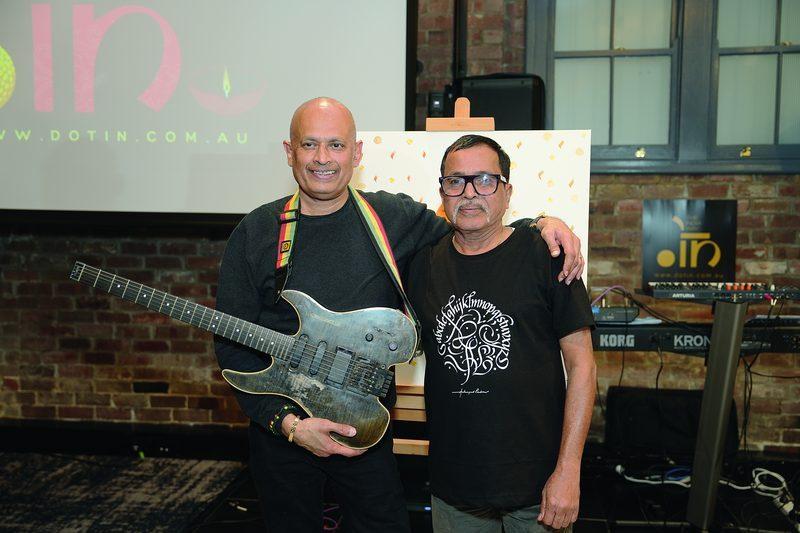
Amid a live audience of over 100, two distinct artistic forces met on stage for the first time: acclaimed singer-songwriter and guitar maestro Roy Venkataraman — celebrated across the Indian independent music scene and internationally renowned for his stint with legendary reggae band The Wailers — and Padma Shri Achyut Palav, the iconic master of Indian calligraphy. A meeting barely hours before showtime, no rehearsals and an unknown format did not deter the duo from engaging in a first-in-Australia, spontaneous interdisciplinary duet.
ROY VENKATARAMAN reflects on reading the room, guitar textures being translated into visual brushwork and connecting dots on stage…
Take us back to that room. The first feeling that pops up.
Tension. This was a tightly-packed programme, arranged minute-to-minute. I could see beautiful dances being performed, a lively group of people and we had yet to hit the stage.
What was the planned set?
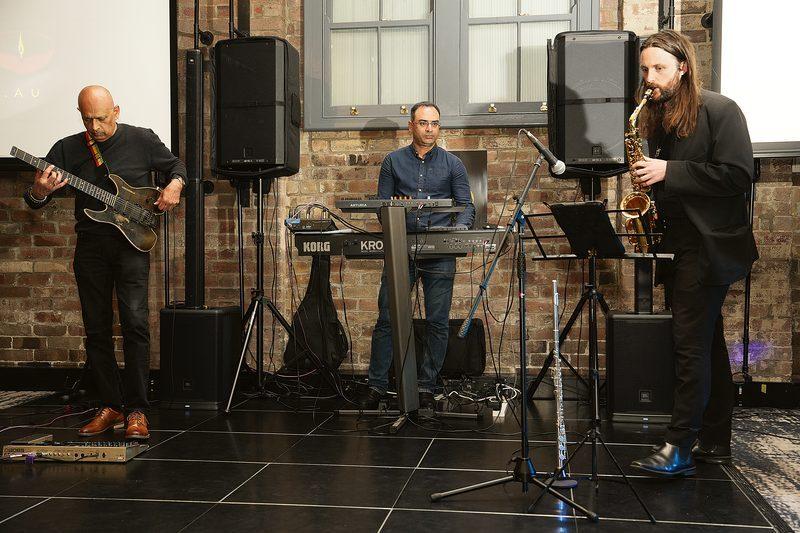
I had written some music recently. Once I came to know about the party, it seemed like the perfect occasion to play these new tunes to the audience.
What were your first thoughts when this live jugalbandi (duet) was proposed to you?
That this sounded really interesting! As an artiste, I love the idea of anything not just aesthetic, but creative and out-of-the-box. Plus, jugalbandis have always been an exciting aspect of Indian performing arts traditions.
Had you and Achyut met earlier?
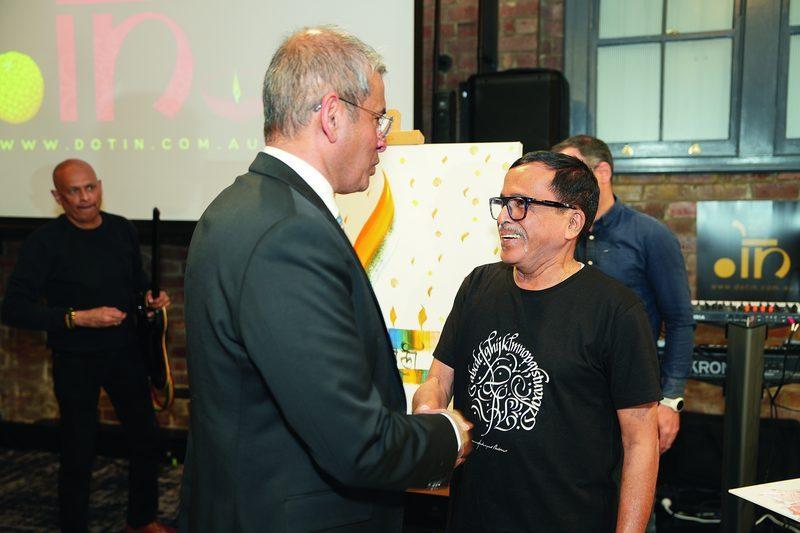
We met for the first time at 6 o’clock that very evening!
Did you want the duet to be that organic?
Before the programme, I did definitely wish we had met earlier. That said, there is no doubt our collaborative exercise worked out rather well in spite of the fact that we didn’t get to speak much.
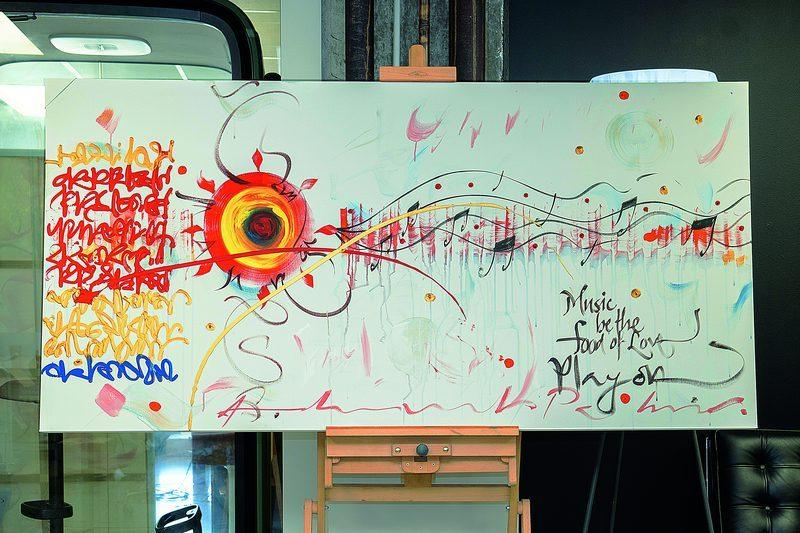
We hadn’t decided on anything exact — he told me the vibe he wanted. First, a nice chilled-out atmosphere. Then, a building up of sorts — this was a 10-minute improvisation piece together. He wanted the third piece to feature a very percussive, Indian rhythm vibe. My experience in some percussion-heavy work back in India came to the rescue — so I layered my guitar over those rhythm tracks. The result was not just the process but also another beautiful piece of calligraphic art.
Could you see him as he was painting?
I couldn’t see all of it clearly from where I was placed on stage. But I could see enough to figure out what he wanted. Almost, what he needed.
And what I was feeling, as well. When you’re live and improvising, you just have to play what you feel at that point. He was doing some amazing work.
In this duet between a performing artiste and a fine arts practitioner, how much of your response came down to experience?
All of it. My experience enabled me to read what he needed in that place and time. And it was his experience that allowed him to trust me.
The main presentation was completely spontaneous from the second he said, “Let’s go.” He just went for it. I was completely locked into what he was doing, composing right in that moment.
Those who do not create art often think there is a natural talent in us, that wonderful moments are created in that instant. Such moments are often spontaneous. But, they are so only after a certain level of experience, a certain number of decades of sadhana. There is immense preparation behind one single note of genius.
So, yes. This was possible because of our collective experience, not just of domains but about people and life.
Would you be able to recreate what you played that day?
With my guitar parts, no. I always just go for it and thus it was improvisation. The base music was written, but what I play over it changes. As they say, you can’t stand in the same river twice.
When you finally saw the completed paintings, did you feel your notes reflected in his brushwork?
Oh yes. Wonderfully so. I could see what I felt while playing — space, openness, dots — become translated on paper. Whenever we practice any art, we’re surrounded by infinite dots. In each piece, we’re just connecting those dots in a unique manner. Music is finally a spiritual connection with other human beings.
And what did Achyut say about your music afterwards?
That he loved it! He appreciated how I followed all the moves he was making. He felt that energy from the right vibration.
I must tell you, however, that a crucial part of all this was his personality — he’s such a lovable, down-to-earth, open person. That warmth made me feel comfortable right away. For those 15 minutes, only the two of us existed for each other. It was a dance in a different form.
ACHYUT PALAV on alchemising sound into visual brushwork and connecting the dots…
Roy and you met only about an hour prior to the event. Do you prefer that raw, zero-rehearsal energy?
We didn’t talk at all, beyond basic introductions. Also, Roy prefers to talk through his music. I have done live collaborations before, but this was a first for me because I was quite unaware of the music or the musicians. Then, I was also jet-lagged.
So, I was nervous, because it is a collaboration after all. And not always is something organic a hit.
How did you approach the exercise?
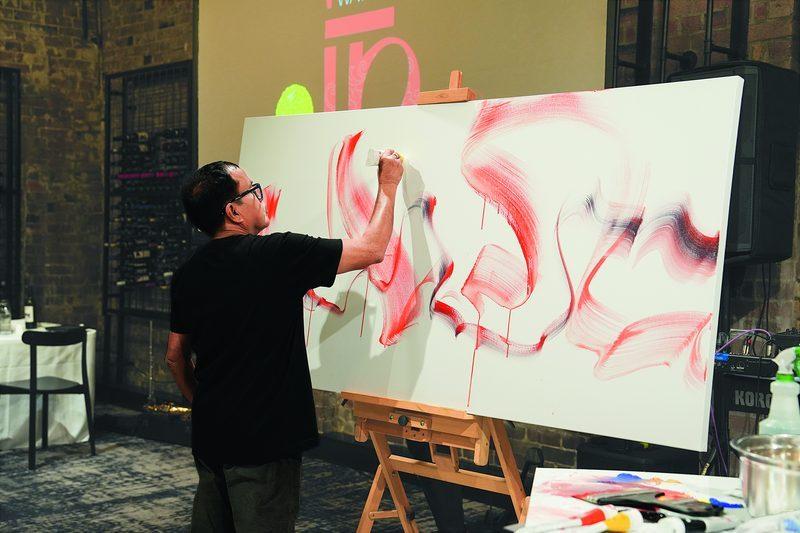
It is extremely important to respect the expectations of the audience. Especially the expectation of excitement. The wow factor. It is the painter’s responsibility to immediately translate sound on paper. That correlation of the music with what is being drawn decides the collaborations’ success.
Whenever I needed it, I asked Roy to play a little faster and he did. That way, there is no chance of boredom.
Tell us how you think about such a process.
Listening to music while creating is part of my process anyway. Who knows how much that music guides my painting? I am especially drawn to folk and classical music. I do not really ‘understand’ classical but there is no doubt it gives me a creative energy and force.
But those vocal movements of theirs, their harkatein, today makes me think, “From this movement, my line can also move like this.”
Why did you request a percussion-heavy track for the end?
It was Diwali, after all. As I heard the music I drew from the dots that surround us. I drew a few dots, and then a diya and a lotus from the dots.
It seems you had not eaten till the evening was over!
Well, this was a live show.
People have to see my body language, my excitement, my immersion, my joy as well.
I am also a performing artiste in such a moment at such an event. Not only a calligrapher, a painter or a designer. Once everything was done, I was happy with the omelette they rustled up.
Were people watching you and not just the canvas?
Of course. People were watching me with great absorption. Afterwards, they spoke to me about how I connected with the music. The answer to that is simple, and yet not. If you do not understand a little music, you cannot respond to it. As one’s ear develops, one can anticipate the next note.
Finally, I am a designer as well. I have to experiment with different treatments. Rollers, flat brushes, the paint tubes themselves and even a tub of water — they were all my instruments.
Our readers see your calligraphy in every issue. How was that experience of bringing your paper art into a dynamic, live show?
I think that day I served as a medium between music and paint, and by doing so, I became one more brick in the bridge between Australia and India.
This is not an empty claim. This feeling was there in the room that day with all of us. All I can say is that the Consul General, Dr S. Janakiraman, said, “Create some unique work on the India-Australia relationship and we will try and ensure that it reaches a large audience.”
And at the end, what was your vibe with Roy like?
Do you know that one of the first such live collaborations was between two maestros of their own art forms, Pandit Bhimsen Joshi and M.F. Hussain in 1988?
This had taken place at the Tata Theatre, Mumbai to raise funds for the Bombay Art Society. Panditji sang live and Husain translated the abstract sounds into brush strokes on a massive canvas while the notes still vibrated in the air.
These were two greats. For Roy and me, we just trusted the intent and craft of the other and let the process paint its own song.