Key Highlights
- India developed sophisticated systems of astronomical observation and timekeeping long before the arrival of European mechanical clocks
- Ancient Ujjain served as the prime meridian of Indian astronomy and remains the reference point for Hindu almanacs
- Maharaja Sawai Jai Singh II built five Jantar Mantar observatories to improve astronomical accuracy and calendar calculations
- The Samrat Yantra at Jantar Mantar can measure time with remarkable precision, accurate to within two seconds
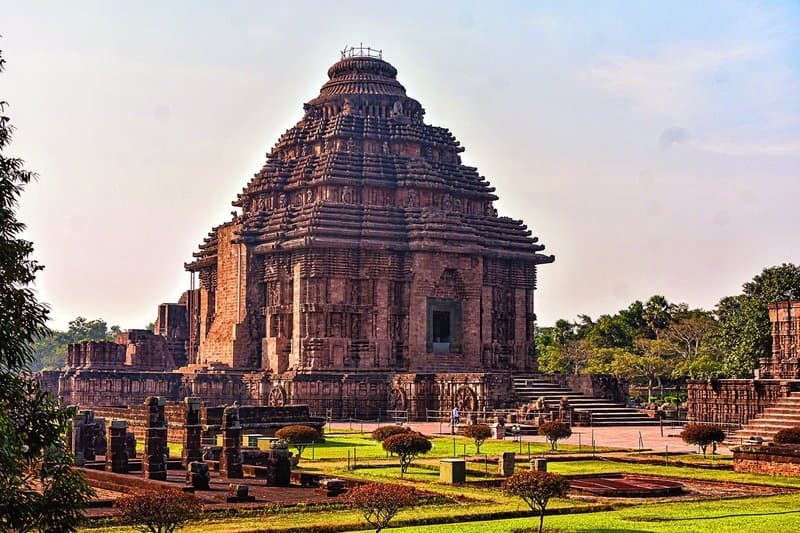
- Konark Sun Temple’s iconic stone wheels are believed to function as highly accurate sundials
- Brihadisvara Temple showcases the Chola dynasty’s advanced understanding of solar orientation and ritual astronomy
- Modhera Sun Temple and Vidyashankara Temple demonstrate how astronomy, architecture and spirituality were deeply interconnected in India
When the English ambassador, Sir Thomas Roe, arrived at the court of the Mughal Emperor Jahangir in 1616, he carried gifts Europeans imagined would dazzle an oriental monarch — glassware, mechanical curiosities, and, most tellingly, a clock: a precision object from Europe, and a symbol of its mastery over the measurement of time. Colonial-era accounts tell us that Jahangir received it with polite indifference — an episode read by generations of historians as evidence that Indian civilisation lacked interest in precise timekeeping, or that ‘scientific’ notions of time arrived only with Europe’s mechanical clock.
Nothing, however, could be more incorrect. Long before mechanical clocks entered Indian courts, the subcontinent had evolved some of the world’s most spectacular traditions of monumental timekeeping. India went beyond measuring time through portable instruments to studying it through architecture itself: giant observatories, temple alignments, stone wheels, shadow-casting towers and geometrically calibrated sacred spaces. If Europe miniaturised time into the ticking clock, India monumentalised it into landscapes of stone.
To understand India’s relationship with time, one needs to begin not with a monument but with a city. Ujjain, the ancient Avantika, served for centuries as the Greenwich of India. In classical Indian astronomy, the prime meridian passed through Ujjain. Even Ptolemy acknowledged “Ozene” as a pivotal reference point, and even today all traditional Hindu almanacs are computed with reference to Ujjain time. Long before Greenwich was a village of any consequence, Indian civilisation had established its great centre of timekeeping on the banks of the Kshipra (or Shipra) river.
The Jantar Mantar
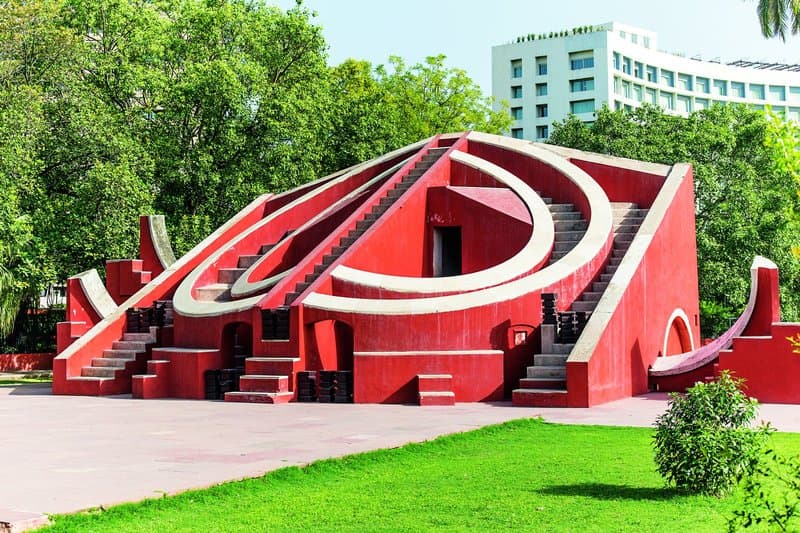
The Jantar Mantar — a collection of astronomical observation sites built by the 18th-century Rajput ruler, Maharaja Sawai Jai Singh II — have pride of place in India’s history of timekeeping. He built his Vedh Shala — the Jantar Mantar of Ujjain — around 1725, honouring a tradition that stretched back two millennia. Its instruments were used to compile the Panchang, the annual almanac that schedules everything from festivals and harvests to weddings and cremations. This was astronomy that regulated an entire civilisation’s daily life.
Ujjain, however, was not the first. Jai Singh commissioned the first of his five great observatories in Delhi in 1724, followed by Jaipur, Ujjain, Varanasi and Mathura. They were the most sophisticated astronomical instruments of their era, and in certain respects outperformed their European contemporaries. The Delhi Jantar Mantar was built to correct what Jai Singh saw as dangerous inaccuracies in existing astronomical tables. In an age when the timing of eclipses governed both religious ritual and political authority, a calendar error could unleash a crisis of legitimacy. Jai Singh, who had studied Hindu, Islamic and European texts with equal appetite, decided that the only solution was to build instruments so large that human error in reading them would become negligible.
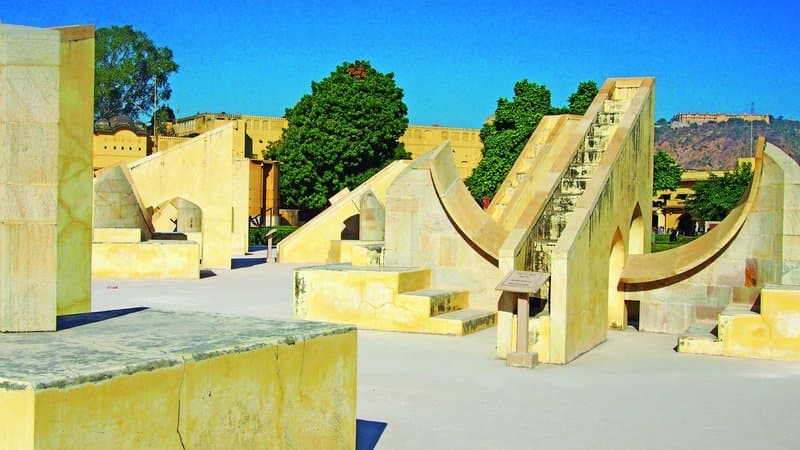
The key principle of the Jantar Mantar is simple enough: the larger the instrument, the finer the measurement. In Delhi, the Samrat Yantra can determine time to within two seconds. In Jaipur, too, the Vrihat Samrat Yantra — a right-angled stone triangle 27.5 metres high and 45 metres long — can work within two seconds. It is not a monument, but a clock itself, working and precise, carved from stone and marble, and astronomers still use it to predict the monsoon’s arrival in Rajasthan. The observatory also houses the Jai Prakash Yantra, a set of two complementary, concave hemispherical bowls that act as a walkable map and inverted mirror image of the sky, enabling precise celestial measurements.
The Sun Temple, Konark
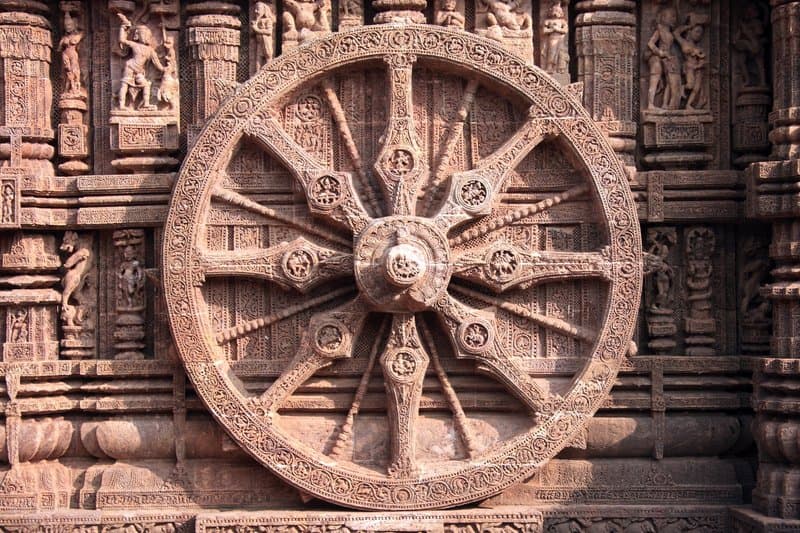
If the Jantar Mantar is science made manifest in architecture, the Sun Temple at Konark, built on the Odisha coast in the 13th century by King Narasimhadeva I, weaves the spiritual and the scientific together, tightly and inseparably. The temple is designed as a colossal stone chariot of the Sun God, Surya. Seven stone horses represent the days of the week. Twenty-four elaborately carved wheels, each 10 to 12 feet in diameter, were long admired purely as masterpieces of sculpture. But in the modern era, many scholars have interpreted them as functional sundials of remarkable precision. According to them, the eight major spokes and eight minor spokes of each wheel divide the day into segments of three hours and 90 minutes respectively. The spokes cast calculable shadows, and beads carved into the rim allow time to be read down to the minute.
Brihadisvara Temple
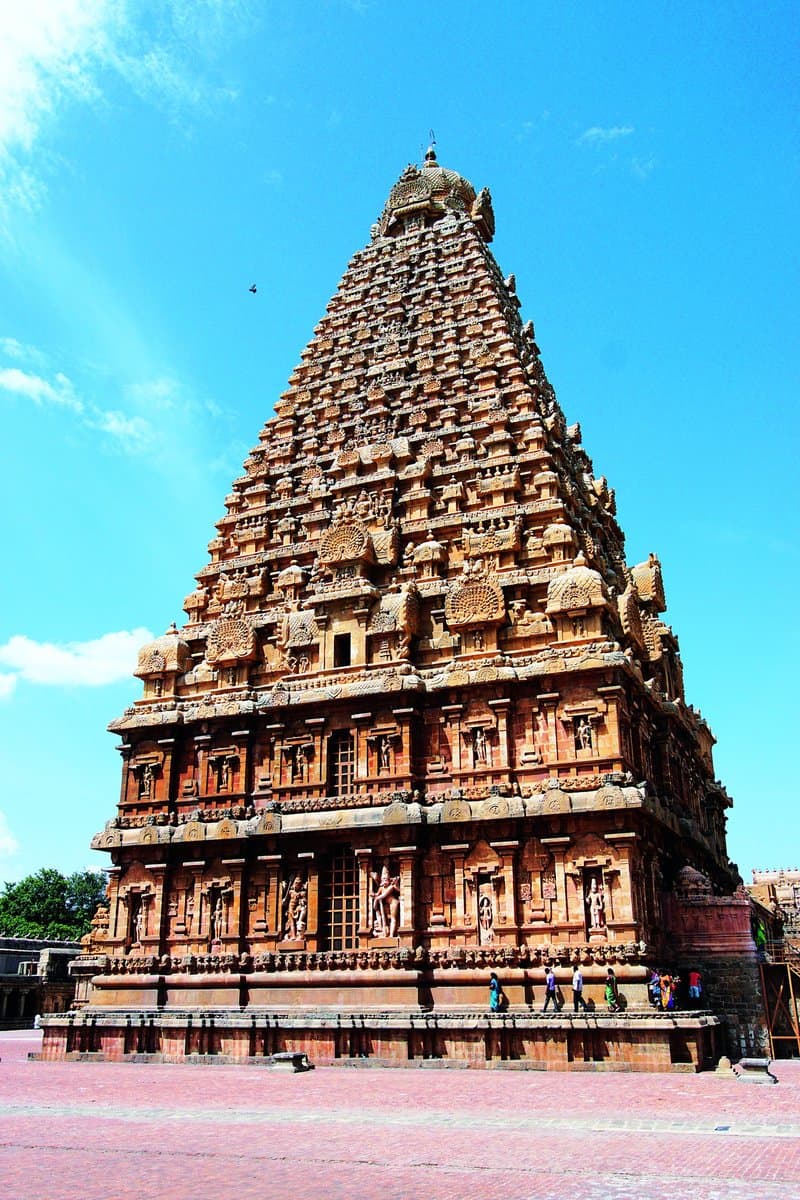
Perhaps the most extraordinary example of all is the Brihadisvara Temple in Thanjavur. Built by the Chola emperor Rajaraja I between 1003 and 1010 CE, the tower is a granite colossus rising 216 feet above the Tamil Nadu plains. At certain times of the year, the tower’s midday shadow becomes so short and compressed near the base that it appears almost shadowless to casual observers, giving rise to the popular belief that this was designed as a cosmological statement informed by classical astronomical texts like the Surya Siddhanta and the mathematics of Aryabhata, who, in the fifth century, had already calculated the earth’s circumference, proposed its axial rotation, and modelled planetary motion. At any rate, there is little doubt that Chola architects possessed a sophisticated knowledge of ritual astronomy, solar orientation, and cardinal alignment.
Modhera Sun Temple, Gujarat
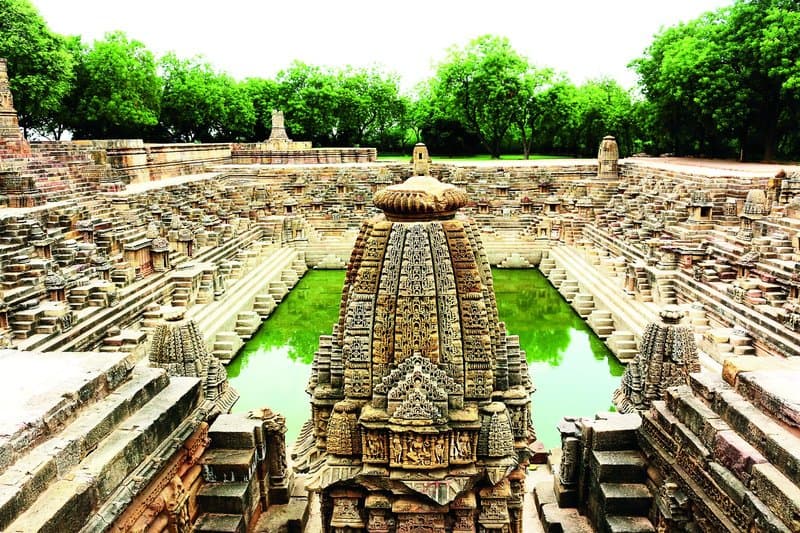
These are the landmarks, but not the full map. The 11th-century Modhera Sun Temple in Gujarat, positioned on the Tropic of Cancer, is oriented so that the first rays of the equinox sun travel its halls to strike a golden image of Surya twice a year, with the punctuality of a well-set clock. The 14th-century Vidyashankara Temple at Sringeri, Karnataka, contains twelve massive pillars corresponding to the 12 signs of the zodiac. It is popularly believed that the pillars are aligned in such a way that sunlight falls on each in the precise sequence of the Hindu solar calendar — a full year encoded in stone. However, some scholars contend that the pillars carry religious symbolism rather than functional astronomical significance.
From Ujjain to Uluru
Australia, interestingly, offers its own deep traditions of celestial knowledge. Long before European colonisation, Indigenous communities developed sophisticated systems of astronomy tied to navigation and seasonal cycles — the sky functioning, at once, as archive, calendar and map. For Indians living there, this opens an intriguing comparative perspective: both Indian and Indigenous Australian traditions embedded astronomical knowledge within ritual and landscape, neither sharply separating science from spirituality in the modern Western sense.
Each of these monumental structures, like the Jantar Mantar, the Konark chariot and the Brihadisvara tower, serves as a reminder that precision astronomical thinking ran as a continuous thread through Indian sacred architecture. The clock Sir Thomas Roe gifted to Emperor Jahangir in 1616 was a perfectly good one. It simply arrived rather late in a civilisation that had already been telling time for centuries — and had the stone edifices to prove it.
What was India’s equivalent of the Greenwich Meridian?
What was India’s equivalent of the Greenwich Meridian?
Ancient Ujjain served as the prime meridian of Indian astronomy and was the reference point for astronomical calculations and traditional Hindu calendars.
Why is the Jantar Mantar important?
Why is the Jantar Mantar important?
Built by Maharaja Sawai Jai Singh II in the 18th century, the Jantar Mantar observatories were designed to improve the accuracy of astronomical observations and calendar calculations.
How accurate is the Samrat Yantra?
How accurate is the Samrat Yantra?
The giant sundial at Jantar Mantar can measure time to within approximately two seconds.
Were the wheels of the Konark Sun Temple actually sundials?
Were the wheels of the Konark Sun Temple actually sundials?
Many scholars interpret the temple’s 24 stone wheels as functional sundials capable of measuring time through the movement of shadows.
What makes the Brihadisvara Temple significant in the history of science?
What makes the Brihadisvara Temple significant in the history of science?
The temple demonstrates sophisticated knowledge of solar alignment, astronomy and architectural planning during the Chola period.
Why is the Modhera Sun Temple associated with timekeeping?
Why is the Modhera Sun Temple associated with timekeeping?
The temple is aligned so the first rays of the equinox sun illuminate the sanctum, reflecting precise astronomical planning.
What is a Panchang?
What is a Panchang?
A Panchang is a traditional Hindu almanac used to determine festivals, auspicious dates, agricultural cycles and religious observances.
Did ancient India have methods of timekeeping before mechanical clocks?
Did ancient India have methods of timekeeping before mechanical clocks?
Yes. India relied on astronomical observatories, temple alignments, sundials and sophisticated mathematical calculations long before European clocks arrived.
How does Indigenous Australian astronomy relate to Indian traditions?
How does Indigenous Australian astronomy relate to Indian traditions?
Both traditions integrated astronomy with ritual, navigation, seasonal knowledge and landscape, viewing the sky as both a scientific and cultural guide.