In the late 19th century, Swami Vivekananda had urged a generation to “arise” and “awake”. Today’s Generation Z, despite the clichés of digital distraction that surround it, seems to have answered that call in its own way.
What do you do when the world appears to have been written by previous generations, but the next chapter is yours to navigate? You start by inventing a new language, one capable of making sense of both the chaos around you and your place within it. That is precisely what Gen Z (technically describing those born between 1997 and 2012, but often applying to anyone who has never used a floppy disk) is doing, imbuing familiar words with meanings uniquely suited to its anxieties and ambitions.
Dismissed by many as ‘terminally online’, Gen Z is beginning to influence the social, cultural and political fabric, not least in India, where it constitutes more than 370 million people. Its vocabulary has now reached the halls of Parliament, with ministers demonstrating their fluency in the Gen Z lexicon with wit and humour.
Whether you are trying to decode a WhatsApp message, participate in an office conversation, or simply understand what a generation is trying to say, consider this your field guide to the language of Gen Z.
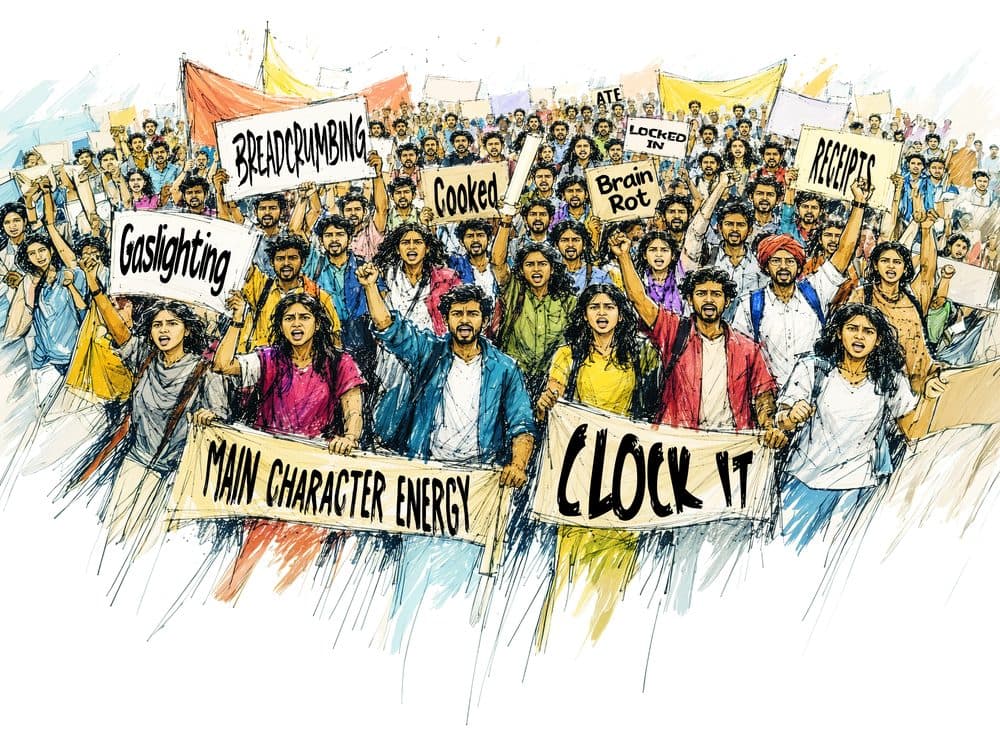
Ate: Performing a task with the kind of confidence and flair that leaves no room for criticism. A one-syllable shorthand for excellence.
Brain Rot: An addiction for the algorithm that results in overfeeding the brain with intellectual junk, from cat videos to 9pm debates.
Breadcrumbing: Paying just enough attention to keep someone interested, without offering clear commitment. This can be particularly unnerving for those used to more fawning behaviour, from manager to ministers.
Canon Event: Inspired by Spider-Man, this refers to a character-building experience that feels incredible (or incredulous) yet inevitable. Examples can include a failed relationship, getting laid off for not using AI, or being attacked with water canons.
Clock It: To observe something, subtle yet significant behaviour. When it’s something good, it could be accompanied by a finger clap or micro-applause — which is exactly what it sounds like. When it’s cringe or performative, be prepared for the Gen Z stare.
Cooked: Beyond exhausted, beyond repair, and sometimes beyond redemption. A rather versatile diagnosis for individuals as well as systems.
Delulu: Delusion cosplaying as optimism but without any of the pressure of living up to chachu or mausi’s expectations.
Gaslighting: Inspired by the 1938 play, Gas Light, and its film adaptation, adopted into clinical psychology to describe emotionally abusive behaviours and now used more generally to call out everything from little lies to mass manipulation.
Locked In: Achieving peak attention span so that notifications don’t register, because the job at hand, be it editing a reel or designing a placard, is all that counts.
Main Character Energy: Living life with constant background music and conducting yourself as if you own the playlist.
NPC: Someone who is incapable of original thought and merely repeats another’s script, generally an object of ridicule for a generation that admires spontaneous communication.
Receipts: The screenshots, timestamps and paper trails this generation instinctively collects, having learned that institutional memory tends to be short even though official denials are long.
Touch Grass: A gentle reminder to log out of all apps for at least 10 minutes and stare at the sky (or the ceiling) in a bid to briefly reconnect with the real world.