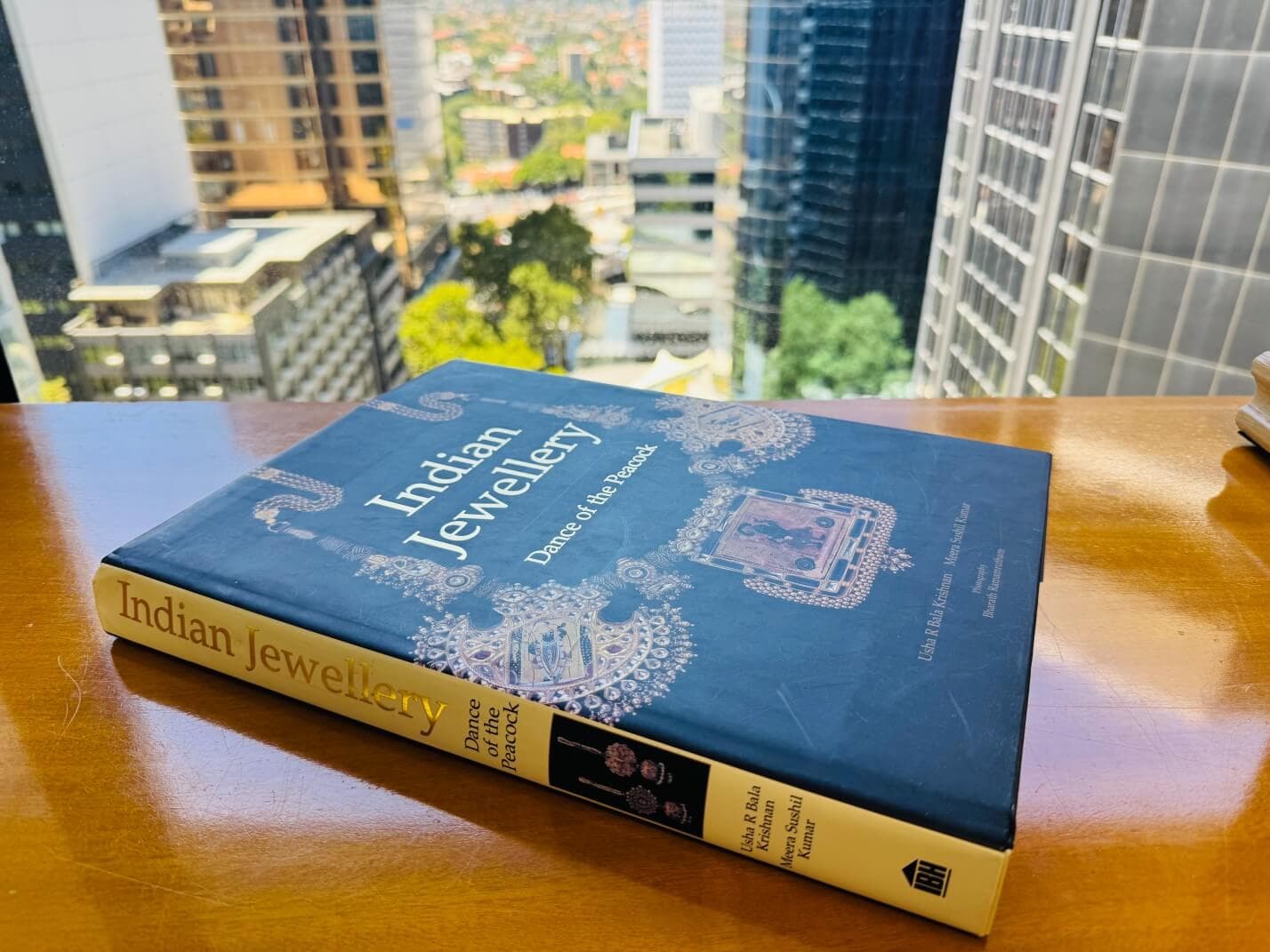
The jewellery of India represents not just one of the greatest traditions of human artisanship in the world, it has also been one of history’s witnesses, chroniclers and indeed, agents. It is this that makes the beautifully illustrated Dance of the Peacock a work of great significance.
Balakrishnan is a highly regarded independent scholar of Indian art and culture and a pre-eminent historian of Indian jewellery. She is the chief curator of the World Diamond Museum. Usha has a PhD in Ancient Indian Culture and a post-doctorate degree in museum studies from New York University, USA.
Divided into 10 chapters, this book weaves factual information with fascinating stories recorded in travelogues and chronicles across the centuries. It features over 500 colour illustrations of pieces sourced from private and public collections.
The Epilogue: The Scattering of a Legacy
Indian Maharajas were generous with their gifts to the reigning English monarch and gifted many a splendid gem and jewel as pledges of allegiance or just to win favour.
King George II and Queen Charlotte received manifold gifts from Indian rulers during their long reign from 1760-1820. Many of these items were sold after their death to Rundell, Bridge & Rundell, the court jewellers, who recycled the stones into new settings. Notable among the gems were a large round diamond, presented by the Nizam Ali Cawn, and two large almond-shaped diamond drops — presented by the Nawab of Arcot to Queen Charlotte. The round diamond and the Arcot drops were subsequently set into a tiara by the Paris firm of Lacloche and were bought by Harry Winston in 1959, who used the three famous stones for rings!
The fashion for Indian jewellery was popularised by Queen Victoria, who had a taste for them but wore them for political reasons as well. When the Queen presented a collection of Indian jewellery to her daughter-in-law, Princess Alexandra, on the occasion of her marriage to Albert Edward, the Prince of Wales, in 1863, the gifts “established gem-set and enamelled Indian jewellery as a fashionable as well as an aesthetic commodity, at once more ornamental and less barbaric than items such as tiger’s claw trinkets.
Ноwevег, from one generation to another and even within the long reign of Queen Victoria itself, jewels were broken up, stones recycled and new stones combined with old ones to make up new pieces. This process, not peculiarly Indian, was quite universal. Thus, while stones might be of Indian origin, even among the European nobility, very few ornaments of Indian workmanship have survived.
Not to be outdone by ‘mere’ Maharajas, representatives of ‘the English Crown’ in India amassed vast quantities of wealth in gems and jewels, which they sent back to England. These Nabobs, a term described by Lord Macaulay as people “of neither opulent or ancient families sent to the East at an early age and who returned with large fortunes which they exhibited insolently and rather extravagantly,” transferred their money home in the form of gemstones and pearls.
Robert Clive, perhaps the most venerable of all nabobs, and his son Edward Clive assembled a collection of lndian art, including gem-set items acquired as booty and presents from local rulers during their stay in India.
Robert Clive, especially, is reputed to have acquired many fabulous gems in India. In 1766 he even deputed an individual named Motte, ‘to purchase diamonds at Sambhalpur on the Mahanadi. In 1767, Clive left India carrying ‘a million for himself, two diamond drops worth twelve thousand for the Queen, a scimitar, dagger and other matters covered with brilliants for the King.’
It was during Edward Clives’ tenure as Governor of Madras (1798-1803) that important items of Tipu memorabilia were procured. After the fall of Tipu Sultan in 1799, his vast treasury was ransacked and divided among the soldiers, who subsequently auctioned them to realise their monetary worth. Even Tipu’s throne was not spared; it was broken up and individual parts auctioned off.
But under instructions from the Governor General Lord Mornington, the “most significant contents of Tipu’s palace” were sought to be saved; fragments of the throne made in Mysore, including two tiger-head finials and the golden huma bird from the canopy (505, 506), were purchased on behalf of the King of England. Lord Mornington gifted Lord and Lady Clive one of these tiger-head finials. The Clive collection, housed at Powis Castle, provides valuable insights on the opulence and aesthetics of the period.