From the Mumbai underworld to the political heartland of Uttar Pradesh and the troubled landscape of Kashmir, Vishal Bhardwaj has brought Shakespeare’s stories into an Indian setting while keeping their universal appeal. In exclusive excerpts from Vishal Bhardwaj: The Literary Imagination on Screen, published by Om Booms International, the filmmaker speaks to Dr. Surabhi Modi Sahai about adapting Shakespeare, following his instincts and why the Bard’s stories continue to connect with audiences across generations and cultures.
How does Vishal Bhardwaj approach adaptations? Is there a formula or a guiding principle?
Not really. You go by instinct. Every subject, every book comes with its own problems and advantages, so you respond to that. I have tried adapting many other plays that didn’t quite work out, so I left them midway. One was Antony and Cleopatra, and even King Lear, for that matter.
When you start thinking about or exploring a film, do you give a face to your characters? Are there certain actors you always like to go back to?
We give a face to the characters, yes, but not an actor’s face. Like when we had to make Iago into Langda Tyagi (in Omkara). That was based on a classmate of mine. He was senior and his name was Langda Rathi. So that face was in my mind. But when it came to actually playing Iago, we approached Saif (Ali Khan) very late. There is a big difference between Iago and Ishwar Tyagi, so you have to start making them your own. They come from your culture, your soil. That is how the adaptation starts.
For me, the most important thing in an adaptation is the backdrop. At the end of the day, the story remains human. Human emotions are the same, whether in Meerut or Scotland. Seeing Macbeth in an underworld scenario (Maqbool) or Hamlet in the Kashmir insurgency (Haider) — the backdrop is the most important thing for me.
Human emotions are the same, whether in Meerut or Scotland
Once you relocate Macbeth, Othello and Hamlet to Mumbai, Uttar Pradesh and Kashmir, how much of Shakespeare do you feel you need to retain? Is there a point at which you stop asking, ‘What did Shakespeare mean?’ and start asking, ‘What does this story mean to me?’
The backdrop becomes so important because it then reflects my personality, my politics, my poetry, my thinking, my identity…. My contemporary conditions, socio-political conditions, should be reflected in my work, my times. Shakespeare still had meaning for me beyond the backdrop because Shakespeare was telling human stories and commenting on his socio-political environment at that time through those stories. The human being has not changed. Human beings are still the same as they were 450 years ago. The socio-political environment has changed, but the problems and the exploitation within those situations and institutions are the same. The manifestations can be different, but the exploitative nature is the same.
Looking at the trilogy as a whole, Maqbool, Omkara and Haider are radically different films in terms of setting, language, politics and even cinematic texture. Yet there is a common preoccupation with power, desire, betrayal and violence. Did you consciously discover this common thread, or did you recognise it only after completing the three films?
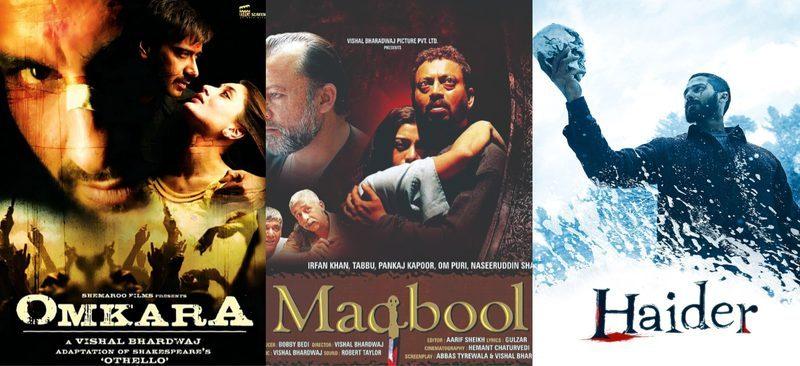
That was a very conscious decision…. Hamlet in Kashmir — you understand the world. And the UP (in Omkara) was something nobody had seen before: that atmosphere, those characters. It was like the underworld of UP, or the politics of UP, just as Mumbai has its underworld. To put Macbeth in the Mumbai underworld and find the correct and true tone of the play in your contemporary setting is the most important thing. That’s what excites me. Then, once you fix a world, finding the parallels is fun: Macbeth wants the crown, so Lady Macbeth becomes the crown; the witches become cops. Finding those parallels is what I enjoy.
Were you ever worried by the burden that most film-makers have when they adapt Shakespeare?
No. When I did it the first time, I had no expectation that these films would be watched, let alone studied at that level. So the first one happened out of ignorance. When that reaction came… at the Toronto Film Festival, when the international press reacted to it, I realised the places I had ventured into. I didn’t know that I could get my whole body burned by putting my hand there. But because I had worked with complete honesty, I didn’t have the burden of Shakespeare on my head, so something new emerged.
After that, I consciously followed it. I had to work with Shakespeare off my shoulders. The first time, I simply had no idea what I was getting into. It’s like a fool not knowing what he is getting into, but if it hits the bulls-eye, you then have to understand why… The good thing about all three movies is that people don’t need references. Those who have read Shakespeare enjoy them differently; those who haven’t can watch them as standalone films.
After Maqbool, Omkara and Haider, do you think of yourself as having a special relationship with Shakespeare? Has your understanding of Shakespeare also changed because of the trilogy itself?
Of course. It is established. It’s been more than twenty years that we have known each other and have been working together. So there is a special relationship. There is some connect I have with Shakespeare.
Shakespeare didn’t happen accidentally. When I look back, I remember reading The Merchant of Venice in school, in Class 8 or 9. When I came to the pound-of-flesh point, I remember thinking, ‘Oh damn! This guy is very smart.’ I still remember that. At that time, I had nothing to do with literature or film, but whatever you read or experience never really goes to waste. Somewhere, it remains in your subconscious. Then I saw Gulzar saab’s Angoor, and in the last shot Shakespeare winks from inside the portrait. That image also remained in my mind…. Angoor was a very big moment for me too.
Once I become passionate about something, I go into its depth. So I went into Shakespeare’s depth and, after reading the plays one by one, realised, ‘My God, this man is more than a genius. He was something else.’
Shakespeare is Shakespeare. Nobody is close to Shakespeare. He was a master blaster — full-on drama. His work is very commercial. It’s a rare writing ability: he is so profound, so poetic, and yet so entertaining and commercial, reaching from the lowest common denominator to the highest intellectual. That is very rare. To cater to one side of the mind is easy, whether the low or the high, but to cater to both, you really need a very wide spectrum of ability.
If you had to identify one thing that you have taken away from literature as a film-maker — not a story or a character, but a way of looking at the world — what would it be?
What I have taken from literature is how even the grossest, most disturbing thing or the ghastliest sin can be expressed in profound language, in a very elegant manner. That’s what I have learned from it. Shakespeare has ghastly things and characters, but the way he writes them is the difference between literature and pulp.