Cancun, home to some of the most beautiful beaches in Mexico, hosted the United Nations Climate Change Conference back in 2010. The turquoise water, the long coastline, the hotels — everything looked almost untouched. But somewhere on that beach, I remember seeing a single word scribbled in the sand: “Hope?”
Even after 16 years, that punctuation, in many ways, still captures the entire climate conversation.
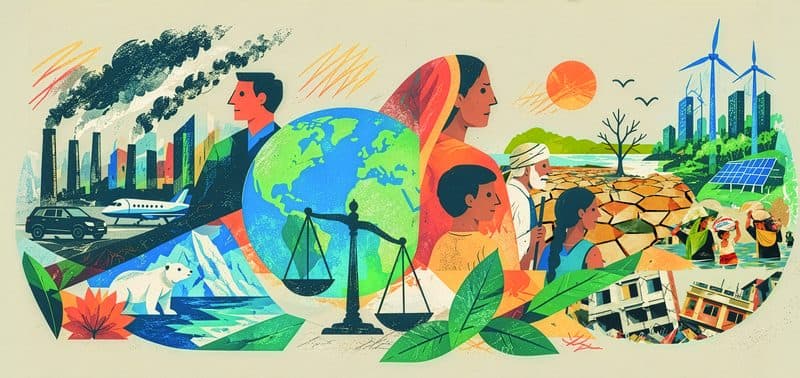
Every climate summit begins with hope. But every summit also carries the weight of a difficult reality: the climate crisis has never been only about science. It has also been about fairness. Climate change cannot be tackled by dividing the world into winners and losers. Everyone has to move together. But moving together does not mean moving equally. That is where climate equity comes in.
The carbon sky that belongs to everyone
Climate equity can be explained through a simple metaphor. Imagine the atmosphere as a giant sky that belongs to all of humanity.
Under the Paris Agreement (adopted in December 2015), if the world wants to limit temperature rise to around 1.5 degrees Celsius (many experts believe this is already impossible), there is only a certain amount of carbon dioxide that can still be released into this shared sky. Scientists call this the remaining carbon budget.
The problem is that this sky is heavily occupied. Out of the estimated carbon space available, a large portion has been used by industrialised countries. The remaining space is now being contested. Countries like India, China, Brazil and South Africa are saying: we also need to grow. But these countries are being asked to develop within a much smaller carbon space than the countries that industrialised before them. This is the fundamental contradiction and, according to many, the fundamental injustice.
The historical responsibility for emissions does not disappear simply because today’s emissions are distributed differently. The United States, for example, has historically emitted far beyond its fair share of carbon. In climate discussions, this is sometimes described through the idea of ‘overshooting’ one’s carbon budget — consuming more than its allocated share of atmospheric space. This is where climate inequity begins.
The world recognised this principle decades ago through the concept of Common But Differentiated Responsibilities (CBDR) under the UN climate framework. The idea was straightforward: everyone has a responsibility to act, but responsibilities cannot be identical because countries have different histories and different capacities. The challenge is that this principle has often remained stronger in dialogue than in action.
When disaster arrives before help
The travesty of climate change is that the people suffering the most are often the people who contributed the least to creating the problem.
Nepal is a powerful example. It is a Himalayan country with very low historical emissions but extremely high climate vulnerability. Years before the glacier-related disaster in August 2026, Nepal had sought support for climate adaptation measures related to glacier risks and early warning systems. Support which took almost seven years to be evaluated and approved by the Green Climate Fund (GCF).
It isn’t certain that had funding had arrived earlier, lives lost in the devastating flash floods could have been saved. Climate disasters are complex. But a stronger early warning system, better preparedness and greater resilience could have reduced the scale of human suffering.
In West Bengal’s Sundarbans, the largest mangrove forest in the world, millions of people live on the frontline of climate change. Cyclones such as Aila (2009) and Amphan (2020) have shown how climate-linked disasters can destroy livelihoods even when they do not always result in immediate loss of life. Agriculture is affected by rising salinity. Livestock is lost. People are forced to migrate.
The question is: who pays for these losses?
That is why the demand for a Loss and Damage mechanism becomes such an important part of climate negotiations. Mitigation and adaptation are investments in the future. Loss and damage are about people who are suffering today.
COP31 gives Australia an influential role in steering discussions while bringing the concerns of the Pacific closer to the centre of the process
Mitigation gets markets, adaptation gets forgotten
At Copenhagen in 2009, developed countries committed to mobilising $100 billion annually by 2020 for developing nations. The target was delayed. More recently, countries agreed at COP29 in Baku to scale climate finance, but the gap between what vulnerable countries need and what is available remains enormous. The problem is not only the amount of money, it’s where the money goes.
Mitigation projects often attract investment because they have clearer economic returns. Solar energy, electric vehicles and clean technology can create business opportunities. Climate adaptation is less glamorous but just as vital. Building flood resilience, protecting coastal communities or strengthening early warning systems may save thousands of lives.
India’s moment — and India’s dilemma
India occupies one of the most complex positions in the climate debate. It is a growing economy with enormous development aspirations. It is also among the countries most vulnerable to climate impacts. This is where India’s potential leadership lies. It has demonstrated important global initiatives, particularly in renewable energy and through the International Solar Alliance. But climate leadership cannot only be about mitigation. It must also be about adaptation and protecting vulnerable communities within India itself. India has the opportunity to bridge the divide between the developed world and the Global South — but that requires bringing climate policy and environmental action closer together.
Removing the question mark
When it comes to the issue of climate equity, science is no longer the missing piece. Scientists, after all, have done their job. They have warned us about the risks. Even businesses are increasingly understanding that sustainability is not merely a slogan but a survival strategy. The missing element is communication and collective imagination.
If we are to remove the question mark from “Hope?” and build a more climate equitable world, we need to start by changing how we talk about climate. Not just at COP events and intergovernmental meetings, but also in daily news and conversations.
Such conversations will acquire particular significance at COP31 in Antalya this November. Turkey will host the summit, but Australia will lead its formal negotiations, with Climate Change and Energy Minister Chris Bowen serving as President of Negotiations. COP31, therefore, will be another test of whether climate diplomacy can move beyond promises towards a system in which responsibility, resilience and finance begin to reflect the unequal realities of the crisis.
Where Climate Hits Hardest
Sundarbans, India & Bangladesh: Low-lying islands face cyclones, storm surges, sea-level rise and saltwater intrusion, threatening farms, freshwater, homes and livelihoods.
Nepal’s Himalayas: Rapidly warming mountains, retreating glaciers and expanding glacial lakes heighten risks of floods, landslides and glacial lake outburst floods.
Sindh, Pakistan: Extreme monsoon flooding meets poverty, fragile infrastructure and intense heat; the 2022 floods alone affected around 33 million people.
Mekong Delta, Vietnam: Sea-level rise, upstream changes, sinking land and saltwater intrusion threaten a densely populated agricultural delta that is crucial to Vietnam’s food production and livelihoods.
Sahel, Africa: A fragile belt already facing severe heat, drought and rainfall variability, where climate stress compounds food insecurity, water scarcity and pressure on already vulnerable livelihoods.
Small Island States (Pacific & Caribbean): Low-lying islands face rising seas, stronger tropical cyclones, coastal erosion and freshwater stress, while even relatively small disasters can cause enormous economic losses.
The Arctic: The Arctic is warming much faster than the global average, accelerating sea-ice and permafrost loss and disrupting ecosystems, infrastructure and indigenous livelihoods.