Key Highlights
- The Penguin Random House India Essential Cookbook series values substance over glossy presentation
- The collection documents Indian regional cuisines through stories, rituals and recipes
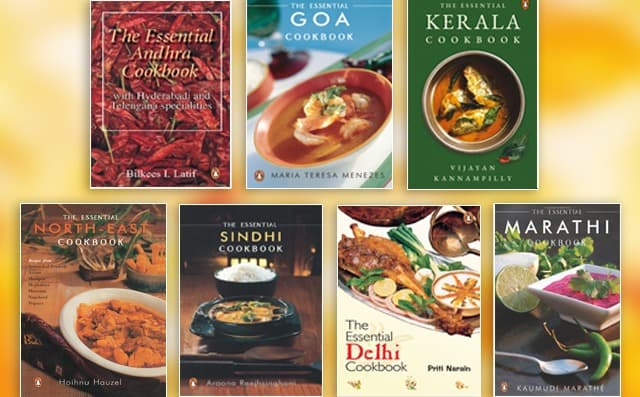
- First launched in 1992 with The Essential Delhi Cookbook, the series now spans seven volumes
- The books preserve culinary knowledge traditionally passed down orally within families
- Each volume explores food as culture, connecting recipes to festivals, seasons and daily life
- The series features respected culinary voices including Bilkees Latif, Maria Teresa Menezes and Hoihnu Hauzel
Today’s Pinterest-y world demands bookshelves that are ‘curated’, not stacked, with ‘to-be-seen’ volumes rather than ‘to-be-read’ ones. Add to this mix a luxury kitchen and you have the perfect setting for picture-perfect cookbooks, with art-directed smears and garnishes.
The Penguin Random House India Essential Cookbook series offers a starkly contrasting idea of luxury. These modest, almost austere paperbacks are defined by a deliberate restraint. Like a well-appointed library or a perfectly balanced thali, nothing here clamours for attention. The series reveals itself slowly, through narrative and an almost anthropological curiosity about how India eats.
Indian cuisine is not a monolithic entity — it is a sprawling, multi-generational, multi-directional conversation held over sputtering oil and the rhythmic thud of a pestle.
Codifying the ephemeral
The nuances of Indian regional cooking are largely passed down through the frustratingly imprecise unwritten instructions of grandmothers, aunts and even the occasional uncle. The Essential Cookbook series is one of the first successful attempts to codify this knowledge. Kicking off in 1992 with Priti Narain’s The Essential Delhi Cookbook, a volume that replaced the generic “curry” narrative with a scholarly survey of Baniya, Kayasth and Mughlai traditions, the collection is today an authoritative library of seven volumes.
Indian cuisine is not a monolithic entity — it is a sprawling, multi-generational, multi-directional conversation held over sputtering oil and the rhythmic thud of a pestle. The series documents the coexistence of both — the rustic simplicity of a Bengali chochchori and the quiet, regal dignity of a slow-dum Awadhi biryani.
Minimalist covers invite the reader into a startlingly evocative experience. These are books you can ‘smell’ — be it the mustard-oil pungency of a Bengali kitchen, the heady aroma of Sharbat-e-Ghulab in a Delhi summer, or the deceptive simplicity of a Kerala avial.
The series treats food as culture. Introductions dwell on serving rituals, eating etiquette and the seasonal logic of ingredients. Recipes follow, anchored firmly in context — festivals, seasons, domestic rituals. Food belongs to life around it. A pickle is about summer. A stew about monsoon. A sweet about return. The effect is cumulative.
The reader not only cooks from these books, but begins to understand why some dishes exist at all.
The custodians
The series’ authors are all definitive voices in their fields, and were chosen for their status as custodians of heritage. With the Essential Andhra Cookbook, Bilkees Latif brings the high-court sophistication of Hyderabadi specialties — dishes that require patience and a certain disregard for cholesterol levels. Vijayan Kannampilly notes that Kerala’s cuisine differs from other Asian cuisines in rejecting the heavy-handed use of spices that grow literally in their backyards. In The Essential North-East Cookbook, Hoihnu Hauzel writes with intimacy about a region long underrepresented in food writing — its flavours both rooted and unexpectedly cosmopolitan.
In Maria Teresa Menezes’s The Essential Goa Cookbook, about 200 recipes cover this coastal cuisine. The Essential Marathi Cookbook, by Kaumudi Marathe, presents a rare overview of Marathi foodways. In The Essential Sindhi Cookbook Aroona Reejhsinghani explores a culture shaped by displacement.
End notes
The series does not aestheticise Indian cuisine. It trusts the reader’s curiosity, patience, and willingness to engage with complexity. It assumes an understanding that flavour is history, and that recipes are often the last surviving documents of a way of life.
What is the Essential Cookbook series?
What is the Essential Cookbook series?
A collection of regional Indian cookbooks published by Penguin Random House India that documents India’s diverse food traditions.
When did the series begin?
When did the series begin?
The series began in 1992 with Priti Narain’s The Essential Delhi Cookbook.
What makes these cookbooks different?
What makes these cookbooks different?
They focus on cultural memory, rituals and regional identity rather than glossy food styling or trend-driven recipes.
Which cuisines are featured in the series?
Which cuisines are featured in the series?
The books cover cuisines from Delhi, Andhra, Goa, Maharashtra, Sindh, Kerala and North-East India, among others.
Who are some of the featured authors?
Who are some of the featured authors?
Bilkees Latif, Maria Teresa Menezes, Kaumudi Marathe, Hoihnu Hauzel and Aroona Reejhsinghani are among the contributors.