


 ion
ion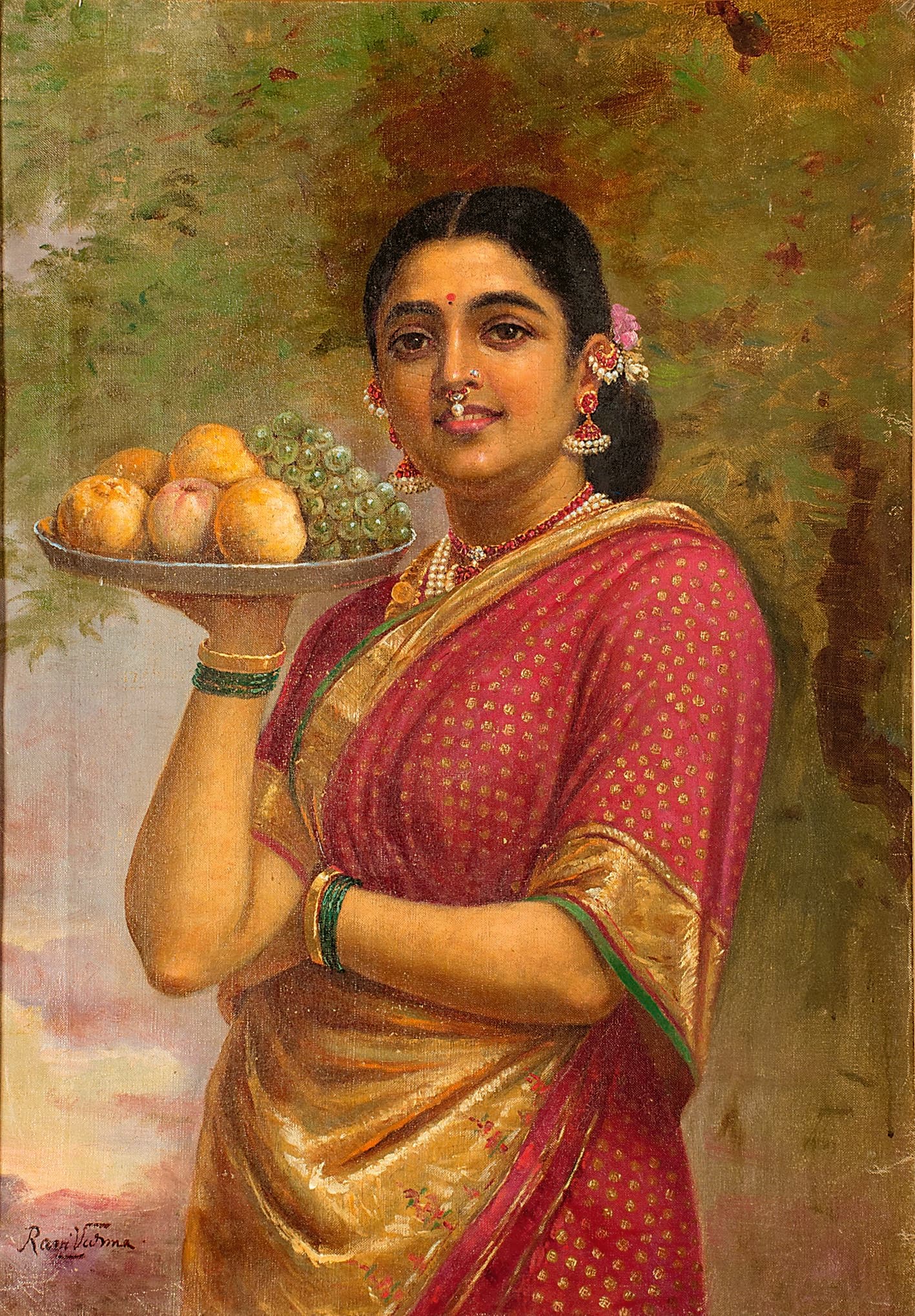
Raja Ravi Varma’s famous painting, Woman Holding a Fruit, is also often catalogued as Maharashtrian Lady with Fruit. Since Ravi Varma himself did not give formal titles to his paintings, the naming usually results from cues in the works themselves. And in this luminous example, there are several distinct visual, cultural and sartorial clues to the subject’s regional identity: the jewellery, the hairstyle, the nauvari (nine-yard) drape of the saree and the saree itself. Bold crimson, the saree has a heavy gold zari border and a dense tapestry-woven pallu. The jewel tones and the quiet brocade are significant indicators of sarees woven in the town of Paithan, Maharashtra, during the reign of the Peshwas.
A woven history of power and patronage
The textiles woven in this ancient town on the north bank of the Godavari River have always reflected its stories. As dynasty followed dynasty through the cycles of political power, the weave’s design language kept developing. It flourished under the Satavahanas and then evolved into an art form under the 18th-century Peshwa court in Pune. Patronage from the Nizams of Hyderabad meant that Paithani textiles became the definitive sartorial marker of regional nobility. Sarees, shelas (sacred shoulder drapes), patkas (headdress), waistcloths — both women and men of the aristocracy showered favour on Paithanis.
Motifs rooted in Deccan culture
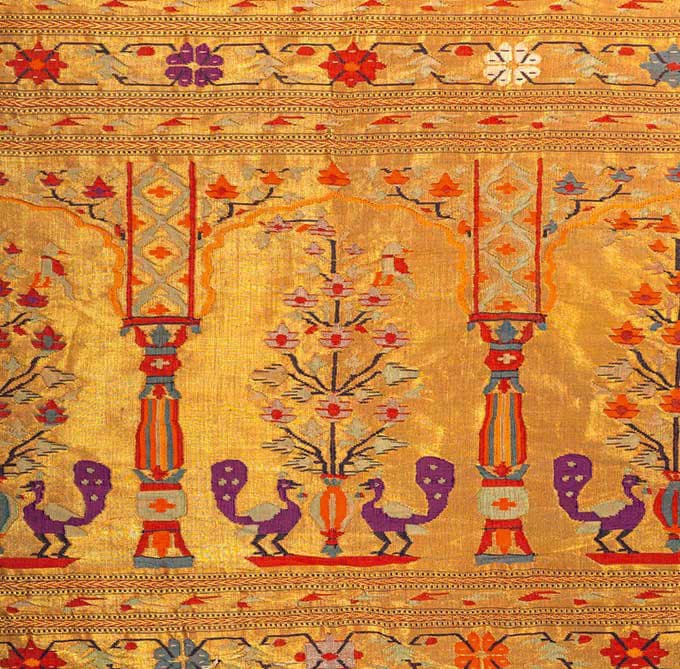
This relationship is mirrored in the Paithani’s visual lexicon. This draws from Deccan court arts and the flora and fauna of the region. The bangdi mor, a peacock within a bangle, symbolises grace and protection. The humble parrot is depicted in a highly stylised crisp form known as the muniya and usually marches along borders. The asawali, a delicate flowered vase motif, draws from both nature and the decorative arts, while the narali, or stylised coconut motif, directly draws from the woodwork of old Deccan mansions.
The craft of kadiyal
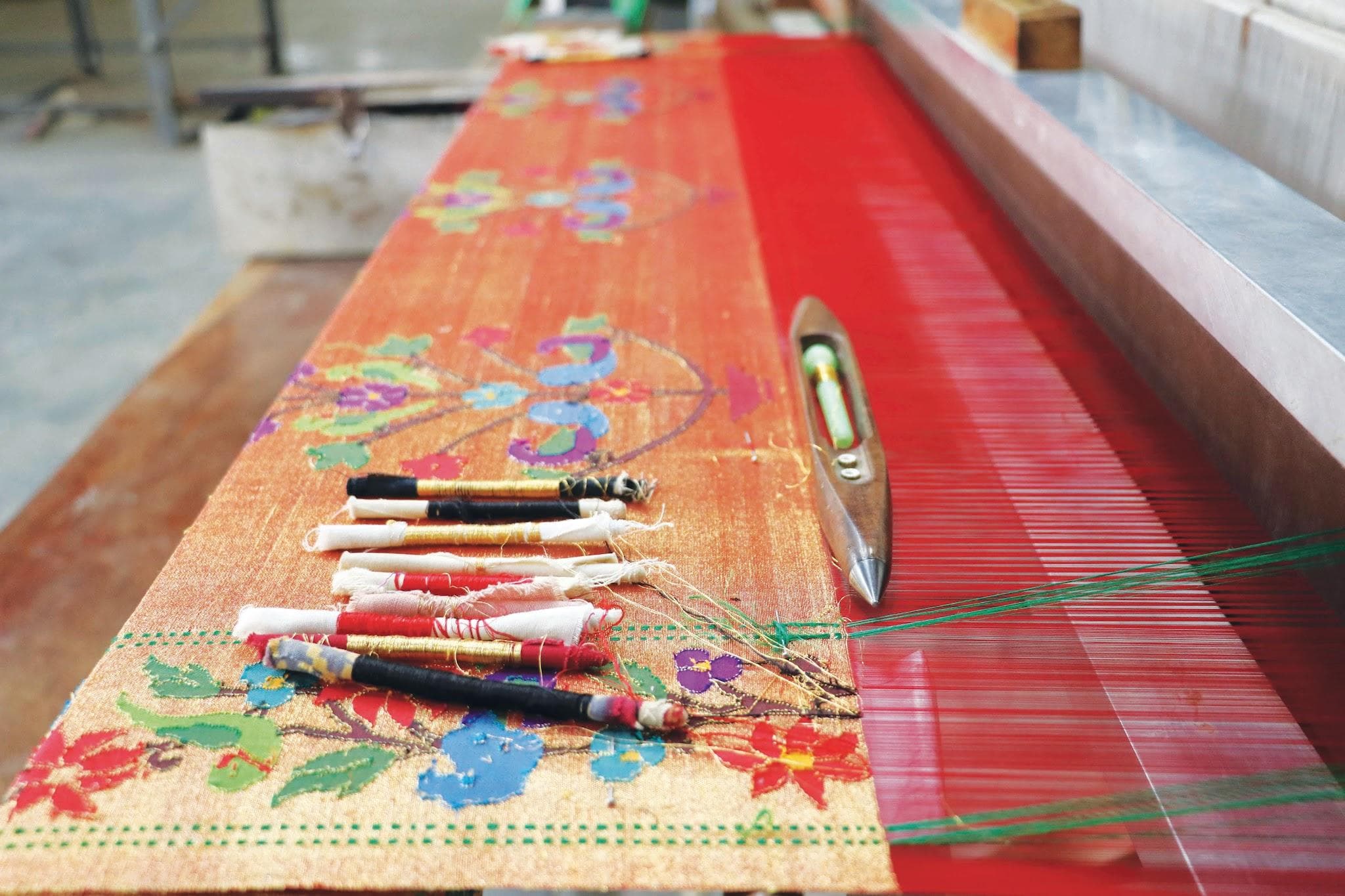
But what exactly made the Paithani so valued? The ancient double-interlock tapestry weaving technique (kadiyal) that is at the core of its weaving philosophy. Weavers manually intertwine coloured weft threads with tiny bamboo spindles called kandis onto fine silk yarn and pure silver or gold zari. Thus, the reverse side has not a single float (loose thread), rendering front and back virtually identical. Then there is the solid gold base — the pallu is usually constructed by weaving fine, pure silk onto a ground of solid zari.
The patina of patience
Creating a genuine Paithani is an exercise in extreme patience as the weavers can only progress a fraction of an inch per day while weaving the pallu sections. Simple handloom Paithanis, with basic muniya borders and sparse body buttis, take one to two months while high-detail masterpieces featuring dense floral vines and multi-coloured peacock borders can take up to three to six months. And if we are talking heritage heirloom and grand tapestry pieces with elaborate designs such as the bageecha (garden), one saree can take a masterweaver from 18 to 24 months.
Custodians and guardians
The survival and revival of the Paithani weave, however, owes more to the dogged dedication of masterweavers who have spent decades keeping the complex geometry of these looms alive in memory and skill. Celebrated artisans such as Shantilal Vithalsa Bhandge, who has been honoured with both the prestigious National Award and the Sant Kabir Award, and master craftsmen such as Khimji Soni and Bhaurao Samrit have safeguarded this centuries-old craft. The Weavers Service Centre and independent ateliers in Paithan and Yeola have worked to facilitate modern authenticity markers such as the GI tag (number 150 in the designated regions of Paithan and Yeola in Maharashtra).
Valuing the heirloom
When it comes to price points, the strong heirloom value of the weave commands premium pricing. Rising interest in regional craft revival, sustainable luxury and slow fashion are factors as well. Entry-level handloom pieces crafted with pure silk and silver-gilt zari start around ₹35,000 (AUD $550 approximately) while heritage tapestry heirlooms featuring dense zari pallus and classic motifs range from ₹1,50,000 to ₹4,00,000 and above (AUD $2,200 to $6,000 approximately).
Captured on canvas
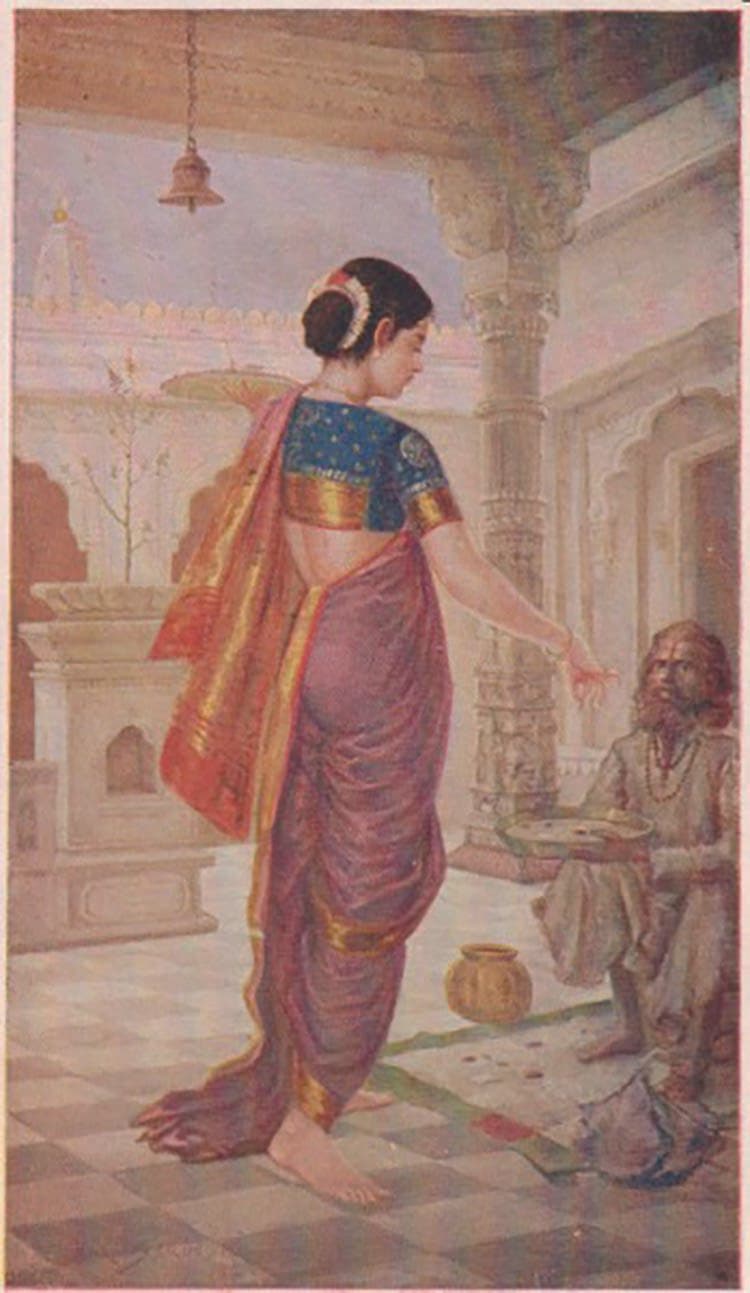
It is thus no coincidence that whenever 19th- and 20th-century Indian artists practicing in the region wanted to imbue their female subjects with dignity, and quiet authority, they draped them in Paithani textiles. Mahadev Viswanath Dhurandhar, a giant of the Bombay School of Art, documented the life within elite Maharashtrian households with meticulous detail and faithfulness. His watercolour illustrations for Otto Rothfeld’s 1920 volume Women of India are known for the textile fidelity — from the structural weight of the nine-yard (nauvari) Paithani, to the exact sheen of the heavy gold border (kath) and the dense, tapestry-woven pallu.
Today, the Paithani is more than an expensive weave. These are heirlooms designed to be worn, and passed down through generations, all while preserving a bit of India’s material culture. And not to forget, feeling like a Raja Ravi Varma muse.
Motif Magic
MUNIYA
On Paithani textiles, the humble parrot has achieved an iconic status as the highly stylised muniya motif. This is mostly woven across borders. A more robust, full-bodied version of the talking bird is often seen woven onto pallus.
BANGDI MOR
The distinctive bangdi mor motif is most usually a peacock encircled within a bangle. This can also sometimes be in the form of a peacock perched on a bangle. This symbolises beauty, grace and protection.
The motif is usually woven with graceful curves, colourful silk threads and rich zari details
ASAWALI
This is one of the most graceful and traditional floral designs in Paithanis. Dainty and delicate, it is typically composed of flowering creepers, blossoms, leaves and branching stems arranged in an elegant pattern, often a vase. In Paithani sarees, asawali designs commonly appear along the borders and pallu, creating a lush gardenlike effect. The intricate motif is woven with colourful silk and zari, highlighting the exceptional skill of Paithani artisans.