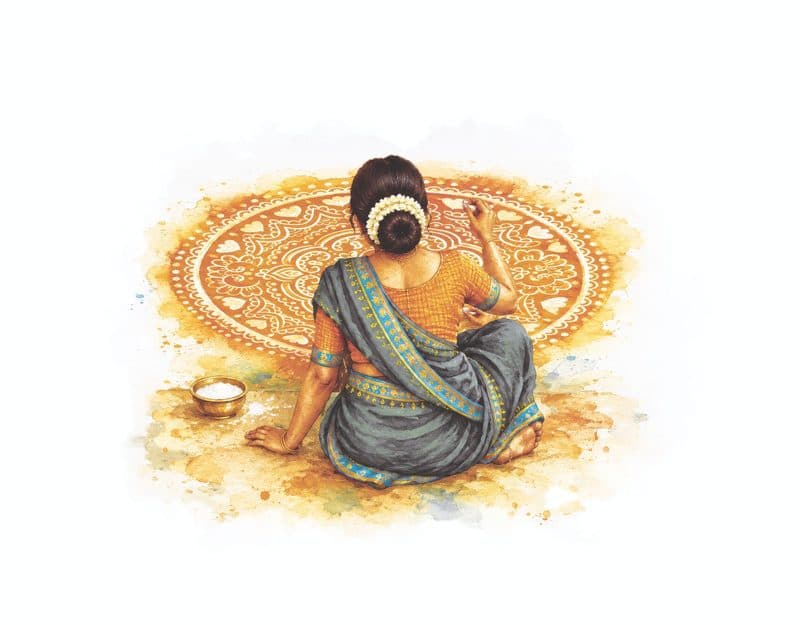
The festive season is upon us, with its memories of childhood. New clothes laid out to be worn after early morning baths, running out to be greeted by that distinctive smell of incense and flowers, and a shouted warning to watch out for the still-wet alpona, kolam or chita that the mothers and grandmothers had spent hours over.
Who doesn’t remember the woman of the house bending low to the threshold, and without an iota of hesitation, drawing with her fingers and a cloth dipped in a rice powder slurry? The patterns could range from simple dots to intricate designs worthy of being framed. The children would have their own ritual competitions of hopping and skipping over the just-drawn lines that would become increasingly challenging with the unfurling of the pattern.
Who doesn’t remember the woman of the house bending low to the threshold, and without an iota of hesitation, drawing with her fingers and a cloth dipped in a rice powder slurry? The patterns could range from simple dots to intricate designs worthy of being framed. The children would have their own ritual competitions of hopping and skipping over the just-drawn lines that would become increasingly challenging with the unfurling of the pattern.
Alpona, kolam and chita, along with aipan and aripan, are regional versions of the ritual art of drawing with rice powder paste on the floor that is found across India. While it is natural that the motif and design lexicon of these forms reference and pay respect to agricultural cycles and sacred geometry, it is also interesting that the medium — ground rice paste known variously as pithar, piroli, biswar, or arisi maavu — represents a sort of environmental hospitality. Because, as the days progress, the edible mix is consumed by insects, birds and organisms that inhabit the soil, before whatever is left is carried away by the breeze. Fundamentally ephemeral, Indian ritual floor art rests its spiritual significance in its impermanence.
Bhuta yajna — the daily offering of food to the smallest living beings — is another pillar the practice rests upon, with this art honouring the elements by representation first and then assimilation.
The eastern horizon
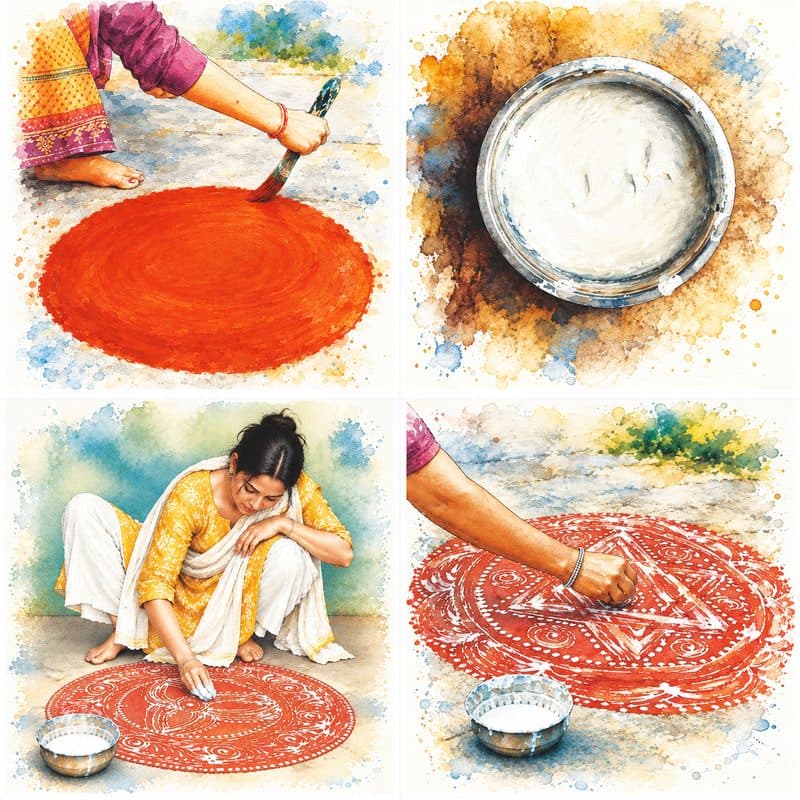
West Bengal, Assam and Odisha call this wet rice paste art alpona, with its philological roots probably lying in the Sanskrit alepana, which means ‘to smear’. Traditionally practiced using piroli — a thick slurry of newly harvested autumn rice — alpona is characterised by unbroken, fluid hand movements, with the practitioner using a small swab of cotton cloth or the three middle fingers to draw across the floor.
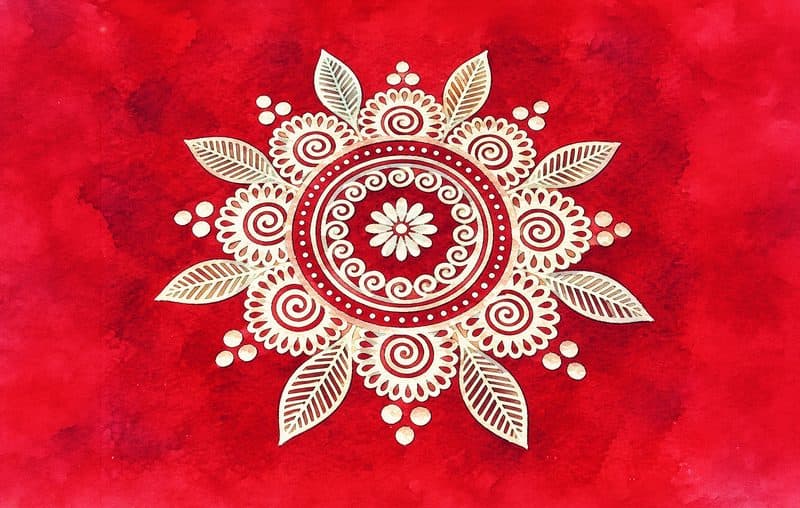
The visual lexicon is strongly agrarian. A central point, bindu, holds concentric and rhythmic rings with stylised lotus petals, sheaves of paddy (dhaner chhora), fish and the delicate footprints of Goddess Lakshmi. The clean bold strokes echo the winding waterways and lush flora of the Gangetic delta.
The southern algorithm
In the south, structural geometry and mathematical rigour replace the fluid artistry of alpona. Tamil Nadu’s arisi maavu kolam, when practised daily, is often drawn using dry rock powder. But, for festivals, wet soaked-rice paste applied with cloth or two fingers, framed with rich red terracotta dye (kaavi) is non-negotiable.
The pulli or dot grid lies at the heart of the kolam. A matrix of points is drawn in rectangular arrays or in staggered triangular lattices. Then, the practitioner navigates around these with continuous, closed loops called sikku kolam. Fun fact: computer scientists and topologists have studied sikku kolam for its adherence to graph theory since lines loop seamlessly around dots without ever intersecting them or lifting from the surface. For the math nerds among us, these complete complex Eulerian circuits.
The northern thresholds
In the north, sacred floor art as a daily practice has historically preferred dry powders. Chowk purana, practiced across Uttar Pradesh, Madhya Pradesh, and parts of Punjab, while not as ubiquitous as in other parts of India, is the most direct regional equivalent. Here, wet pastes of rice slurry (pithar) or chalk water are used to mark sanctified squares or chowks for weddings, feasts and pujas. For non-ritual days or even seasonal agrarian rites such as Navratri, dry variants come into play. Coarsely ground dry rice flour, wheat flour, turmeric and crushed pulses are used to outline the chowks. Even when using dry powder instead of wet paste, northern traditions still share the core philosophy of using raw, edible agricultural yield to create a temporary sanctified space and then to return it to the earth.
The Himalayan heights
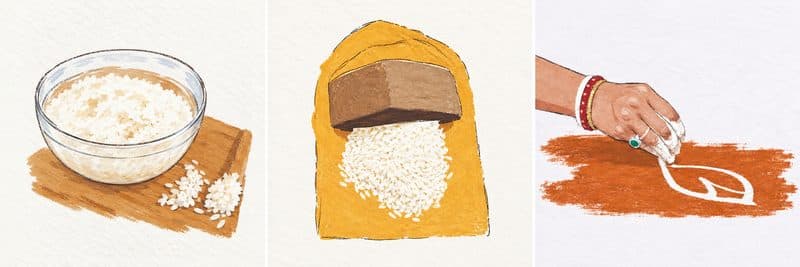
In the Kumaon mountains of Uttarakhand, this takes on a more rigid and stark visual identity. Aipan, as it is called here, works on a strict two-colour dynamic. First, a smooth base coat of wet, iron-rich terracotta clay (geru) is applied, which is then overlaid with sharp-white lines drawn using biswar — a refined slurry of soaked raw rice ground on a traditional stone mortar or sil-batta.
The method of application is strict. Practitioners use the underside of the middle three fingers, and structure designs around sacred enclosed frames called chowkis. Each occasion demands its own specific geometric yantra layout, such as the Saraswati chowki or Chamunda chowki. Clean, linear and axis-driven, aipan features alternating bands of parallel lines (dhara), lotus motifs and central geometric patterns.
The bounds of geography
Among these, only aipan has a GI tag, which it received in November 2021 under Class 16 (Paper and Stationery, Artists’ Materials, and Works of Art). This is because of its distinct, standardised visual language (the contrast of geru and biswar) which is tied to the specific geography and culture of the Kumaon hills.
On the other hand, alpona, kolam, and chita are widely distributed, community-held traditions. Practiced across multiple states, these demonstrate significant regional variations, making them ineligible for a GI tag.
The bottom line
In recent years, with busier lives and smaller families, floor stickers that mimic these designs have become an undeniable convenience. While we may bemoan the lost arts that made our childhoods so distinctive, undeniable too is the disproportionate responsibility women carry in preserving cultural practices. But increasingly there is a gentle shift. Men and women across India and the global diaspora are discovering newer reasons for learning these ritual arts, including a need for the tactile, for the slow and for the sustainable — an act of cultural connection and preservation. From being a purely nostalgic nod to the past, learning to trace fluid alpona scrolls or drawing geometric kolam grids during festive weeks is increasingly being seen as a mindfulness practice.
Today the custom of drawing these patterns rich in ancestral meaning has become restricted to special days. Yet, these temporary patterns remain an indelible part of our collective memory and psyche.